Home / Motorized Linear Stages / PI M-111.12S vs CYGXN40-0601-15-28
ComparisonPI M-111.12S vs CYGXN40-0601-15-28
This is the closest comparison on the site, because for once it is like against like: the M-111.12S is an open-loop stepper stage with no encoder, exactly what ours is. What separates them is precision against speed, and price.
10× the maximum velocity and 4 kg against their 30 N (≈ 3.1 kg)
0.1 µm unidirectional repeatability, 2 µm backlash, 0.05 µm minimum move
Every PI figure below is read from their own published document, cited at the foot of this page. Figures that share a unit but were not measured the same way are kept in a separate table and marked — why that distinction decides the comparison.
Measured the same way
directly comparable| Parameter | PI M-111.12S | CYGXN40-0601-15-28 | Unit | Basis |
|---|---|---|---|---|
| Travel | 15 | 15 | mm | Total stroke, both catalogues. |
| Drive class | 2-phase stepper, no integrated sensor | 28 stepper, no integrated sensor | — | Both open loop. Neither stage knows its own position. |
| Maximum velocity | 1 | 10 | mm/s | Manufacturer maximum, both catalogues. |
| Screw lead | 0.4 thread pitch | 1 (φ6) | mm | Advance per screw revolution. This is most of why the velocities differ. |
| Maximum load | 30 N (≈ 3.1 kg) | 4 kg (≈ 39 N) | — | Carrying load. PI publishes newtons; converted at 9.81 m/s² and shown both ways. |
| Stage mass | 0.4 | 0.31 | kg | Stage only, no controller. |
| Body material | Aluminium, black anodised | Aluminium, black anodised | — | Both catalogues. |
| Guideway | Precision linear ball bearings | Crossed roller | — | Bearing type as described by each manufacturer. |
| Limit and reference | Non-contact Hall-effect limit and direction-sensing reference switches | Sensor entry provided; sensors not stated as included | — | What ships on the stage. |
| Operating temperature | -20 to +65 | Not published | °C | Manufacturer stated range. |
Same unit, different measurement
not comparable as printed| Parameter | Published figures | Why they do not compare |
|---|---|---|
| Repeatability (µm) | PI 0.1 — Unidirectional, labelled as such in the datasheet. Ours ± 0.3 — The supplied catalogue gives one ± figure and does not say whether it is unidirectional or bidirectional. | These are not comparable as printed, and the likely direction is not in our favour. PI states its figure is unidirectional; if ours is also unidirectional then theirs is three times tighter, and if ours is bidirectional the two still are not the same measurement. This is a precision manufacturer and we do not claim to beat it here. |
| Backlash (µm) | PI 2 — Published in the datasheet for the leadscrew versions. Ours Not published — The supplied catalogue does not give a backlash figure for this stage. | These are not comparable figures, because only one of them exists: they publish backlash and we do not. On an open-loop stage backlash is the number that decides whether you can reverse direction without losing position, so its absence on our side is a real gap. Ask engineering before you design a reversing move around it. |
| Minimum incremental motion (µm) | PI 0.05 — Published in the datasheet. Ours Not published — The supplied catalogue does not give a minimum incremental motion. | Not comparable — we have no figure to put against theirs. The catalogue publishes positioning accuracy and repeatability but not the smallest move the stage can reliably make. |
What separates them
drive classThese are the same class of machine, which makes the rest of this page unusually direct.
Both are open-loop stepper stages: the controller counts steps and trusts the mechanics. There is no position feedback, so a missed step is not detected or corrected.
Everything below is read out of the two published catalogues. Where a figure is the manufacturer's, the source is named. Where the two numbers share a unit but were not measured the same way, they are in a separate table and the difference is spelled out, because in this category that is where specification errors come from.
When to stay with PI
honestly- The move is small and must land. PI publishes 0.1 µm unidirectional repeatability, 0.05 µm minimum incremental motion and 2 µm backlash for this stage; we publish none of those three on the same basis, and one of them not at all.
- You need the switches on the stage. The M-111.12S ships with non-contact Hall-effect limit and reference switches; our catalogue lists a sensor entry, not sensors.
- You are building on the PI controller and software stack, or you need the vacuum-compatible or XY/XYZ variants from the same family.
When the CYGXN40-0601-15-28 is the better buy
what we actually compete on- Cycle time dominates. Ten times the maximum velocity on the same travel, from a 1 mm screw lead against 0.4 mm — both figures published.
- The payload is above about 3 kg. Their 30 N is roughly 3.1 kg; ours is 4 kg.
- The schedule cannot absorb a lead time, or the budget cannot absorb a precision-brand price for an axis that is doing fixturing rather than metrology.
Source
where their figures come fromPI figures on this page are read from M-110 · M-111 · M-112 Compact Micro-Translation Stage datasheet, R3 10/09/15.0, PI (Physik Instrumente), 2008, Technical Data table. Manufacturer datasheet. Loads are published in newtons; the conversion to kilograms is shown wherever it is used. We do not reprint their drawings or images. Confirm the current revision against PI before you design to any of it — and confirm ours in the quotation before you order.
The CYGXN40-0601-15-28
full specifications and drawing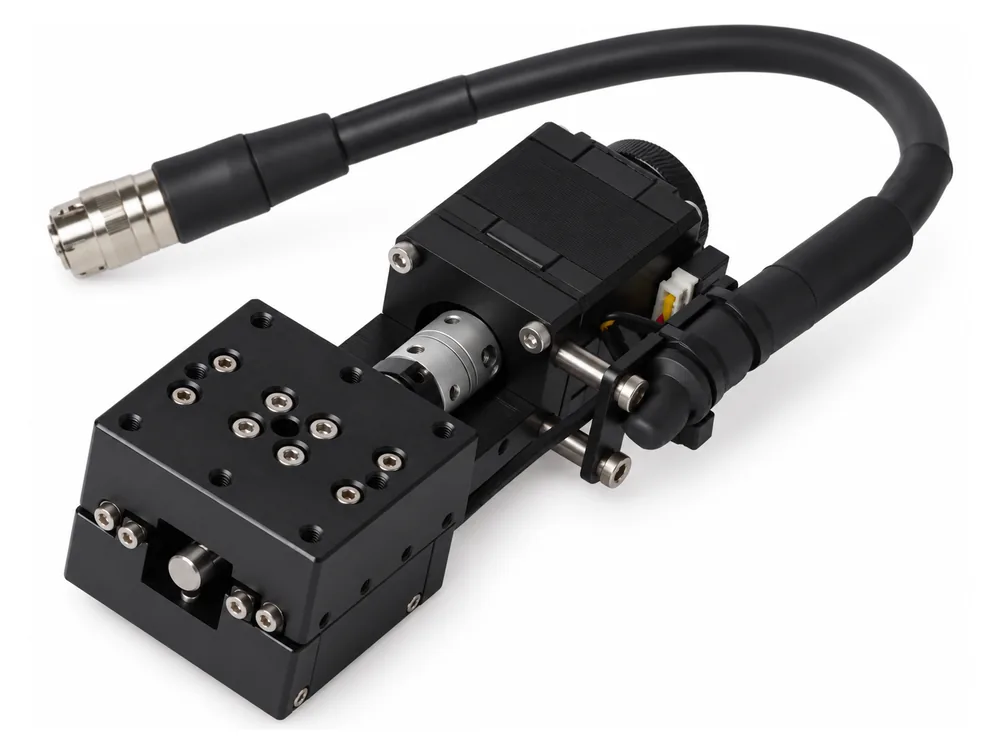
Stock and despatch are confirmed on the quotation for the quantity you need.