Home / Motorized Linear Stages / Zaber X-LSM025A vs CYGX60-0801-25-42
ComparisonZaber X-LSM025A vs CYGX60-0801-25-42
If you are pricing an X-LSM against a bare stepper stage, this page exists to tell you what the price difference is buying — because on most published figures the Zaber is the stronger product, and the honest answer is not that we beat it.
Price, on an axis doing fixturing rather than metrology. That is the whole case
Built-in controller, 250 N in either orientation, 26 mm/s, and three figures we do not publish
Every Zaber figure below is read from their own published document, cited at the foot of this page. Figures that share a unit but were not measured the same way are kept in a separate table and marked — why that distinction decides the comparison.
Measured the same way
directly comparable| Parameter | Zaber X-LSM025A | CYGX60-0801-25-42 | Unit | Basis |
|---|---|---|---|---|
| Travel | 25.4 | 25 | mm | Total stroke, both catalogues. Not identical — check it against your envelope. |
| Drive class | 2-phase stepper, no encoder | 28/42 stepper, no encoder | — | Both open loop. Neither stage knows its own position. |
| Controller | Built into the stage, daisy-chainable | Not included and not specified in the catalogue | — | What you have to buy and integrate separately. |
| Maximum speed | 26 | 10 | mm/s | Manufacturer maximum, both catalogues. |
| Centred load | 250 N (≈ 25.5 kg), horizontal or vertical | 7 kg (≈ 69 N), presumed horizontal | — | Carrying load. Zaber publishes newtons and states both orientations; our catalogue gives one figure and does not state the orientation. |
| Maximum continuous thrust | 25 (peak 55) | Not published | N | Force the drive can deliver along the axis. |
| Microstep size | 0.047625 | Not published | µm | Smallest commanded increment. |
| Guideway | Not stated on the pages read | Crossed roller | — | Bearing type. |
Same unit, different measurement
not comparable as printed| Parameter | Published figures | Why they do not compare |
|---|---|---|
| Repeatability (µm) | Zaber < 3 — Published as "repeatability" without stating unidirectional or bidirectional. Ours ± 0.3 — The supplied catalogue gives one ± figure and does not say whether it is unidirectional or bidirectional. | These are not comparable figures: neither manufacturer states the basis, so the tenfold gap could be a real difference, a difference of measurement, or both. Nobody should specify an axis on this row alone. Ask both suppliers what the figure means before it decides anything. |
| Accuracy (µm) | Zaber 15 to 60, varying with travel — A range across the series, published against travel length. Ours 5 — A single catalogue figure with no measurement standard, test temperature or load condition stated. | These are not comparable as printed. Theirs is a range that grows with stroke, which is what accumulated screw error does; ours is one number with no stated distance or condition. A single figure that does not say what it covers cannot be read as beating a range that does. |
| Backlash (µm) | Zaber < 12 — Published for the fine-pitch models. Ours Not published — The supplied catalogue does not give a backlash figure for this stage. | These are not comparable figures, because only one of them exists. On an open-loop stage backlash decides whether a reversing move lands, and we do not publish it. |
What separates them
drive classThese are the same class of machine, which makes the rest of this page unusually direct.
Both are open-loop stepper stages: the controller counts steps and trusts the mechanics. There is no position feedback, so a missed step is not detected or corrected.
Everything below is read out of the two published catalogues. Where a figure is the manufacturer's, the source is named. Where the two numbers share a unit but were not measured the same way, they are in a separate table and the difference is spelled out, because in this category that is where specification errors come from.
When to stay with Zaber
honestly- You want one part number to solve the axis. The X-LSM has its controller built in and daisy-chains; ours needs a drive, a controller and a cable set that the catalogue does not specify, and that integration is real work and real cost.
- The payload is above about 7 kg, or it hangs vertically. Zaber publishes 250 N centred in either orientation; our catalogue publishes one 7 kg figure and does not state the orientation it applies to.
- You need speed as well as travel: 26 mm/s against our 10 mm/s, both published maxima.
- You want backlash, thrust and microstep size on the datasheet. Zaber publishes all three; we publish none of them.
When the CYGX60-0801-25-42 is the better buy
what we actually compete on- Price is the binding constraint and the axis is doing fixturing, not metrology. That is the honest case for this stage against an X-LSM, and it is the only one on this page.
- You already have drives and controllers in the cabinet, so an integrated controller is redundant rather than a saving.
- The schedule cannot absorb a lead time.
Source
where their figures come fromZaber figures on this page are read from X-LSM series product and specification pages, Zaber Technologies, Read 18 September 2026. Manufacturer product pages. Thrust and load are published in newtons; the conversion to kilograms is shown wherever it is used. We do not reprint their drawings or images. Confirm the current revision against Zaber before you design to any of it — and confirm ours in the quotation before you order.
The CYGX60-0801-25-42
full specifications and drawing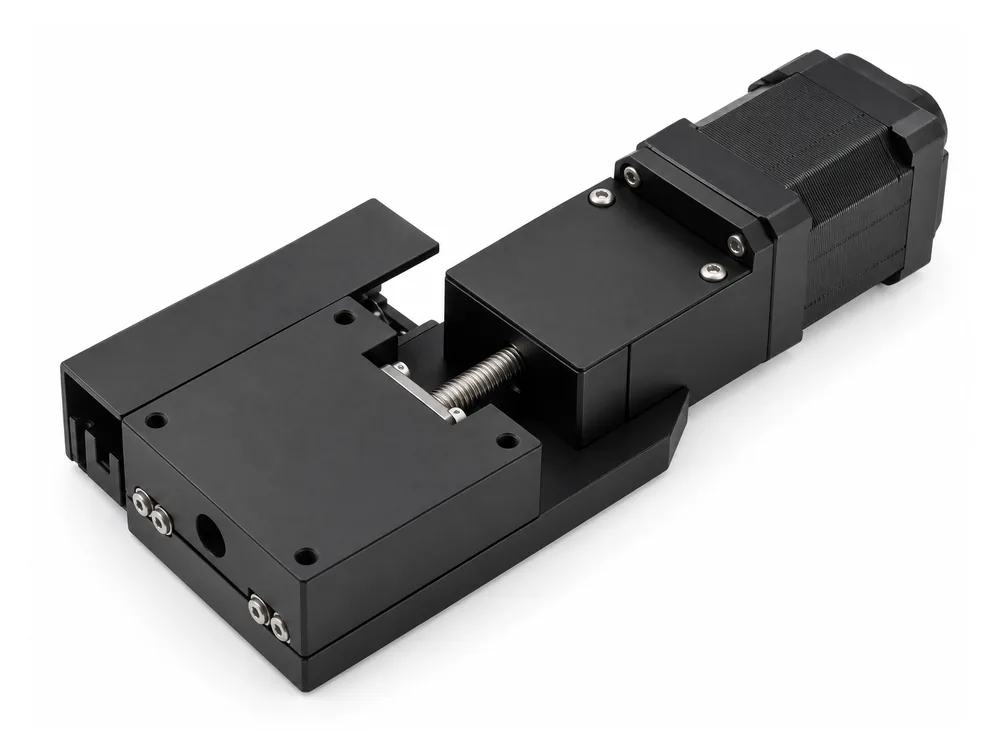
Stock and despatch are confirmed on the quotation for the quantity you need.