Key takeaways
- Write three distinct requirements before selecting a test instrument.
- Attach the measurement location and operating conditions to every limit.
- Leave unsupported catalogue fields unresolved until engineering confirms them.
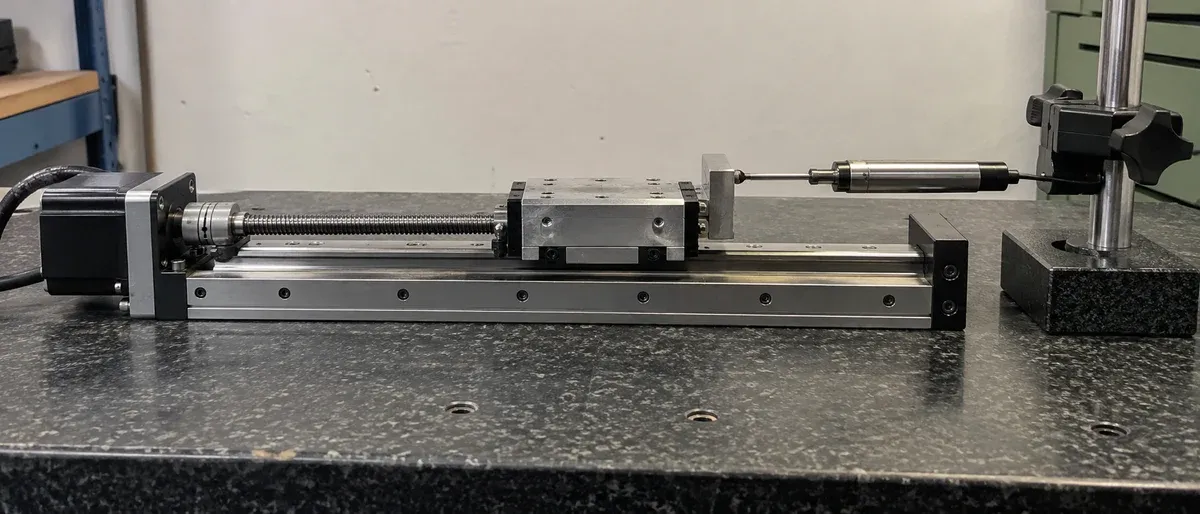
Start with the operation, not the smallest number
An acceptance worksheet should describe what the machine must do before it lists a stage specification. “Place the sample at a surveyed coordinate,” “return to yesterday’s inspection site,” and “make a detectable fine adjustment” are different requests. Treating all three as a single precision requirement can produce an impressive quotation that does not answer the application question.
Use the site’s specification guide for the underlying definitions and catalogue basis labels. This worksheet goes one step further: it assigns evidence to each requirement. Newport also explicitly distinguishes controller or encoder resolution from minimum incremental motion. That distinction matters when a supplier offers a small command increment as evidence for a physical adjustment capability. See Newport’s terminology reference.
Build three requirement rows
For the accuracy row, write the external datum, target coordinates, useful travel and location on the payload where position matters. Specify whether the requirement concerns a signed error, an absolute bound, or a peak-to-peak span. Those descriptions cannot be silently exchanged. Include whether compensation is enabled and which calibration file applies.
For the repeatability row, name the return sequence. Does the process always arrive from the same side? Does it reverse direction? Does it re-home between parts? Require individual observations rather than only a final summary so the chosen statistic can be checked. Keep a reference-establishment test separate if restarting the machine is part of the workflow.
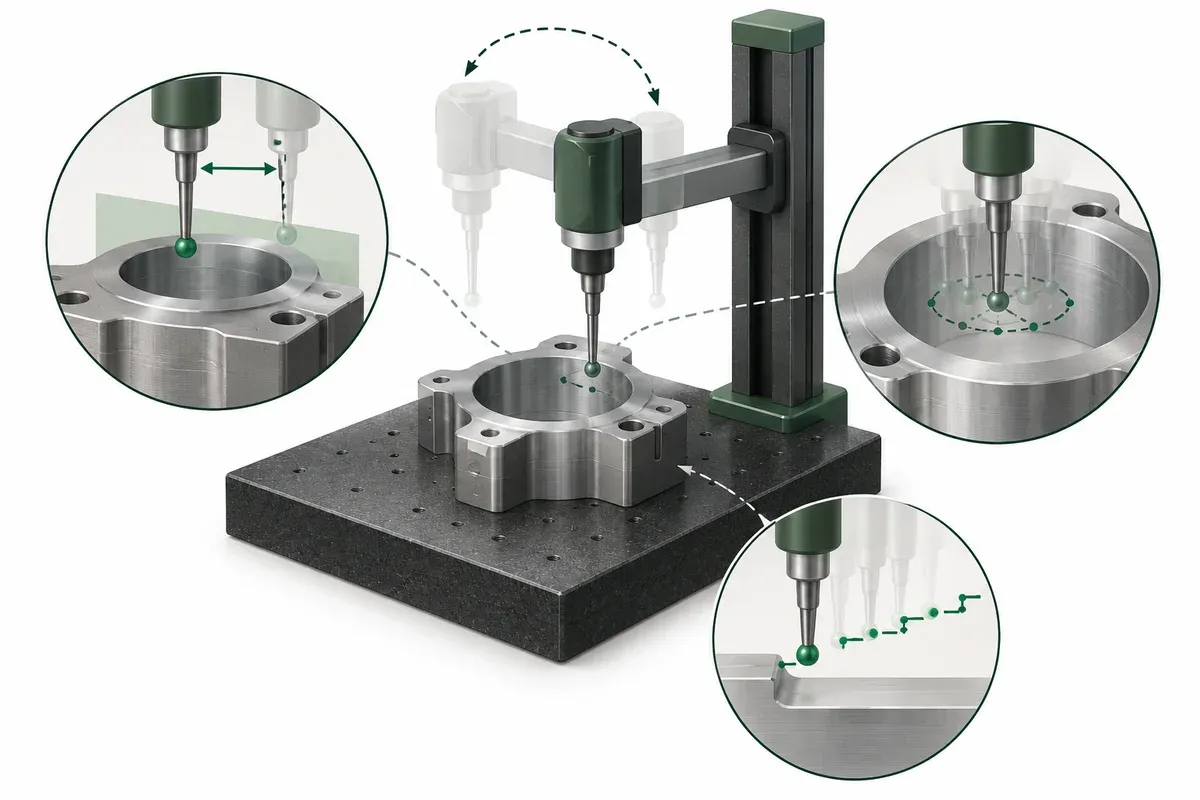
For the fine-adjustment row, state the command increment to investigate, measurement instrument, observation interval and criterion for distinguishing motion from noise. This is a proposed experiment, not a promise that any selected stage will execute the increment. An encoder count and an independently observed payload displacement belong in separate columns.
Add the evidence columns before requesting a quote
Beside each row, leave spaces for the proposed limit, unit, direction convention, operating conditions, instrument uncertainty and decision rule. Ask who provides each item: the buyer, supplier, integrator or test laboratory. Assigning an owner prevents an unresolved engineering question from becoming an assumed purchasing condition.
Record total working travel independently from its coordinate notation. A span written as ±12 mm covers 24 mm total; it does not supply 24 mm on each side. Confirm that acceleration, approach and safe stopping distances fit inside the available range. The acceptance coordinates should describe the useful operating region, without implying permission to contact mechanical end stops.
Preserve missing information explicitly. If bidirectional repeatability is not confirmed for a configuration, leave that row open. Do not insert zero, borrow a value from a neighboring model, or use the smallest number elsewhere in the datasheet. The comparison pages demonstrate why mismatched bases need visible explanations.
Hypothetical example: inspection plus alignment
Imagine a fixture that first moves a camera to a known inspection location, revisits that location repeatedly, and then nudges an optical component during alignment. No measured performance or pass limit is assumed here. The worksheet would contain an external-coordinate check for camera placement, a repeated-return sequence for inspections, and an independent small-motion trace for alignment.
Suppose the camera is later raised on a spacer. The original requirement rows should now flag their measurement location for review. An unchanged controller setting does not establish unchanged performance at the raised camera. This example shows why the functional point belongs in the requirement rather than in an informal note attached after testing.
Practical checklist for the acceptance meeting
- Describe the production action corresponding to each of the three rows.
- Identify the external datum and physical point being evaluated.
- Confirm total travel, coordinate origin and safe approach distances.
- Separate proposed requirements from catalogue values and actual observations.
- Name the statistic, approach direction and compensation state for each test.
- Assign an owner to every unconfirmed condition or missing source document.
- Agree how uncertainty affects acceptance before viewing the results.
End the meeting with a list of closed requirements and open questions, not a single “precision approved” box. For the report, state uncertainty and the basis used to express it; NIST’s reporting guidance is a useful reference. A proposed test plan should remain pending until the responsible engineer confirms that its evidence answers the actual application requirement.
Questions
Can a small resolution value replace an accuracy requirement?
No. A command increment does not establish the workpiece position error over the requested travel.
Should a return-to-point task include an accuracy test?
Include one if the task also needs a known relationship to an external datum. Otherwise explain why relative return performance is the relevant requirement.
Who should choose the acceptance limits?
The application owner and supplier should agree limits and decision rules before testing; an example worksheet is not a contractual specification.
Sources & scope
Sources support the specific points described below. General engineering guidance and third-party examples do not establish a catalogue model's performance or suitability.
- Newport: Motion Basics Terminology and Standards
Resolution and minimum incremental motion are distinct; approach direction matters for repeatability.
Accessed - NIST TN 1297: Reporting Uncertainty
Reporting uncertainty with its stated basis.
Accessed
Related engineering resources
Continue reading
Stage Selection & Buying Guides
Comparing an open-loop stage with a closed-loop alternative fairly
Compare open-loop and closed-loop stage proposals by locating feedback, matching specification definitions and defining the process evidence you need.
Selection guide · 4 min read ·
Mounting & Mechanical Integration
Checking the support surface before installing a precision stage
Organize a support-surface readiness review around documented requirements, contact geometry, surface condition and traceable inspection evidence.
Integration guide · 4 min read ·From requirements to a quotation
Review your stage requirements
Share the motion envelope, payload, orientation and acceptance criteria. Request confirmation of the exact configuration before ordering.
Request a Quote