Key takeaways
- Identify what is measured and where feedback closes the loop.
- Match measurement basis before comparing numerical ratings.
- Treat controls, detection and recovery as explicit parts of the proposal.
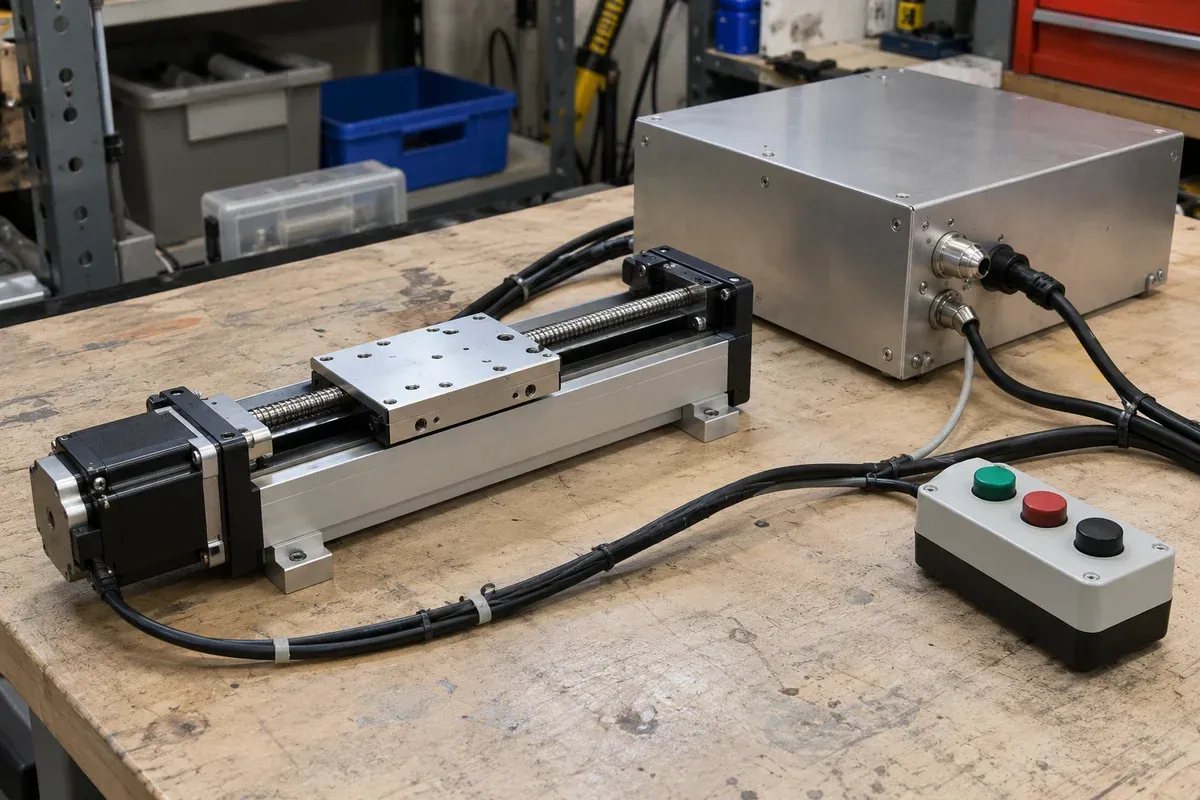
Identify the feedback boundary first
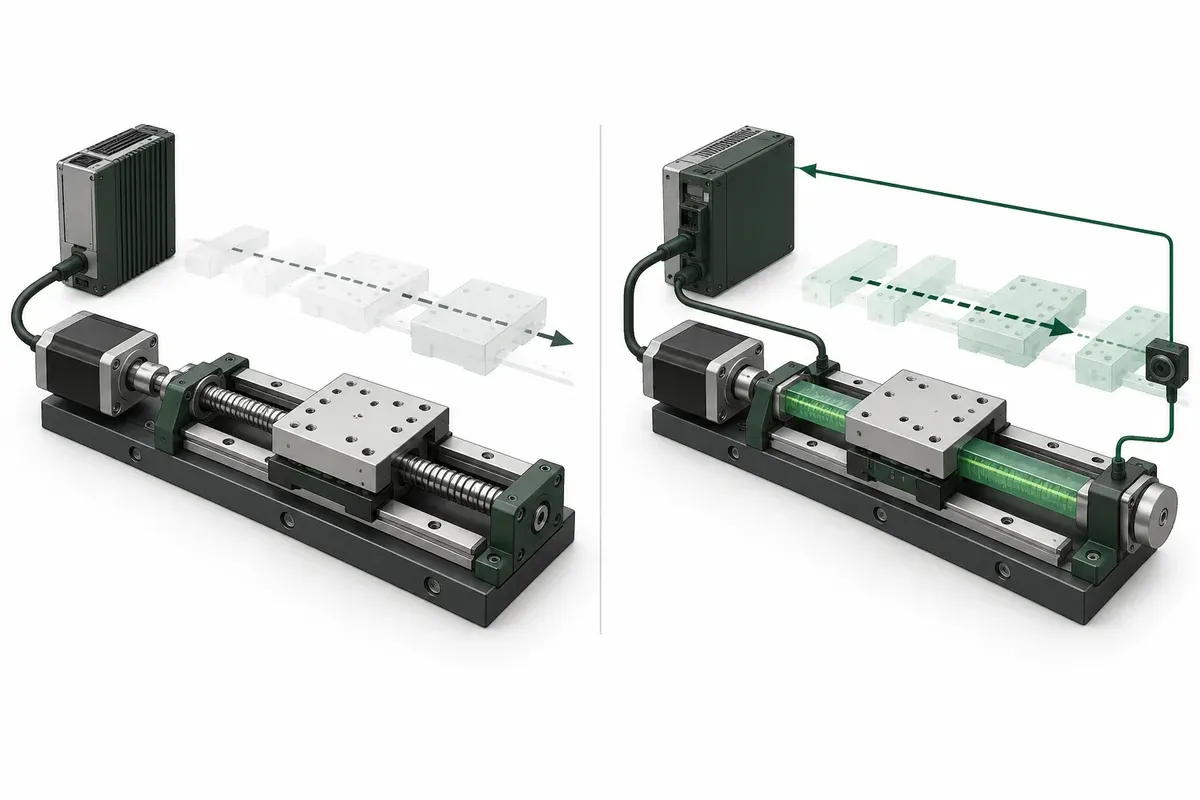
The phrase closed loop is incomplete unless the comparison identifies what is measured. A motor encoder observes a different location from a scale measuring carriage motion. Neither description alone proves performance at an elevated fixture or the actual process point.
The site’s comparison section distinguishes open-loop stepper proposals from closed-loop alternatives and documents mismatched specification bases. Use that approach when preparing your own comparison: start with the system architecture, then inspect the figures. A smaller number does not settle a comparison when the measured quantities or conditions differ.
Draw the measurement chain
Sketch the command source, controller, motor, drive mechanism, moving platform and workpiece. Mark the feedback sensor and the quantity it reports. Ask which parts of the mechanical chain are represented by that measurement and which remain outside it.
In an open-loop positioning arrangement without position feedback, commanded steps are not direct evidence that the workpiece reached its target. In a closed-loop arrangement, the controller responds to its feedback, but the measurement location and system design still matter. Do not turn either observation into a universal prediction that one architecture always succeeds or fails.
For a hypothetical assembly with a long fixture between the platform and the measured feature, ask how position at the feature will be verified. This question remains relevant even when the motor position is measured. It is an application-level evidence question rather than an argument against feedback.
Put comparable quantities in comparable rows
Create separate entries for command resolution, minimum incremental motion if established, positioning accuracy and repeatability. Include direction of approach, travel range, load, controller configuration and any compensation basis associated with each figure. Leave missing information unresolved.
Newport’s terminology distinguishes command or detection resolution from reliably delivered incremental motion, and separates unidirectional from bidirectional repeatability. Those distinctions are useful for structuring a comparison. They do not mean that another supplier uses the same measurement procedure or guarantees the same performance.
A hypothetical offer might give a return-position figure from one approach direction while another gives a result from both directions. Do not rank them by the printed magnitude alone. Ask whether the task requires both directions and request a comparable basis or a clearly stated exception.
Describe the consequence of an unobserved error
Explain what the process does after a move. Does it take a non-contact reading, make contact, place a component or proceed to another coordinated operation? Identify what evidence is required before the next step. This helps the supplier understand why position observation or another verification method matters to the application.
Ask what the complete system can detect, how it reports a problem and what recovery requires. Avoid claiming that a feedback label establishes machine safety or that a reported position alone proves the process completed correctly. The responsible system engineer must assess those functions and their boundaries.
Keep selection questions separate from implementation settings. This article does not prescribe control gains, motor current, fault thresholds or safety circuitry.
Compare the complete control package
List the proposed drive, controller, sensor, cables and software interfaces for each option. Ask whether the published performance applies to that package. A mechanically attractive stage with an unresolved control arrangement is not yet a complete alternative.
Use a short review checklist:
- Is the feedback device and its location identified?
- Are performance quantities and approach directions comparable?
- Does the evidence apply to the proposed controller and load?
- What detection and recovery behavior is documented?
- What must the integrator still provide or verify?
Keep any operating assumptions visible. If a requirement can only be met under a restricted approach sequence or a specific configuration, that condition belongs in the comparison.
Document which reviewer owns each open question so control and mechanical assumptions are resolved together before release.
Make a decision from application evidence
Choose a candidate when its documented architecture and performance support the actual task, with a clear plan for unresolved requirements. Preserve the specification basis and control scope with the quotation. An open-loop versus closed-loop comparison becomes useful when it explains what is observed, what is guaranteed and what remains the integrator’s responsibility. Without those distinctions, the labels can obscure more than they clarify.
Questions
Does closed loop mean the workpiece position is directly measured?
Not necessarily. Feedback may come from a motor encoder or another location. Ask what motion is observed and what lies mechanically between that point and the workpiece.
Is command resolution a fair substitute for repeatability?
No. Resolution describes a command or detection increment, while repeatability describes return behavior under defined conditions. Compare like quantities.
Is an open-loop stage automatically unsuitable for automation?
No. Suitability depends on the task, operating conditions, required evidence and system-level handling of faults. Do not decide from the label alone.
Sources & scope
Sources support the specific points described below. General engineering guidance and third-party examples do not establish a catalogue model's performance or suitability.
- PositioningStages comparisons
Comparison framework distinguishes drive classes and flags mismatched specification bases.
Accessed - Newport motion terminology
Distinguishes resolution from minimum incremental motion and unidirectional from bidirectional repeatability.
Accessed - How to read the specifications
Definitions and the catalogue, derived and not-confirmed labels used on this site.
Accessed
Related engineering resources
Continue reading
Accuracy & Metrology
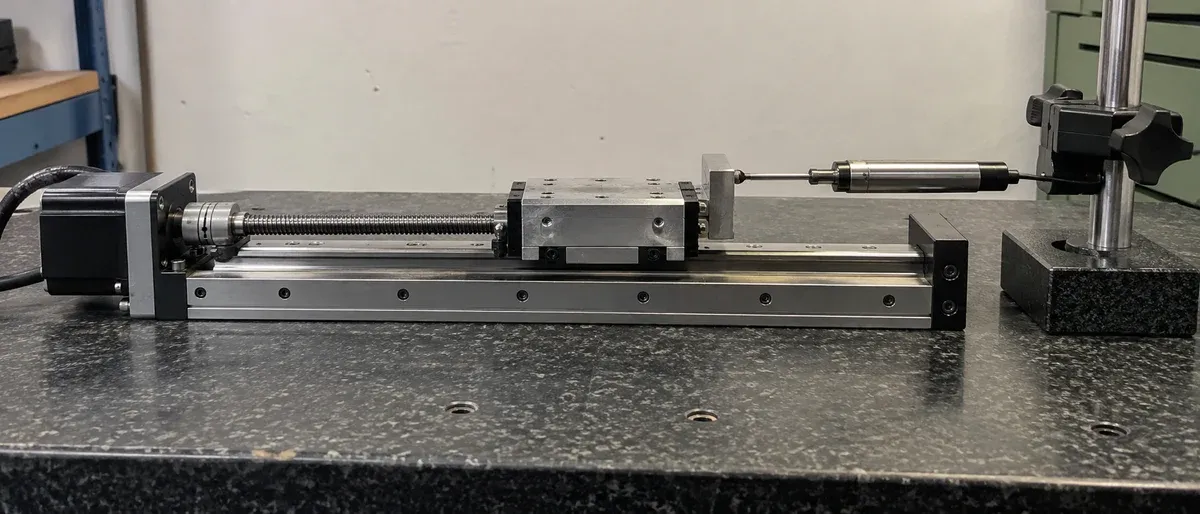
Accuracy, repeatability and resolution: three separate acceptance questions
Turn accuracy, repeatability and resolution into separate acceptance requirements, with a worksheet for evidence, conditions and decisions.
Verification guide · 4 min read ·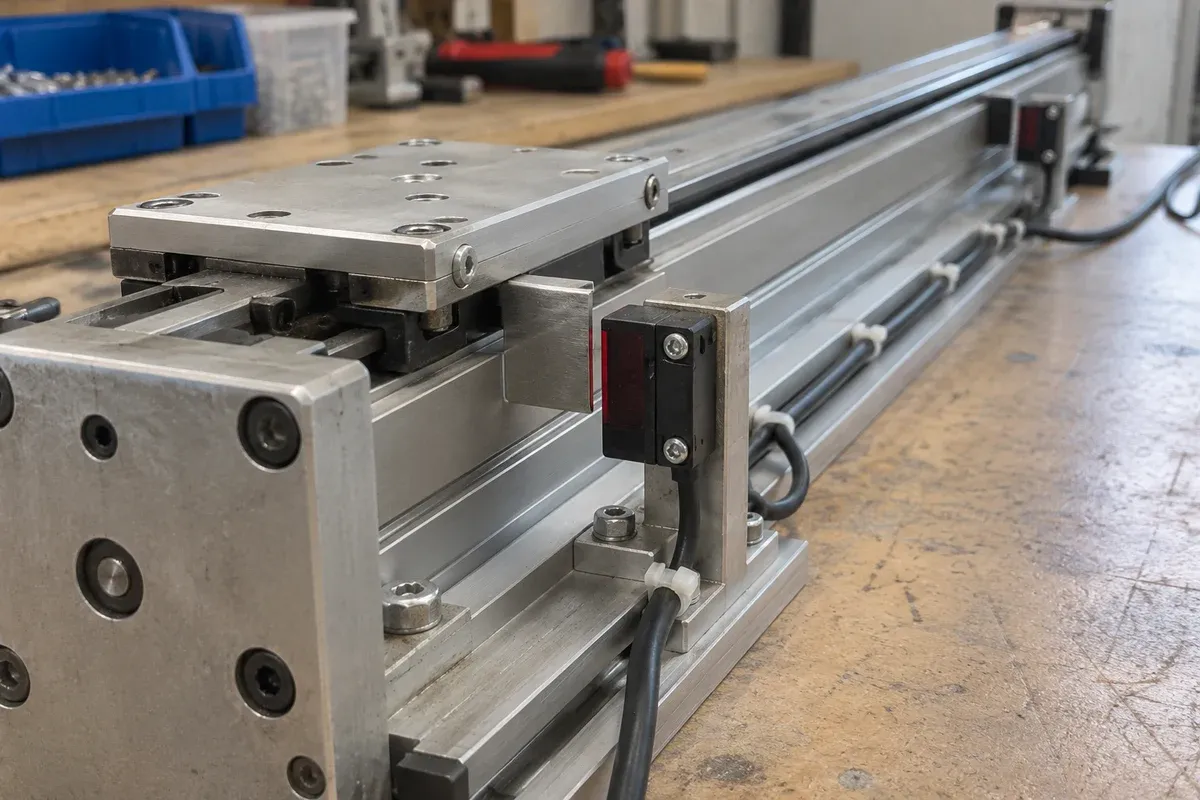
Motion Control & Automation
Homing, machine zero and work offsets: defining the coordinate system
Define homing, machine coordinates and fixture offsets with a controller-neutral reference worksheet and a hypothetical example.
Integration guide · 4 min read ·From requirements to a quotation
Review your stage requirements
Share the motion envelope, payload, orientation and acceptance criteria. Request confirmation of the exact configuration before ordering.
Request a Quote