Key takeaways
- Define following error before comparing traces from different systems.
- Record sample rate and processing when calculating velocity from position.
- Evaluate the useful scan interval separately from acceleration and deceleration.
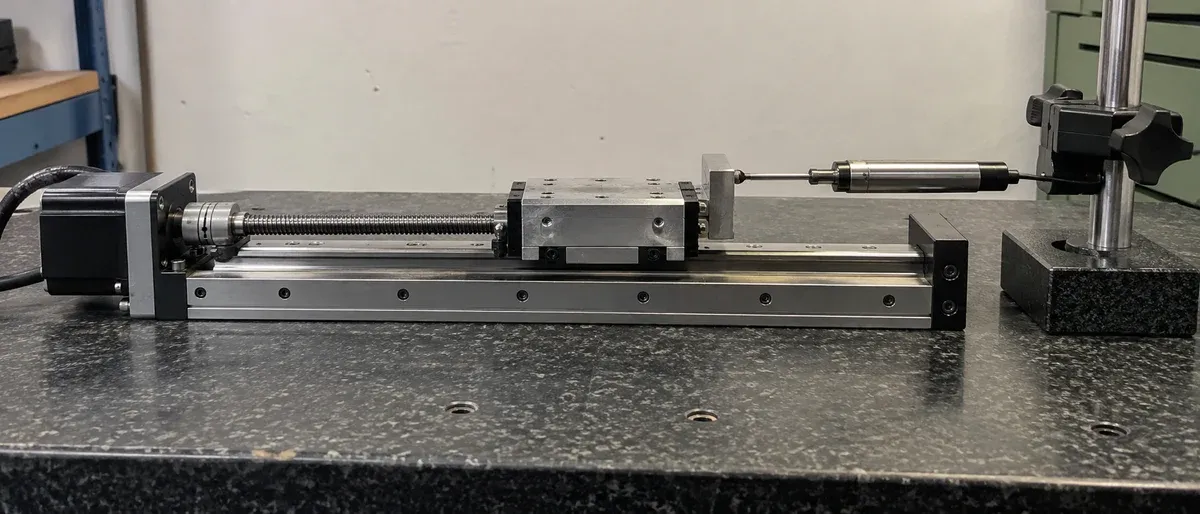
Define the scan quantity before choosing a metric
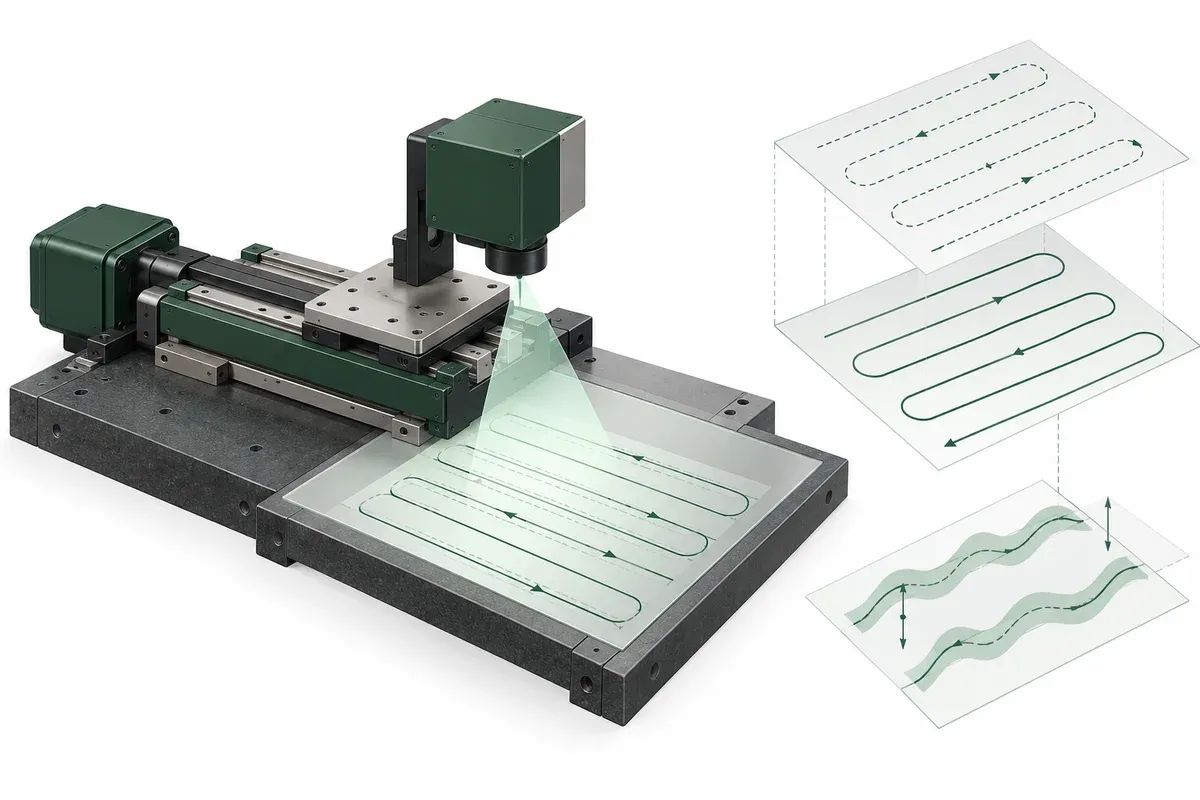
A scanning process may care about local exposure spacing, path lag, deposition uniformity or smooth motion during acquisition. Begin with that consequence rather than requesting a generic velocity-stability percentage. Decide which interval of the move is useful and what position or timing evidence can answer the process question.
The term following error needs special care. Zaber’s velocity-stability article describes a residual relative to a best-fit motion line. A controller may instead report error relative to its commanded trajectory. Label the chosen definition, reference trajectory and sign convention; those results should not be compared as though the names alone made them equivalent.
Capture the trajectory and its timing
Record commanded and measured position with synchronized timestamps where available. Identify the measurement point, sensor, scale and reference frame. If position feedback is used for a diagnostic trace, explain whether it is motor-side, carriage-side or otherwise located. An external sensor at the workpiece can answer a different physical question from an internal feedback channel.
Save the entire move, including acceleration and deceleration, before selecting a constant-speed analysis window. State the window boundaries in time or position and why they correspond to the production acquisition region. Do not trim away a disturbance that occurs during useful production simply to make the result look more stable.
Document speed, acceleration, trajectory shaping, payload, mounting and cable routing. Retain controller tuning and compensation identifiers. If several configurations are compared, change one factor at a time when possible and keep the others fixed. Otherwise describe the comparison as a configuration change rather than attributing it to a single cause.
Make processing part of the specification
Calculating velocity from sampled position requires an explicit differentiation method and time interval. Zaber notes that this calculation is sensitive to sampling. Record filters, averaging, resampling and bandwidth rather than attaching a percentage to an unexplained trace. Preserve raw data so the processing can be reviewed.
State whether the summary is peak deviation, a statistical interval, root-mean-square value or another agreed quantity. Identify its denominator when expressing a percentage. A percentage referenced to commanded speed is not automatically interchangeable with one referenced to measured mean speed. Near zero speed, consider whether a percentage is even a useful way to communicate the result.
For trajectory residuals, retain any fitted line parameters separately. Removing the mean slope can isolate certain variations while concealing a mean-speed mismatch. If the application cares about absolute timing over the scan, report that mismatch separately rather than letting the fit erase the relevant requirement.
Hypothetical example: scanning a coated strip
Imagine a process that acquires data only over the middle portion of a linear move. The proposed report includes the full motion trace and a clearly marked useful interval. Within that interval, it calculates measured mean speed, an agreed velocity-variation statistic and a separately defined trajectory residual. No example performance values or acceptance limits are assumed.
The engineer compares two acquisition settings and notices that the processed velocity traces differ. Before blaming the mechanism, the team reviews sample timing and filtering. It also checks whether the corresponding position trace changes materially. This exercise separates a measurement-processing question from a genuine motion change without assuming either explanation in advance.
Practical checklist for dynamic verification
- State the process consequence that the scan metric must represent.
- Define following error, reference trajectory and sign convention.
- Preserve the complete move and identify the useful analysis window.
- Record sampling, differentiation, filtering and summary statistic.
- Identify the percentage denominator where one is used.
- Save payload, mounting, tuning and trajectory settings.
- Report position and timing uncertainty alongside the chosen metric.
Use NIST’s reporting guidance for a transparent uncertainty statement. The static specification guide remains relevant, but good static repeatability or fine command resolution does not establish scan quality. Dynamic evidence must match the speed, acquisition window and installed conditions that the process actually uses.
Questions
Is following error always commanded position minus actual position?
No. Some references use a best-fit trajectory residual. State the exact definition and sign convention used in the report.
Can increasing sample rate improve a velocity result automatically?
No. Differentiating position can amplify noise; acquisition bandwidth and processing must suit the application.
Should acceleration data be excluded?
Only when the defined objective is the constant-speed interval. Preserve the full move and disclose the selected interval.
Sources & scope
Sources support the specific points described below. General engineering guidance and third-party examples do not establish a catalogue model's performance or suitability.
- Zaber: Velocity Stability and Following Error
Velocity derived from position depends on sampling; Zaber uses a best-fit trajectory definition for its following-error metric.
Accessed - NIST TN 1297: Reporting Uncertainty
Report measurement uncertainty with the basis used.
Accessed
Related engineering resources
Continue reading
Accuracy & Metrology
Accuracy, repeatability and resolution: three separate acceptance questions
Turn accuracy, repeatability and resolution into separate acceptance requirements, with a worksheet for evidence, conditions and decisions.
Verification guide · 4 min read ·Accuracy & Metrology
Comparing typical and guaranteed specifications without mixing them
Build a comparison sheet that keeps typical values, guaranteed limits, test conditions and contractual acceptance evidence distinct.
Verification guide · 4 min read ·From requirements to a quotation
Review your stage requirements
Share the motion envelope, payload, orientation and acceptance criteria. Request confirmation of the exact configuration before ordering.
Request a Quote