Key takeaways
- An optimization objective needs valid measurements and explicit channel rules.
- Search limits are fixture requirements, not just software preferences.
- Record why a run ended before calling it successful.
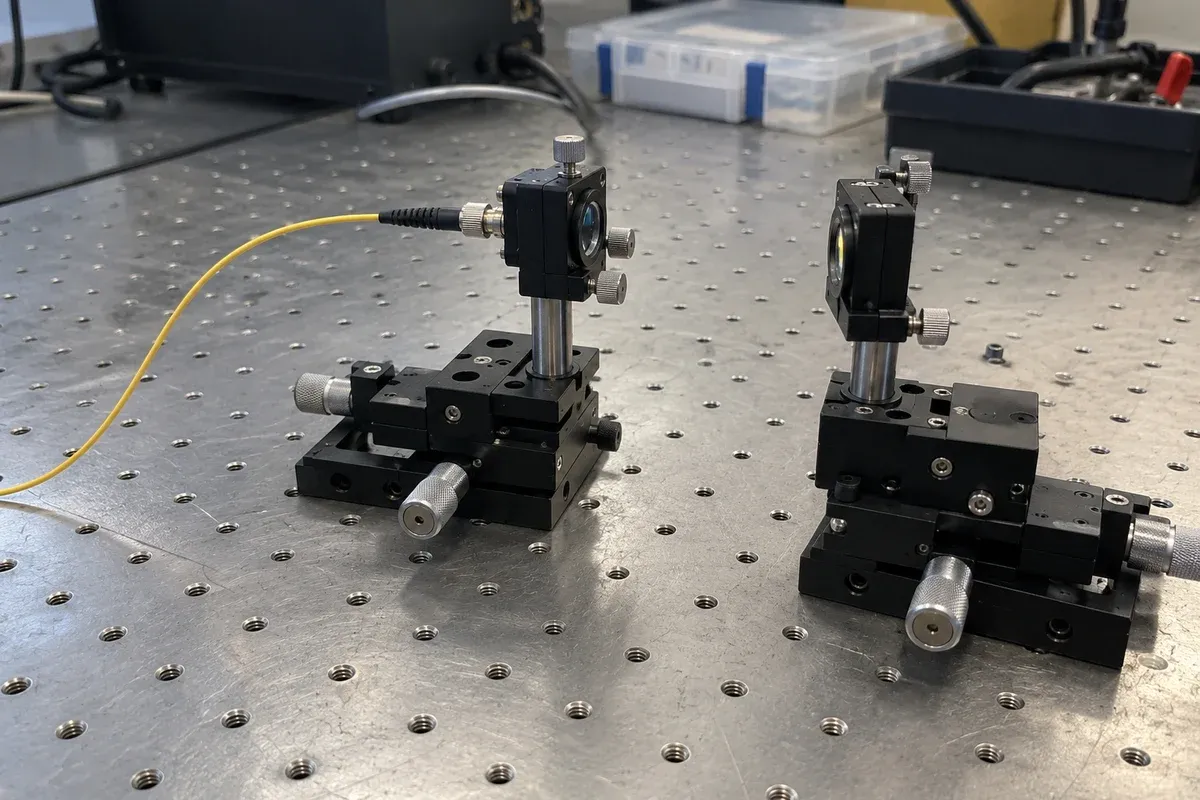
An optical-power search is an experiment that links motion, measurement and a decision. Specifying only the smallest commanded increment leaves out the information needed to decide whether the experiment found anything useful. Before selecting a mechanism, write a short brief that defines what may move, what will be measured and what will end the run.
This guidance concerns a proposed evaluation setup. It is not an operating recipe, a coupling-performance claim or a statement that the catalogue includes optical-feedback control.
Define the objective and valid observations
Name the optical quantity being evaluated and the conditions under which readings are comparable. For multiple channels, explain whether acceptance applies to each channel, a worst-channel result or another explicitly approved metric. A total can hide a weak channel, so do not leave the aggregation rule to a software default.
PI’s photonic assembly reference describes optical measurements feeding an alignment process. The general lesson for this brief is to define the measurement path. PI’s controller functions and performance are not specifications for these catalogue stages.
Ask the instrument owner to identify invalid, stale, saturated or unavailable readings. Record how those conditions are represented in the data. The trial should distinguish “no acceptable signal observed” from “the instrument did not provide a valid observation.”
Bound the search in physical space
Draw an allowable region relative to the actual part and holder. Include clearance for cables, optical surfaces and tooling. The region should be checked against the fixture geometry rather than selected solely from the travel available in a product listing.
State which directions may change together and which require separate review. Include an initial-pose requirement and an approved recovery destination. A search that begins from an unknown pose has a different risk and interpretation from one starting at a verified datum.
Assign the qualified system designer responsibility for collision prevention and optical safety. Search bounds are useful process constraints, but are not a substitute for independently required protective measures.
Make pose and measurement association testable
Define the record created at each observation: run identifier, target position, relevant position evidence, channel readings, validity state and acquisition time. If the hardware only reports commanded position, label it accordingly. Do not describe a requested coordinate as a measured interface position.
Clarify when acquisition may begin and what signals establish that condition. A command acknowledgement may only mean that a command was received. The controller and instrument documentation must establish what their completion and readiness signals actually mean in the chosen integration.
Plan to preserve unsuccessful runs. They can reveal an insufficient capture region, intermittent feedback or a poor objective definition that would disappear from a folder containing only successful trials.
Practical search-brief checklist
- Define the objective and individual channel acceptance rules.
- Identify measurement units, validity states and the reference conditions.
- Mark the verified starting pose and permitted search envelope.
- Document the handshake that associates a pose with an observation.
- Specify stop reasons: accepted result, invalid feedback, boundary reached, timeout or operator stop.
- State what evidence must be retained for each stop reason.
- Identify who may approve a revised search region after an unsuccessful trial.
Give every stop reason a distinct result label. “Finished” is too ambiguous for an experiment that may finish without detecting usable optical power.
Hypothetical example: a misleading best value
Suppose a proposed bench evaluates four optical channels. A preliminary software concept selects the pose with the highest sum of all four readings. During requirements review, the optical engineer points out that one channel could remain below its acceptance limit while the others dominate the sum.
The team changes the brief to retain each channel value and make the acceptance rule explicit. It also distinguishes a valid below-limit result from a missing channel reading. No coupling value or search speed is predicted by this example; it illustrates an objective-definition problem that motion precision alone cannot resolve.
Decide what the first trial must establish
The first evaluation should answer whether the measurement is usable, the pose association is reliable and the permitted region is adequate for the intended investigation. Only then can observed sensitivity help refine motion requirements. Use the specification basis guide when comparing those requirements with catalogue entries. A finer-looking number cannot compensate for an undefined experiment.
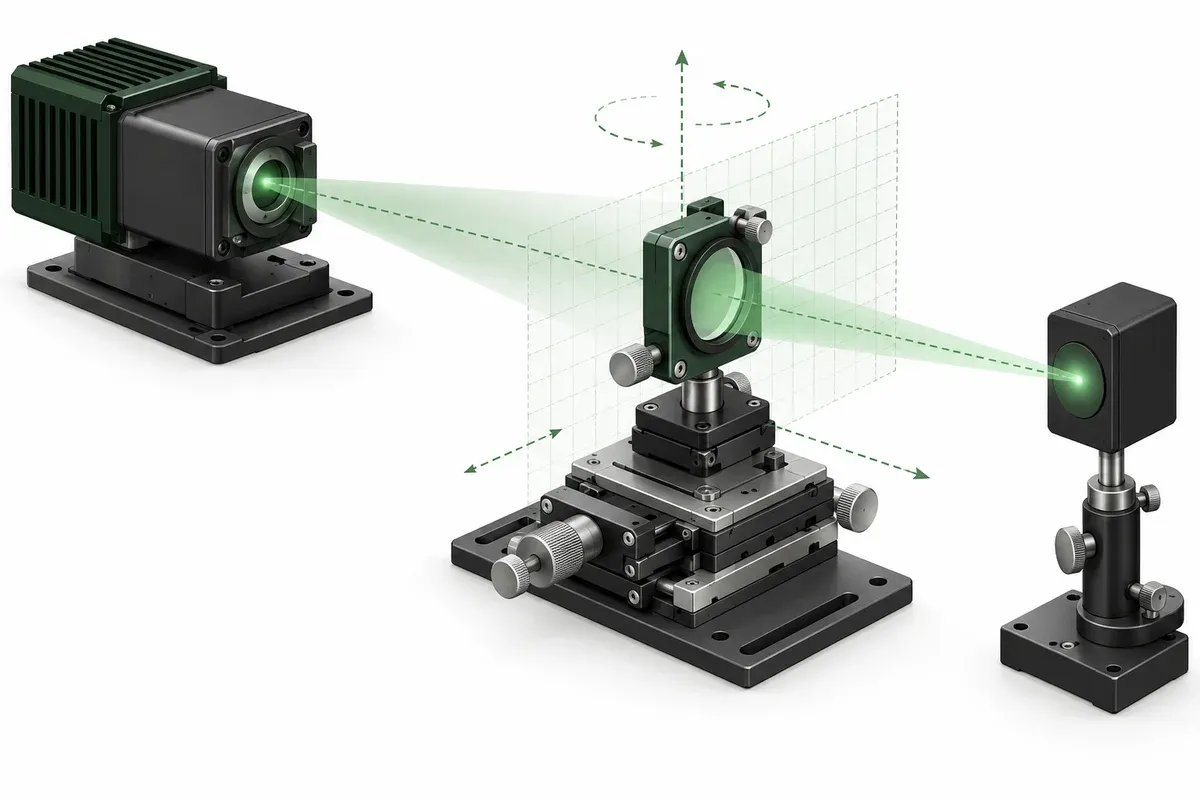
Questions
Is the highest sampled power necessarily the global optimum?
No. It is only the best valid observation in the sampled region under the stated conditions.
What should happen when the power reading is invalid?
Flag the observation and follow a predefined hold or recovery path. Do not treat an invalid reading as evidence of alignment.
Can the stage controller replace the optical measurement system?
Only a specifically documented integrated solution could do that. A mechanical stage listing does not establish measurement or search functionality.
Sources & scope
Sources support the specific points described below. General engineering guidance and third-party examples do not establish a catalogue model's performance or suitability.
- PI: Case Study, Photonic Array Device Assembly
Third-party example of optical feedback, coupled alignment axes and attachment; no performance transfer to this catalogue.
Accessed
Related engineering resources
Continue reading
Applications & System Design
Choosing what must move in a benchtop laser-processing concept
Compare moving the sample and moving the process head in a laser-processing concept while keeping motion validation and safety responsibilities explicit.
Application guide · 4 min read ·Applications & System Design
Defining degrees of freedom for a fiber-array-to-chip alignment bench
Map translations, rotations and pivot locations for a proposed fiber-array alignment bench without assuming six axes solve the optical task.
Application guide · 4 min read ·From requirements to a quotation
Review your stage requirements
Share the motion envelope, payload, orientation and acceptance criteria. Request confirmation of the exact configuration before ordering.
Request a Quote