Key takeaways
- Compare complete moving assemblies and service routes, not just component mass.
- Motion requirements and laser-process qualification are separate workstreams.
- A stage does not provide or certify a complete laser safety system.
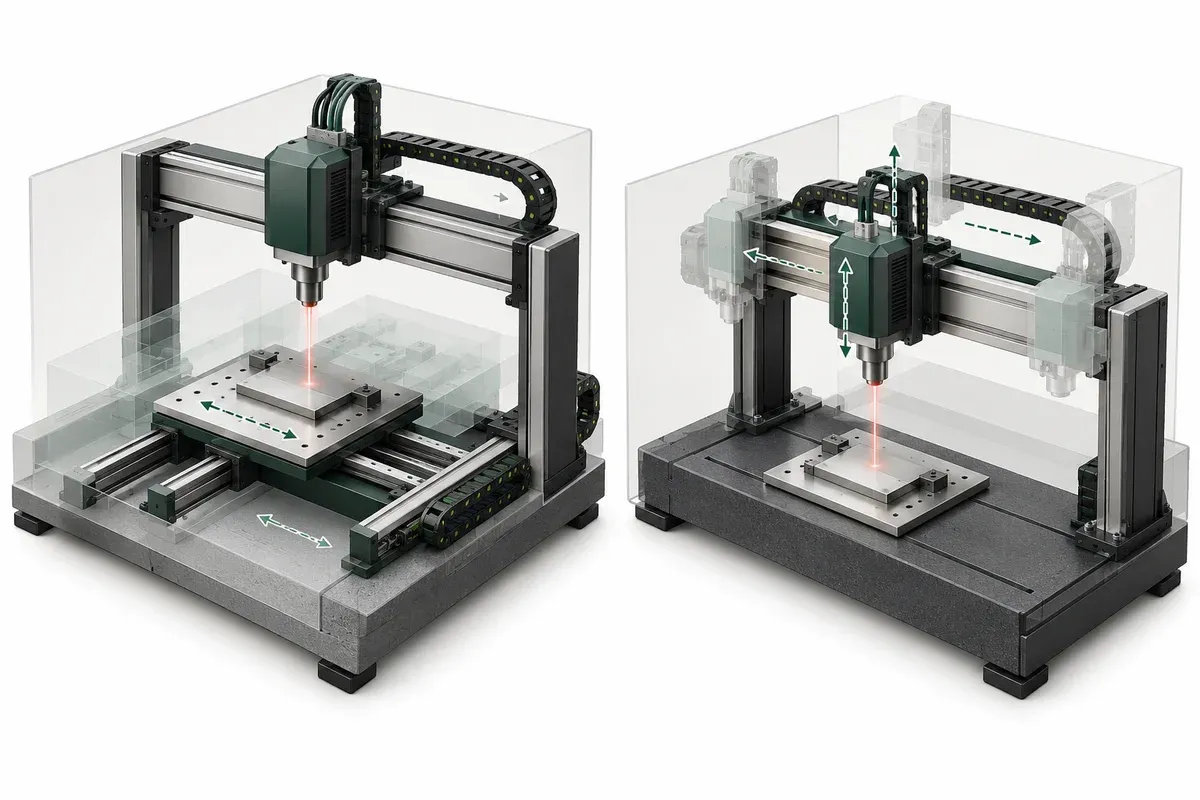
A benchtop laser-processing concept often reaches an early architectural question: should the sample move beneath a fixed process head, or should the head move over a fixed sample? The answer changes the payload, service routing, working envelope and integration responsibilities. It should be decided before a stage is selected by travel alone.
This article is a conceptual mechanical review, not an operating procedure. It provides no laser settings, processing recipe or safety qualification, and it does not establish that catalogue stages are suitable for a laser application.
Compare the complete moving assemblies
For a moving-sample arrangement, include the sample, holder, adapters and any services attached to them. Consider how the fixture retains the sample and whether loading requires a separate position. The work envelope should include the complete part rather than only the process region.
For a moving-head arrangement, include the head support and all required connections. Ask the head supplier to identify routing and orientation constraints. Do not assume that moving the smaller-looking component produces the lower mechanical load or simpler integration.
Draw both concepts at the extremes of their intended motion. Mark anything that crosses a boundary or obstructs access. This comparison often exposes an architectural constraint more decisive than a small difference in a catalogue motion figure.
Define motion independently of process settings
State the geometric path or positioning sequence needed by the concept. Identify whether the process requires indexed locations, coordinated movement or another mode that must be verified with the actual controller.
The laser-process owner must establish how motion interacts with the material result. A stage speed rating does not specify a valid processing speed, and a controller’s commanded trajectory does not by itself demonstrate a qualified feature on the workpiece.
Keep material acceptance, motion acceptance and process safety as separate sections in the requirements package. Their interfaces matter, but passing one does not automatically satisfy the others. Avoid copying operating parameters from unrelated demonstrations into an unqualified bench.
Design the safety boundary before integration
OSHA’s laser-hazard standards page is an official starting reference for applicable safety considerations. It is not a complete assessment of a particular installation or a substitute for competent local review.
The responsible designer must evaluate optical exposure and other relevant process hazards, protective systems and operating conditions. Motion paths, penetrations and service routes need to be considered within that design. Do not assume that a mechanical stage cover contains hazardous radiation or that motion software provides a safety-rated function.
Keep the concept at the drawing and requirements stage until the relevant safety and process reviews authorize further activity. Nothing in this worksheet calls for energizing a laser, defeating an interlock or experimenting with an unprotected beam.
Practical architecture-review checklist
- Draw fixed and moving components for both candidate layouts.
- List complete moving masses, offsets and service connections.
- Mark loading access, maintenance access and the intended working envelope.
- Identify controller functions that require explicit confirmation.
- Keep geometric motion requirements separate from material-process settings.
- Assign ownership of containment, protective controls and process-hazard assessment.
- Define the evidence needed before an integrated processing trial is approved.
Ask suppliers questions within their scope. A motion supplier can assess a specified mechanical configuration; it cannot be assumed to approve the laser, material or complete protective system through a stage quotation.
Hypothetical example: a light head with difficult services
Suppose a concept review initially favors moving a compact head because its visible housing is lighter than the sample holder. The complete layout reveals a connection bundle whose permitted routing is incompatible with the proposed motion envelope.
The team reopens the architecture comparison and asks the head supplier for verified interface constraints. It does not solve the issue by exceeding those limits or altering protective controls. This invented scenario makes no claim about a particular head, stage or processing result.
Make the shortlist conditional
Use linear or multi-axis listings to identify mechanical candidates only after the architecture is defined. Keep every candidate conditional on exact load, interface, controller, environmental and safety requirements. A well-documented concept is a useful design input; it is not a qualified laser-processing machine.
Questions
Is a benchtop laser setup inherently low risk?
No. Physical size does not determine optical or process hazards. A qualified system assessment is required.
Can the stage enclosure be treated as a laser enclosure?
Not without specific design and verification for that purpose. Mechanical covers do not establish optical containment.
Does this guide recommend laser power or scan speed?
No. It compares motion architecture only; operating parameters require validated equipment, materials and safety procedures.
Sources & scope
Sources support the specific points described below. General engineering guidance and third-party examples do not establish a catalogue model's performance or suitability.
- OSHA: Laser Hazards, Standards
Official safety reference identifying standards relevant to laser hazards; not a complete safety assessment or certification.
Accessed
Related engineering resources
Continue reading
Applications & System Design
Building a positioning brief for an optical-power search experiment
Define a bounded optical-power search experiment with measurement validity, pose association and stop criteria before specifying motion hardware.
Application guide · 4 min read ·Applications & System Design
Defining degrees of freedom for a fiber-array-to-chip alignment bench
Map translations, rotations and pivot locations for a proposed fiber-array alignment bench without assuming six axes solve the optical task.
Application guide · 4 min read ·From requirements to a quotation
Review your stage requirements
Share the motion envelope, payload, orientation and acceptance criteria. Request confirmation of the exact configuration before ordering.
Request a Quote