Key takeaways
- Choose the layout from the work-point geometry and installation constraints.
- A horizontal payload rating does not establish vertical lifting capacity.
- Review holding and loss-of-power behavior with the complete system supplier.
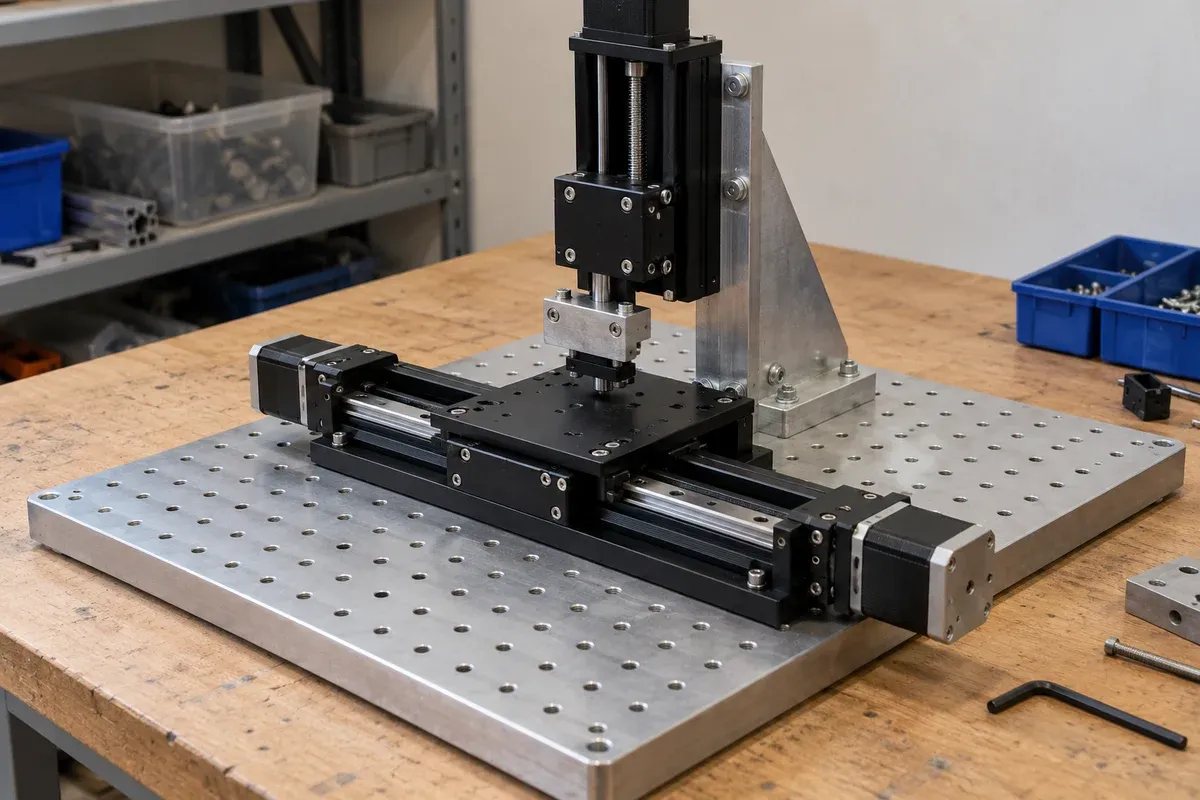
Begin with the direction of useful motion
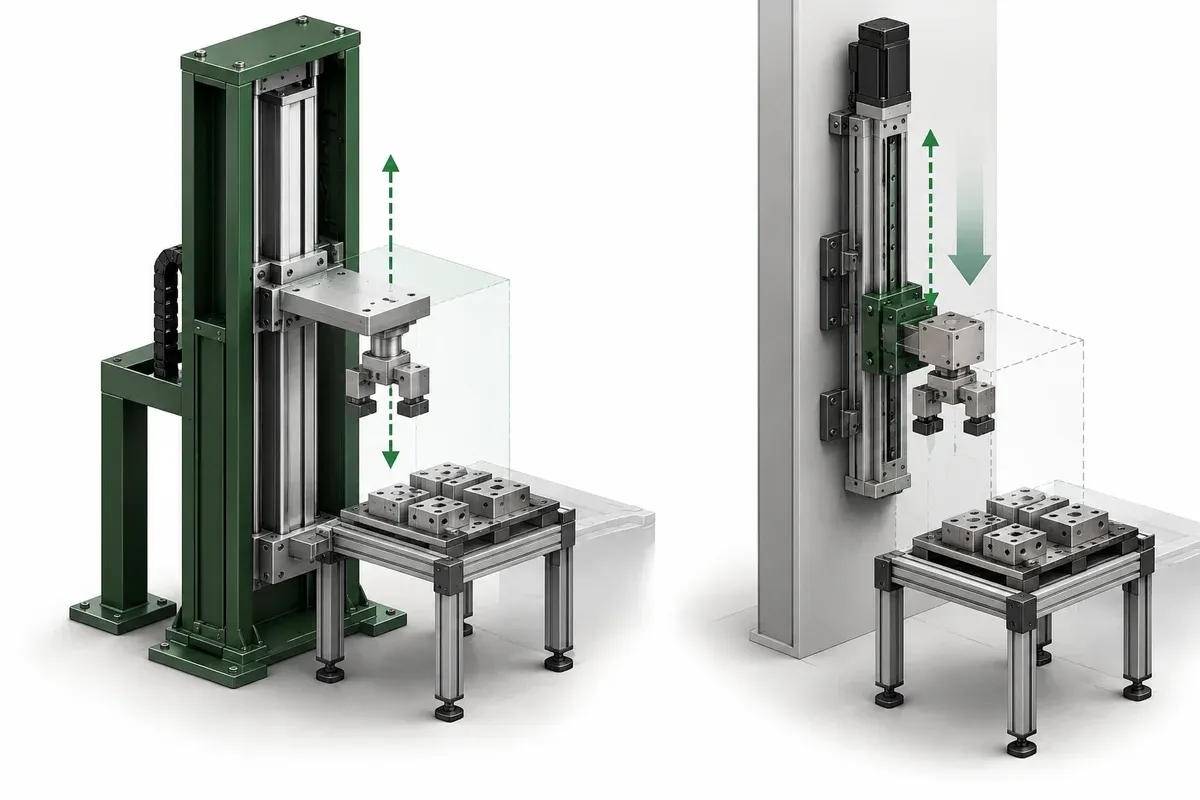
Both a dedicated lift and a linear stage mounted vertically can be considered for a task requiring vertical translation. The first selection question is where the workpiece must move and how its mounting surface must be presented. Sketch the work point, the stationary reference and the available support structure before comparing nominal stroke.
A horizontal platform moving upward may suit a sample fixture that must remain accessible from above. A side-mounted vertical axis may suit a different geometry. These are layout possibilities, not statements of capacity. The appropriate choice depends on the actual mechanism, mounting orientation and complete assembly.
Compare the two installation envelopes
Draw each candidate at its lowest and highest required positions. For a lift, inspect platform height and access underneath or around the mechanism. For a vertically mounted linear axis, include its support bracket, the offset fixture and the motor location. A footprint comparison that omits the bracket is not a comparison of installed systems.
In a hypothetical microscope fixture, the sample surface must move through a 12 mm process range while preserving access to a clamp from above. A lift candidate may offer a convenient horizontal mounting plane. A vertical-axis candidate may fit a narrow side space but require a bracket to reach the sample. Neither observation establishes which can carry the load or meet the focus requirement; it identifies the geometry that must be reviewed.
Check loading and maintenance positions as well as process endpoints. Confirm that the selected arrangement leaves room to insert the sample, operate the clamp and service the mechanism without relying on unreviewed disassembly.
Describe gravity loading explicitly
The catalogue’s specification guide states that a horizontal payload is not reused as a vertical rating. Preserve that distinction in the comparison. Ask for the load capability in the intended orientation and identify everything that must be raised, including adapters and any carried axes.
Show the center of mass relative to the mounting plane and motion axis. A fixture extending away from a vertical mounting face presents a different loading geometry from a compact assembly directly above a platform. Give the supplier the drawing needed to assess the proposed arrangement rather than asking whether an unspecified number of kilograms is acceptable.
Keep confirmed values and unanswered questions in separate fields. If a candidate lacks a required vertical rating, mark it for engineering review. Do not enter zero, reinterpret another rating, or conclude that a larger horizontal capacity solves the missing evidence.
Review holding and interruption behavior separately
Moving a load upward, maintaining its position and responding to an interruption are separate requirements. Describe what must happen during normal dwell, a commanded stop and loss of power. Ask the system supplier to explain the actual arrangement and any required components for the specific configuration.
Do not infer load-holding behavior from a motor type, screw label or photograph. Also avoid converting a general selection discussion into a safety procedure. The responsible engineer must assess hazards, guarding and support arrangements for the machine. This article does not provide brake settings, wiring instructions or an emergency-stop design.
Prepare a layout-specific comparison sheet
For each architecture, complete the following review fields:
- Work-point range and required mounting-surface orientation.
- Full moving mass and center-of-mass coordinates.
- Installed envelope, including brackets and adapters.
- Confirmed load rating for the actual orientation.
- Required movement and dwell sequence.
- Documented holding and interruption behavior.
- Measurement location and acceptance configuration.
This sheet makes a missing answer visible without pretending every architecture should use identical hardware. It also separates a geometric advantage from a verified performance advantage.
Choose a candidate, then verify the assembled task
The vertical-lift family and linear-stage family provide different starting points. Compare exact model drawings and request a recommendation tied to your layout. A family description alone cannot validate a vertical installation.
Before final selection, check that the quoted assembly includes the adapters and control components used in the review. Record the drawing revision and any open condition. If the fixture moves its center of mass or changes the carried mass later, revisit the loading and holding questions together. A clear architecture decision should leave the next engineer with evidence, not an assumption that vertical motion was covered by a familiar catalogue number.
Questions
Can I turn any linear stage on its side for Z motion?
Do not assume so. Confirm the permitted mounting orientation, vertical load, drive capability and holding arrangements for the exact configuration.
Is a dedicated lift always more suitable?
No. Its platform geometry, stroke and integration constraints must fit the task. A vertical linear-axis arrangement may be appropriate when supported by configuration-specific evidence.
Does the motor description establish safe load holding?
No. Obtain the actual holding and power-loss behavior for the supplied system, and have the application safety requirements assessed by the responsible engineer.
Sources & scope
Sources support the specific points described below. General engineering guidance and third-party examples do not establish a catalogue model's performance or suitability.
- Vertical lift stages
The catalogue has a dedicated vertical-lift family; ratings must be checked for the exact model.
Accessed - How to read the specifications
Definitions and the catalogue, derived and not-confirmed labels used on this site.
Accessed - PI vertical positioning stage overview
Confirms that dedicated vertical-positioning products exist in different mechanical designs. No PI load or holding capability is attributed to this catalogue.
Accessed
Related engineering resources
Continue reading
Stage Selection & Buying Guides
Comparing screw, linear-motor, piezo, flexure and air-bearing stages
Compare stage actuation, guidance, feedback and support separately, then request configuration-specific evidence for the intended movement and load.
Selection guide · 8 min read ·Stage Selection & Buying Guides
Crossed-roller and linear-ball guides: selection-review questions
Review crossed-roller and linear-ball stage candidates using actual load geometry, stiffness evidence, mounting conditions and documented service needs.
Selection guide · 4 min read ·From requirements to a quotation
Review your stage requirements
Share the motion envelope, payload, orientation and acceptance criteria. Request confirmation of the exact configuration before ordering.
Request a Quote