Key takeaways
- The guideway name does not establish the performance of the finished stage.
- Ask for evidence in the directions and at the work point that matter.
- Compare maintenance and environmental requirements from exact-model documentation.
Start with the finished stage requirement
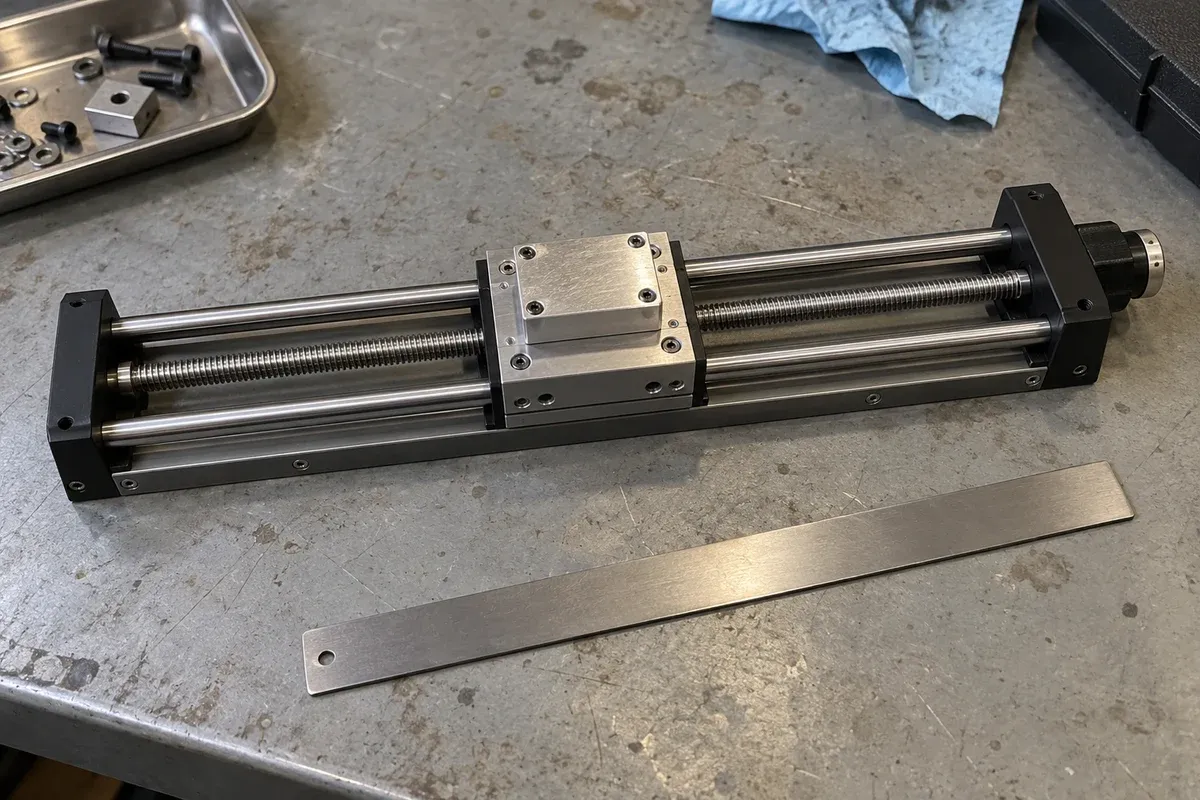
Crossed-roller and linear-ball guideways are both represented in the linear-stage family. The guideway label is useful for filtering candidates, but a finished stage also includes its structure, drive, mounting interfaces and assembly conditions. Compare those complete products against the task rather than selecting a winner from the guideway name alone.
Write the required motion, payload geometry and work-point location first. If the process is sensitive to displacement under load, identify the load direction and where the displacement matters. A generic request for “high stiffness” gives the supplier less to evaluate than a defined force and measurement location.
Understand the component description without borrowing its ratings
THK’s component documentation describes crossed rollers arranged alternately at right angles and distinguishes that arrangement from its ball-guide design. It also discusses preload for its particular guides. These descriptions help explain the terminology, but they do not establish the construction details or performance of an unrelated complete stage.
Ask which exact guide arrangement is used in the proposed model and what documentation supports it. Do not assume that two products carrying the same broad label share preload, dimensions, protection or service instructions. Likewise, do not import a component manufacturer’s lifetime or stiffness claim into a stage comparison without a documented connection to that assembly.
Ask for the loading and displacement evidence you need
Show the supplier the mounting orientation, center of mass and external forces. Identify the relevant directions for loading and any moments created by the fixture. Ask what the published load figure actually covers and what other limits need review.
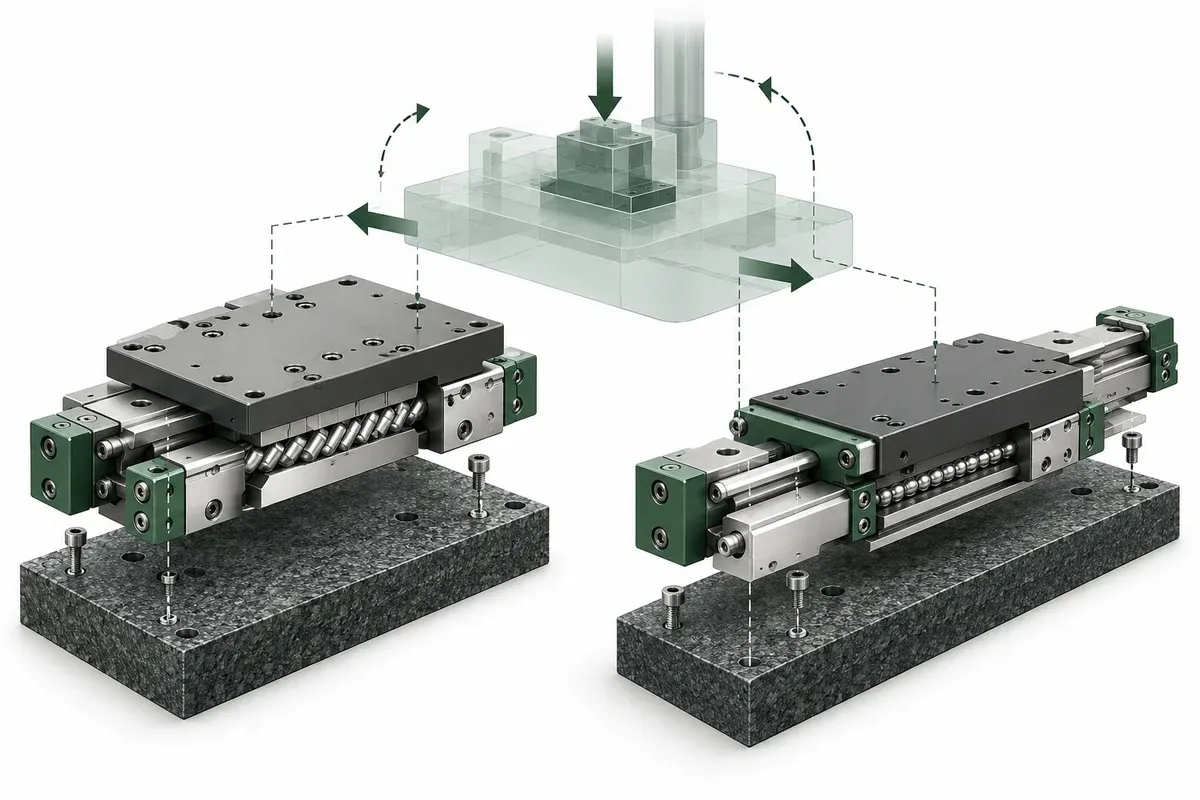
For a hypothetical probe fixture, suppose the work point is mounted on a tall adapter and the process applies a lateral contact force. The useful question is not simply which guide type has a larger mass capacity. The review must address the assembled geometry and the resulting movement at the probe location. The adapter and mounting structure belong in that discussion.
Request a relevant stiffness or displacement basis if the process depends on it. If the catalogue does not supply one, keep the requirement open. A bearing-type preference cannot fill an evidence gap.
Review motion quality separately from load capacity
Ask which geometric motion errors and positioning quantities are specified for the complete stage. Identify the travel range, measurement position and loading conditions associated with them. A stage can have a published load figure while still requiring additional evidence for a sensitive measurement task.
Keep the different quantities in separate comparison rows. Command resolution, repeatability and positioning accuracy describe different aspects of behavior. Straightness or angular motion errors, where provided, also need their own definitions and conditions. The specification guide is the starting point for understanding the site’s data labels.
For a reversing process, describe both approach directions. For a scanning process, explain what must be measured during movement. These task details are more helpful than asking for a single “precision” number that might mean different things to different suppliers.
Confirm installation and service obligations
Request the mounting-surface requirements, assembly instructions and maintenance information for the exact model. Identify who will perform the work and whether access is available after installation. Do not adjust guide preload or substitute lubrication based on a generic selection discussion.
State the environment that matters to the application, including any known contamination or access constraints. Ask for documented protection and compatibility rather than assuming that a ball or roller label predicts suitability. If the required condition is not confirmed, record it as a blocker to final selection.
Run a guideway-neutral selection review
Use the same questions for both candidate groups:
- Does the installed geometry fit the fixture and work point?
- Are the actual load directions and moments covered?
- What evidence describes displacement and motion quality?
- Which positioning figures apply to the required operating sequence?
- What mounting, protection and service conditions must be maintained?
- Which requirements remain unconfirmed for this exact model?
Choose the candidate whose complete evidence best supports the application. Preserve any conditions with the quotation so a later adapter change or different operating environment triggers a review. Guideway terminology should help organize the investigation, not replace the investigation itself.
Questions
Are crossed-roller stages always better than linear-ball stages?
No universal ranking follows from the guideway name. Compare the complete stage against the required geometry, load, movement and evidence.
Does a guideway type establish contamination tolerance?
No. Request the actual protection, environment and service requirements for the proposed model. Do not infer them from the rolling-element label.
Can I change preload to improve a purchased stage?
Follow the manufacturer’s instructions and obtain authorization for any adjustment. A selection article does not establish a safe preload setting or modification procedure.
Sources & scope
Sources support the specific points described below. General engineering guidance and third-party examples do not establish a catalogue model's performance or suitability.
- Motorized linear stages
The listed linear-stage family uses ball-screw drives and includes crossed-roller and linear-ball guideways.
Accessed - How to read the specifications
Definitions and the catalogue, derived and not-confirmed labels used on this site.
Accessed - THK cross-roller and ball-guide overview
Describes the rolling-element arrangements of THK guides and the availability of preload in its crossed-roller design. No component rating is transferred to catalogue stages.
Accessed
Related engineering resources
Continue reading
Stage Selection & Buying Guides
Choosing a vertical lift instead of mounting a linear stage vertically
Compare a dedicated vertical lift with a vertically mounted linear stage by checking layout, gravity loading, support and configuration-specific evidence.
Selection guide · 4 min read ·Stage Selection & Buying Guides
Comparing screw, linear-motor, piezo, flexure and air-bearing stages
Compare stage actuation, guidance, feedback and support separately, then request configuration-specific evidence for the intended movement and load.
Selection guide · 8 min read ·From requirements to a quotation
Review your stage requirements
Share the motion envelope, payload, orientation and acceptance criteria. Request confirmation of the exact configuration before ordering.
Request a Quote