Key takeaways
- Choose acquisition mode from the measurement requirement.
- A stationary accuracy figure does not prove scan performance.
- Include all acquisition overhead in a throughput comparison.
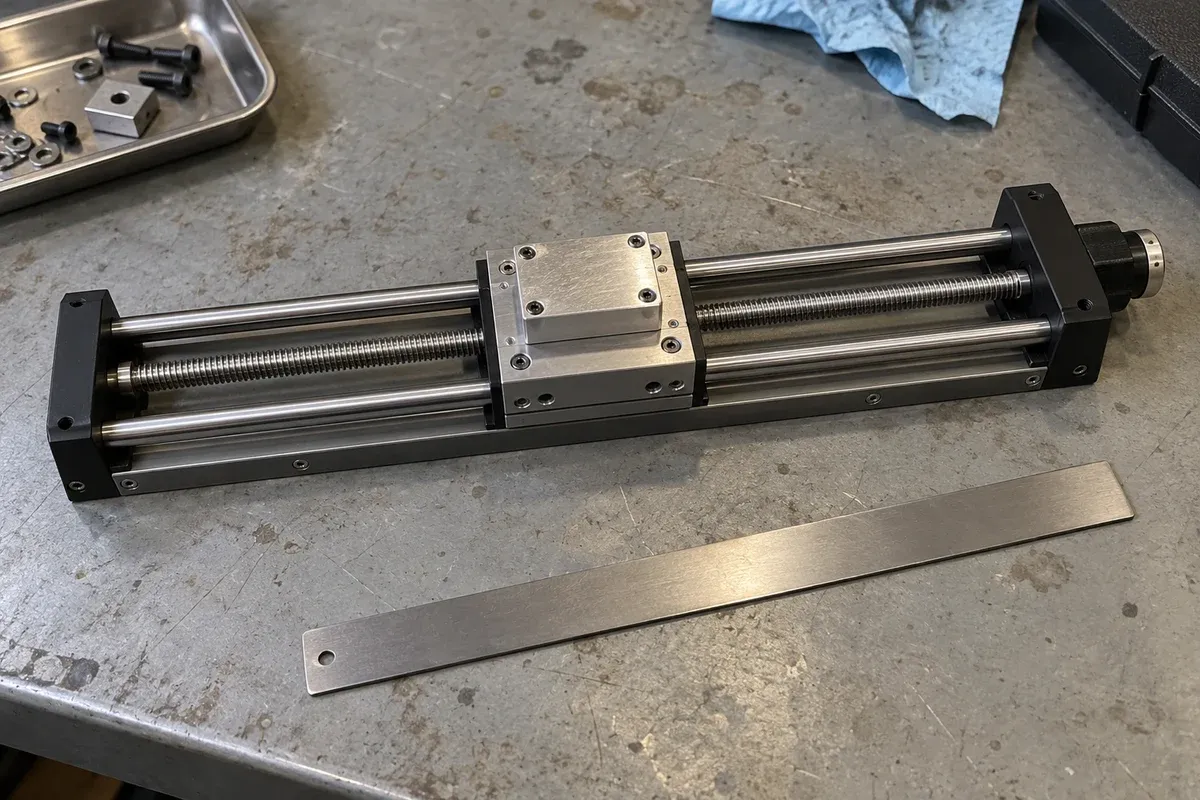
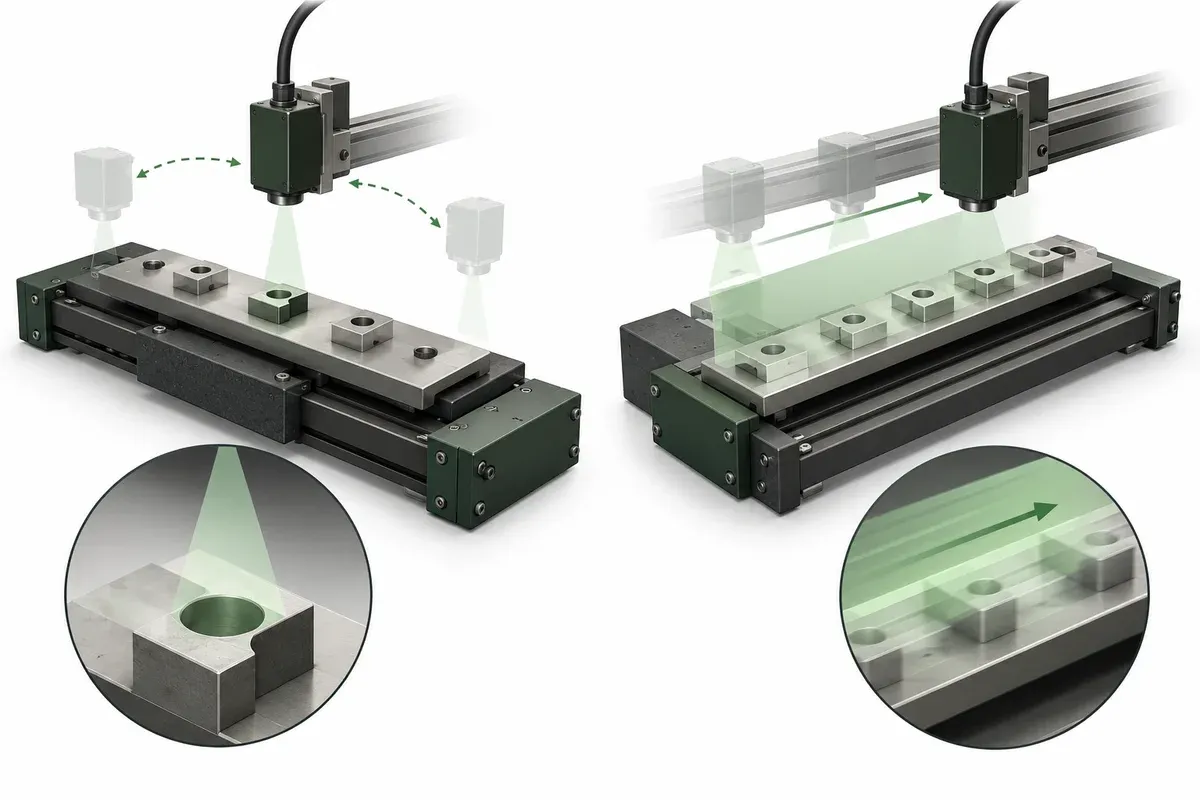
A process that measures only after each move and a process that measures while moving place different demands on a positioning system. The choice should follow the measurement physics and acceptable uncertainty, not a general assumption that continuous scanning is always faster or that stopping automatically produces a valid measurement.
Define when the instrument sees the specimen
In move-and-settle operation, acquisition follows a positioning event and a defined readiness condition. In continuous scanning, acquisition occurs during movement and needs a way to associate measurements with the moving specimen. Document the full acquisition interval in either case, including any averaging or exposure period.
Ask the instrument owner what movement can be tolerated during measurement. Some processes need a stationary target; others can interpret a signal collected along a trajectory. If that tolerance is unknown, choosing the motion mode first simply moves the uncertainty into later commissioning.
Separate the desired operating mode from catalogue capability. Use the stage selector to identify mechanical candidates, then request evidence for the actual dynamic and control requirements from the integration provider.
Compare different performance evidence
For a stationary measurement, define what “settled” means at the point of interest and how it will be observed. A controller’s end-of-move indication may be one input, but the process may require additional evidence. Avoid selecting an arbitrary delay and calling it a validated settling time.
For a continuous scan, request evidence relevant to speed variation, path behavior and measurement association. The Zaber velocity article distinguishes dynamic evaluation from static specifications. Its reported methods and performance belong to its own tested configurations; they do not qualify this catalogue for scanning.
Record the definition used for any dynamic metric. A familiar term can be calculated differently across providers, so compare methods and conditions before comparing numbers. Keep payload, orientation and measurement location in the test description.
Acquisition-mode decision checklist
- Identify whether the measurement can tolerate motion during its acquisition interval.
- Define the stationary readiness criterion or continuous-scan association method.
- List motion time, settling, exposure, readout and processing as separate cycle elements.
- Request loaded-fixture evidence for the mode being considered.
- Include scan entry, exit, direction changes and interrupted acquisition in the review.
- Define how incomplete or unregistered data will be identified.
- Compare total usable-data throughput rather than motion speed alone.
The checklist should produce a justified mode selection and a list of unresolved evidence. It should not prescribe controller tuning, scan speed or dwell settings without the actual system review.
Hypothetical throughput comparison
Imagine a conceptual inspection of fifty points. A stationary approach uses a move, readiness check and measurement at every point. A continuous approach traverses the region in one pass, but needs spatially associated acquisition and may require additional processing or a repeated pass if data are incomplete.
The team creates a time budget for both methods. It includes specimen loading, reference establishment, motion, acquisition, data handling and rejected-run recovery. No invented cycle time is used to declare a winner. The better option is the one that meets measurement quality and throughput requirements with demonstrated evidence.
If the instrument cannot interpret moving measurements reliably, the apparent saving in motion time may be irrelevant. If long settling dominates a stationary process, continuous acquisition may deserve investigation, but only with a suitable measurement and synchronization design.
Validate the selected mode at process level
Test representative specimens and the intended fixture configuration using a reviewed procedure. For move-and-settle, examine whether the readiness criterion produces consistent measurements. For continuous scanning, examine coverage, location association and the behavior at scan boundaries. Keep unusable data in the assessment rather than counting only successful portions.
Use how to read specifications to keep resolution, repeatability and accuracy labels precise. A stage specification can inform the initial choice, while the acquisition mode remains a system-level claim. The release record should say what was demonstrated, under which conditions, and which changes would require the comparison to be revisited.
A change in image exposure or instrument averaging can alter this comparison without changing the stage, so measurement configuration belongs under the same review.
Questions
Is move-and-settle automatically more accurate?
No. Its usefulness depends on the readiness criterion, measurement method and assembled fixture behavior.
Can a repeatability rating qualify a continuous scan?
Not by itself. Dynamic motion and acquisition association need their own evidence.
What belongs in the throughput comparison?
Count loading, referencing, movement, settling where relevant, acquisition, processing and recovery from unusable runs.
Sources & scope
Sources support the specific points described below. General engineering guidance and third-party examples do not establish a catalogue model's performance or suitability.
- Zaber: Velocity stability and following error
Only the distinction between dynamic performance evaluation and static specifications; no source test values are reused.
Accessed
Related engineering resources
Continue reading
Motion Control & Automation
Logging commands, status and errors for a reproducible motion test
Design a motion-test log that separates intent, controller status and measurement evidence while preserving timestamps and operation identity.
Integration guide · 4 min read ·
Motion Control & Automation
Position-triggered versus time-triggered image acquisition
Choose image-trigger requirements from spatial sampling, exposure behavior and position evidence, with a hypothetical timing example.
Integration guide · 4 min read ·From requirements to a quotation
Review your stage requirements
Share the motion envelope, payload, orientation and acceptance criteria. Request confirmation of the exact configuration before ordering.
Request a Quote