Key takeaways
- Log command intent separately from device response and measurement.
- Record clock meaning and configuration revisions.
- Preserve uncertainty and failures instead of converting them into success.
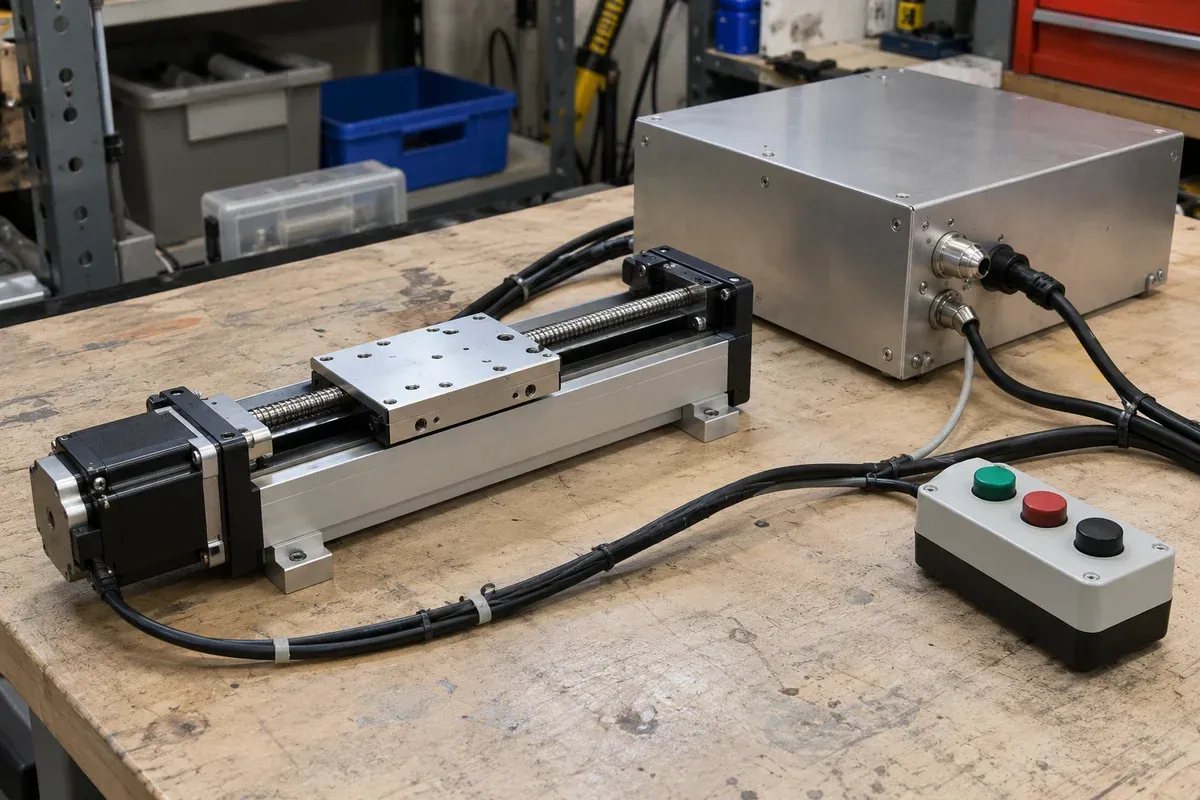
A reproducible motion test needs more than a spreadsheet of requested positions. The record should show what the application intended, what the controller reported and what an independent measurement observed. Keeping those layers separate allows a later reviewer to distinguish a mechanical result from a communication or data-association problem.
Define the questions the log must answer
Start with a specific test purpose: verifying a repeated sequence, investigating an interruption or comparing a configuration change. Then ask what evidence a person would need to reconstruct that test without access to the original operator’s memory.
Record the test identifier, fixture and specimen identifiers, stage configuration, host software version and approved recipe revision. Include relevant load and environmental context. Avoid collecting unrelated personal information or secrets; diagnostic usefulness does not require storing credentials or unrestricted system data.
The Zaber protocol manual separates replies, status and warnings. That is a useful example of distinct information classes, not a universal log format or a protocol supplied with this catalogue.
Use a layered record structure
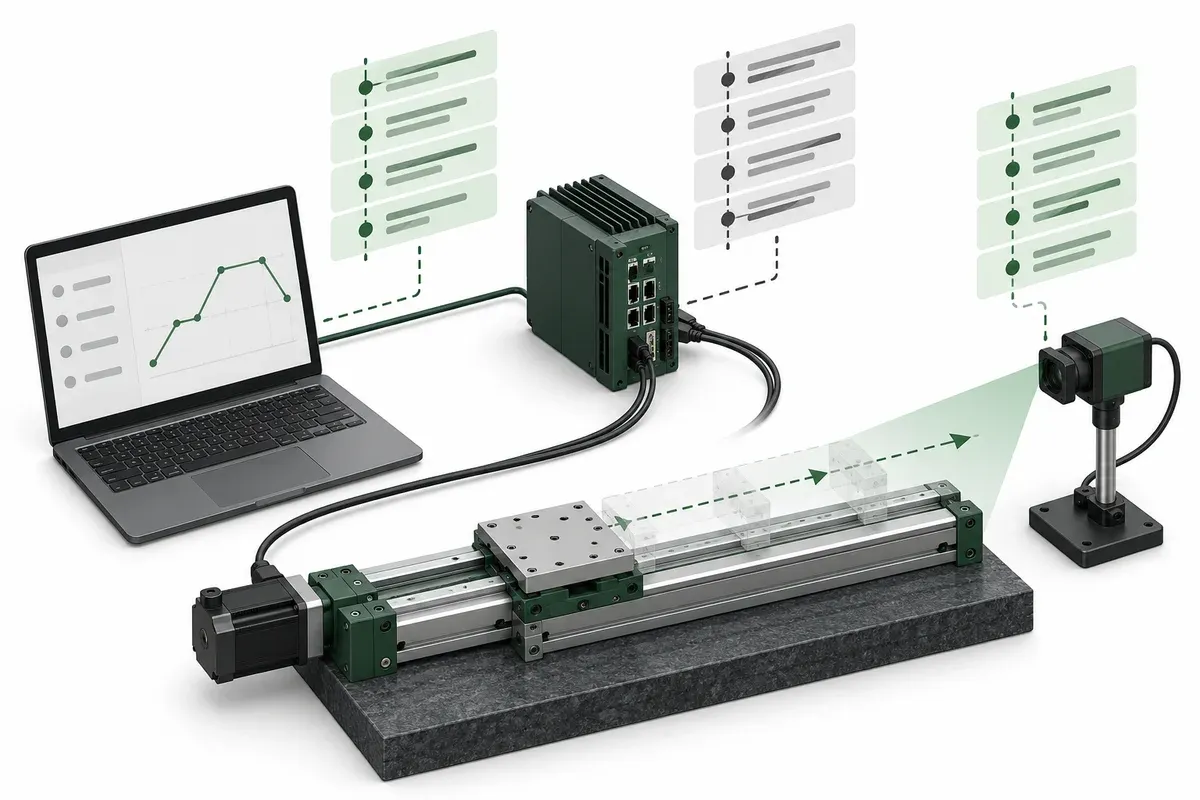
For each operation, store the application identifier, intended action, target or displacement, coordinate frame and units. Add the time the host issued the request and the raw or faithfully interpreted device response. Preserve enough original information to revisit an interpretation if the parser later proves incorrect.
Record completion evidence separately from acceptance. If an independent measurement is available, give it its own identifier, units, timestamp basis and uncertainty context. Do not overwrite the requested position with the measured position or call a command counter a measurement.
Define clock meaning. Host send time, controller event time and instrument acquisition time may come from different clocks and represent different events. Record their source and any established relationship. Apparent ordering across unsynchronized clocks should not be presented as a precise latency measurement.
Reproducible-log checklist
- Save run, operation, sample and measurement identifiers with explicit relationships.
- Record recipe, fixture, controller and host-software configuration revisions.
- Preserve command units, coordinate frame and the meaning of reported position fields.
- Separate request, acceptance, completion, fault and measurement records.
- Identify every clock source and any verified synchronization relationship.
- Mark missing replies, unresolved execution and rejected measurements explicitly.
- Retain the original record when corrections or interpretations are added.
Include a documented export format and retention responsibility. A proprietary viewer can be useful, but the team should know how an authorized reviewer will inspect the relevant evidence later.
Hypothetical interrupted test record
Imagine a run in which operation 024 requests a fixture station, receives an acceptance response and then loses communication before completion is recorded. The instrument subsequently returns measurement M024, but its acquisition state cannot be established from the available evidence.
A useful log preserves all three facts: the requested operation, the acceptance and the unresolved measurement association. It does not replace the missing completion with the next observed idle state or relabel M024 as a successful result simply because a file exists.
When the operator follows the approved recovery procedure, the application starts a new segment and records the restored reference evidence. This gives the reviewer a boundary between trustworthy results and unresolved data. The example specifies recordkeeping, not a controller command sequence.
Test the log before depending on it
Run a reviewed set of normal and interrupted scenarios and ask someone unfamiliar with the implementation to reconstruct what happened. Check whether they can distinguish rejection, delayed response, incomplete motion and missing measurement without guessing. If not, improve the event definitions or associations before collecting a large data set.
Use how to read specifications to keep reported performance terms precise. A log can support a repeatability or accuracy study only when the test method and measurement evidence support that claim; detailed command history alone is insufficient.
Finally, keep corrections additive and traceable. If a unit conversion or clock interpretation changes, preserve the original values and state how the revised interpretation was produced. Reproducibility comes from an honest chain of evidence, including its gaps, rather than from a perfectly tidy table with uncertainty removed.
A short data dictionary should accompany the exported records, explaining field meanings and allowed missing values so downstream analysis does not invent its own assumptions.
Questions
Should a commanded position be logged as actual position?
No. Label its source and meaning; independent measurement and controller-reported values should remain distinguishable.
Can host timestamps measure physical event latency?
Only with a justified relationship to the relevant events and clocks. A timestamp label alone does not establish that relationship.
Should incomplete records be deleted from the test?
Preserve and identify them. Their effect on the result should be handled by the documented test and data-review method.
Sources & scope
Sources support the specific points described below. General engineering guidance and third-party examples do not establish a catalogue model's performance or suitability.
- Zaber ASCII Protocol Manual
Only the distinction among replies, status and warnings in the Zaber protocol; the proposed log schema is original.
Accessed
Related engineering resources
Continue reading
Motion Control & Automation
Choosing move-and-settle or continuous-scan operation
Compare stationary acquisition with continuous scanning by separating settling, dynamic motion, synchronization and throughput evidence.
Integration guide · 4 min read ·
Motion Control & Automation
Position-triggered versus time-triggered image acquisition
Choose image-trigger requirements from spatial sampling, exposure behavior and position evidence, with a hypothetical timing example.
Integration guide · 4 min read ·From requirements to a quotation
Review your stage requirements
Share the motion envelope, payload, orientation and acceptance criteria. Request confirmation of the exact configuration before ordering.
Request a Quote