Key takeaways
- Define whether sampling is tied to elapsed time or spatial position.
- Separate trigger generation, exposure and image delivery.
- Verify spatial registration instead of counting images alone.
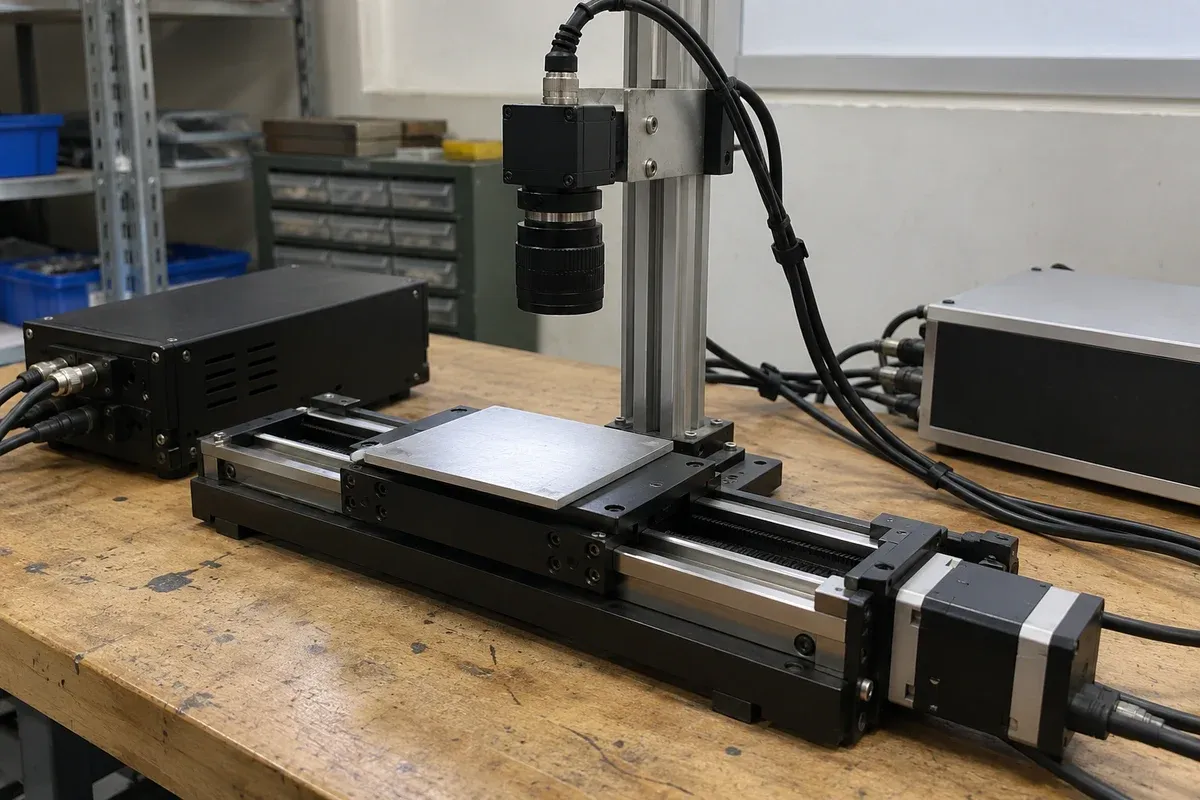
A camera can return the expected number of images while sampling the wrong locations. To specify acquisition correctly, identify what should determine each exposure: an elapsed interval, a position event or a verified stationary state. Then describe how that event becomes an image with a trustworthy location label.
Choose the sampling variable
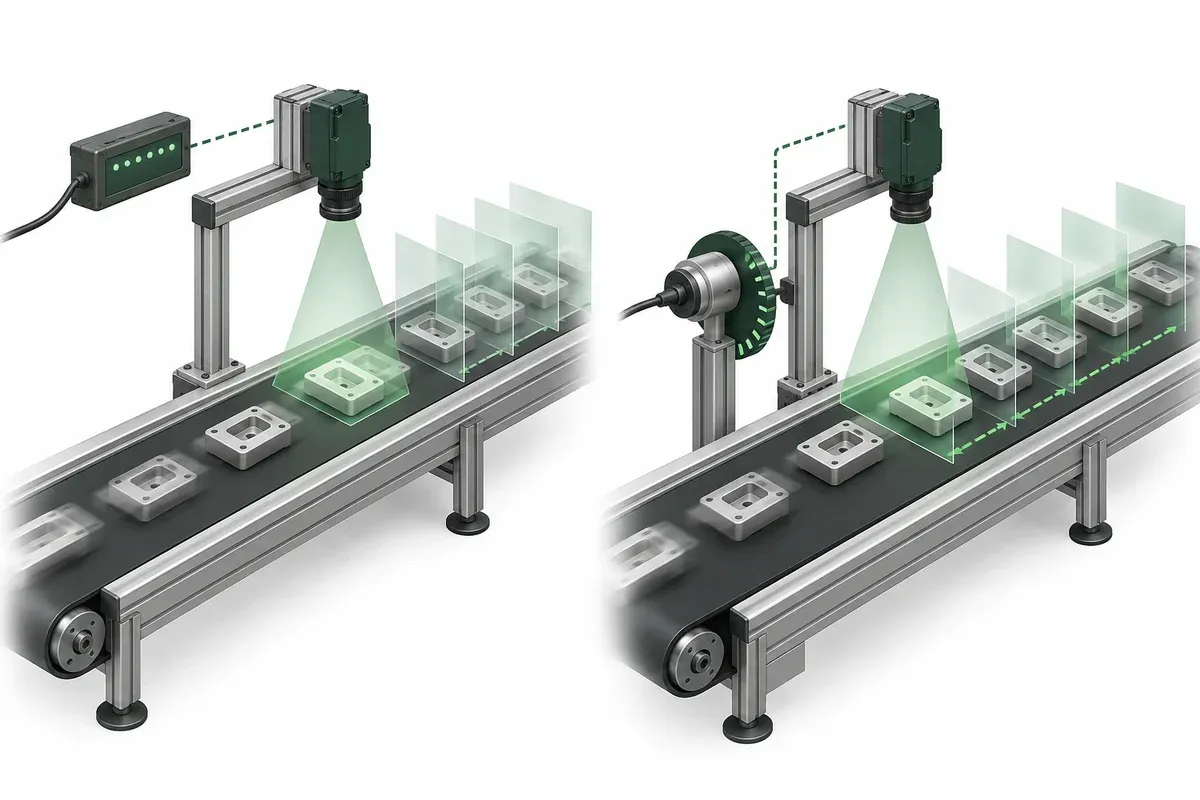
Time-triggered acquisition is organized around a clock. Position-triggered acquisition is organized around a spatial condition or interval. The useful choice depends on the measurement question, motion behavior and available hardware. Neither label alone establishes exposure accuracy or compatibility between a camera and controller.
The Zaber trigger article lists time and distance conditions for its trigger system. This is a reference example of distinct trigger types. It does not establish that these functions are supplied with PositioningStages products.
Write the desired sample locations before selecting the trigger mechanism. If the specimen requires regularly spaced images, specify the spatial coverage and permissible location uncertainty. If a time-dependent process is being observed, explain why the timing itself is the primary variable.
Trace the event through the camera
Distinguish the event source, electrical signal, camera acceptance, exposure interval and image delivery. Each transition can affect the interpretation of the image. Ask the camera provider for its supported trigger mode and timing definitions, and ask the integrator to confirm the complete interface.
Do not assume a connector establishes voltage compatibility, polarity or an approved wiring arrangement. Request the exact documentation rather than prescribing signal levels or pin assignments. Include what happens when the camera is busy or cannot accept another event.
For a moving specimen, exposure covers an interval rather than an abstract point. Define how the image’s representative position will be assigned and whether motion during exposure matters to the measurement. That question remains even when trigger events occur at precisely defined positions.
Image-trigger requirements checklist
- State the primary sampling variable and the intended coverage of the specimen.
- Identify the position source or clock that generates the acquisition event.
- Document camera trigger acceptance, exposure timing and busy behavior.
- Confirm electrical compatibility through approved model-specific information.
- Associate each accepted exposure with a unique image and sample identifier.
- Define treatment of missed, duplicate, delayed or rejected events.
- Verify image registration against an independent spatial or temporal reference.
Include the selected image-processing assumptions in the same review. A stitching algorithm may tolerate certain overlaps while a dimensional measurement requires a different uncertainty statement.
Hypothetical time-spacing calculation
Imagine a conceptual scan moving at a constant 5 mm per second while a camera is requested to acquire every 0.1 second. Idealized spacing would be 0.5 mm. If the actual speed changes, the same time interval no longer guarantees that spacing. These values illustrate arithmetic and are not operating recommendations.
A position-based event could instead be specified at each intended spatial interval, provided the selected hardware can implement it with the necessary evidence. The team would still need to assess trigger latency, exposure behavior and the position source. Merely changing the event label does not eliminate those questions.
If images are taken only after motion has stopped, the design has a different readiness problem: it must establish that the fixture and camera are ready before acquisition. That can be a sensible requirement, but it should be explicit.
Verify registration and completeness together
Use a suitable reference target or another reviewed method to compare expected and observed image locations. Check the first and last image as well as the steady middle of the sequence; startup and completion behavior may differ. Retain evidence of dropped or rejected acquisitions instead of renumbering the remaining files to appear complete.
The optical application overview separates motion from measurement and process control. Apply that same boundary to imaging: a mechanically suitable stage is one component of the acquisition chain. Release the scan only when the combined motion, trigger and camera evidence supports the required spatial or temporal interpretation.
Keep the camera mode and exposure configuration with each test record, so a later image comparison does not silently mix different acquisition assumptions.
Questions
Does a position trigger eliminate camera latency?
No. The trigger event, camera acceptance and exposure interval remain distinct parts of the acquisition chain.
Does a fixed frame interval guarantee fixed spatial spacing?
Only under the required motion conditions. Variable speed changes the distance traveled during a fixed interval.
What should be checked besides image count?
Verify registration, exposure association, coverage and the handling of missed or rejected events.
Sources & scope
Sources support the specific points described below. General engineering guidance and third-party examples do not establish a catalogue model's performance or suitability.
- Zaber: Using triggers to simplify automation
Only time- and distance-based trigger conditions in the Zaber implementation; the acquisition worksheet and arithmetic are original.
Accessed
Related engineering resources
Continue reading
Motion Control & Automation
Choosing move-and-settle or continuous-scan operation
Compare stationary acquisition with continuous scanning by separating settling, dynamic motion, synchronization and throughput evidence.
Integration guide · 4 min read ·
Motion Control & Automation
Logging commands, status and errors for a reproducible motion test
Design a motion-test log that separates intent, controller status and measurement evidence while preserving timestamps and operation identity.
Integration guide · 4 min read ·From requirements to a quotation
Review your stage requirements
Share the motion envelope, payload, orientation and acceptance criteria. Request confirmation of the exact configuration before ordering.
Request a Quote