Key takeaways
- Calculate stroke from the extreme required coordinates.
- Keep working range, service positions and installation clearance separate.
- Do not turn a planning allowance into an unverified limit setting.
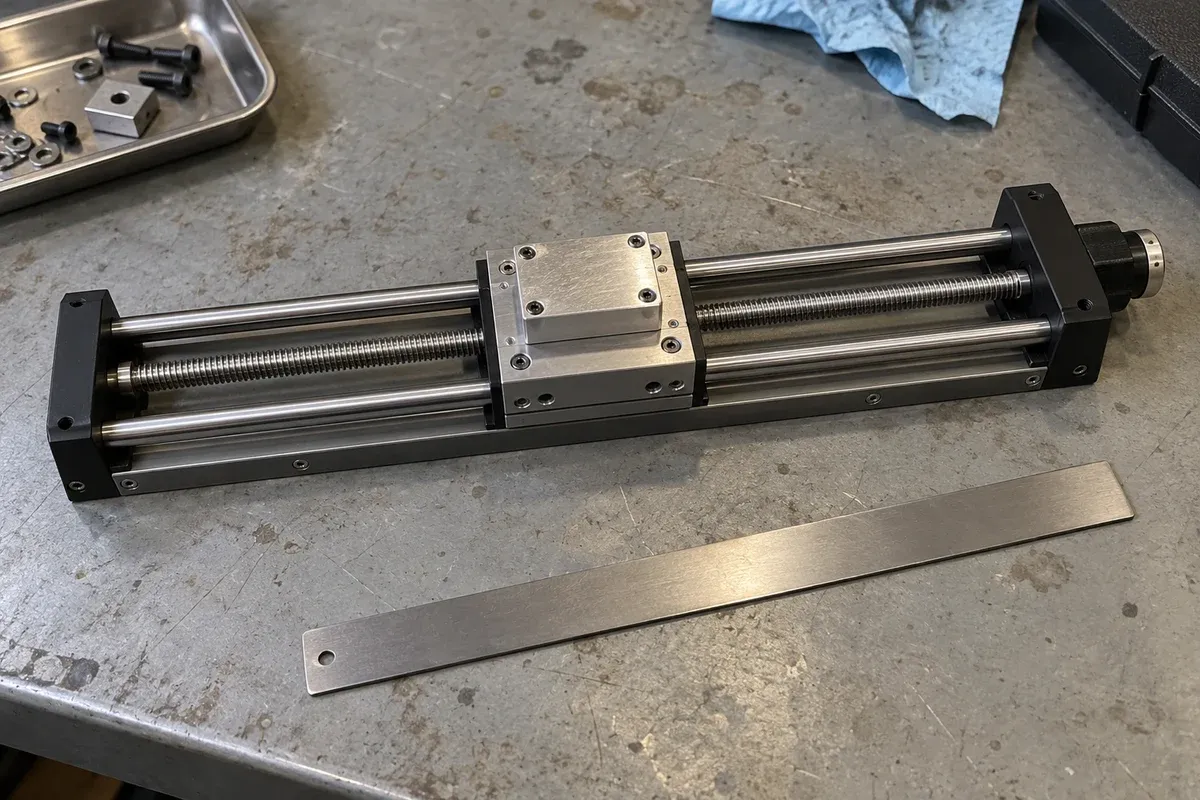
Define a coordinate before calculating a stroke
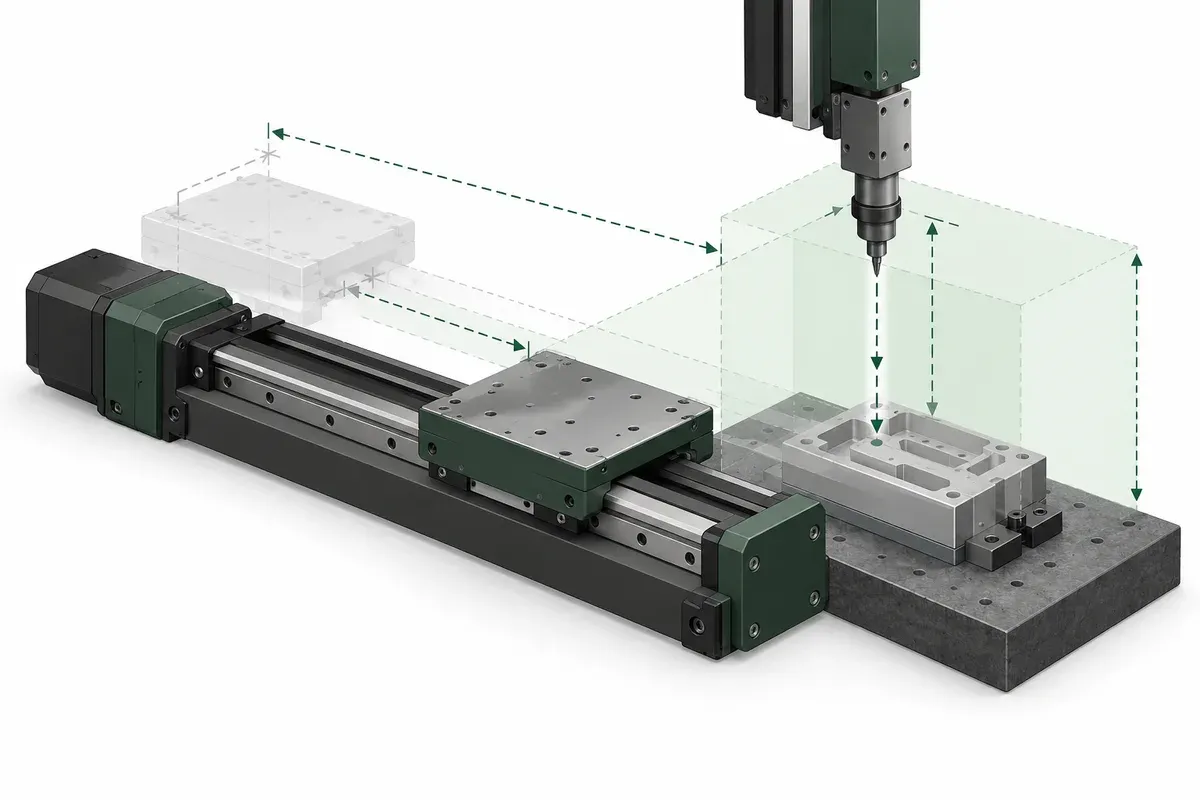
Travel selection begins with positions, not a convenient catalogue size. Choose a reference on the stationary structure, identify the work point, and express every required position along the same axis. Include the positions used for loading and approach, even if the process itself takes place in a much smaller region.
A list of move distances is not equivalent to a required stroke. A carriage can travel back and forth many times while remaining inside a short range. Conversely, one occasional service move can set the minimum stroke even when production moves are small. Describe both the span and the operating sequence so they cannot be confused.
Build a position ledger
Create a ledger with a name, coordinate and purpose for each important position. Useful entries include loading, initial approach, the first and last process locations, inspection, and withdrawal. Record whether each coordinate is fixed, estimated or adjustable by changing the fixture. Show the reference used to measure it.
In a hypothetical single-axis inspection layout, assume loading occurs at 0 mm, the first measurement at 8 mm, the last at 26 mm, and withdrawal at 32 mm. The required coordinate span is 32 mm minus 0 mm, or 32 mm. The measurement region alone spans 18 mm. Choosing from that smaller number would omit operations needed to use the fixture.
This is a planning calculation, not a recommendation to command a particular mechanism to its endpoints. The usable range, limit arrangement and approved operating envelope still need confirmation for the selected configuration.
Separate necessary motion from optional allowance
After finding the span, list uncertainties that might change it. A future clamp revision, a variable part length and an unconfirmed approach distance are different reasons for allowance. Record each reason and its owner instead of adding an unexplained margin everywhere.
For the hypothetical layout, suppose the loading coordinate could move 2 mm in the negative direction after the fixture design is finalized. The provisional span becomes 34 mm, from minus 2 mm to 32 mm. If a second uncertainty affects the same endpoint, check whether the effects can occur together before combining them. This makes the allowance traceable and avoids accidental double counting.
Ask whether an adjustable fixture could absorb some setup variation. That may change the required stage range, but it must not sacrifice access or the process reference. A deliberate mechanical adjustment and a software coordinate shift solve different problems.
Check the swept envelope, not just the moving table
Place the complete moving assembly at the extreme positions and at any intermediate position where it passes close to an obstruction. Include the workpiece, clamps, fasteners, upper axes and cable routing. A stage can provide sufficient nominal travel while the installed assembly collides before completing it.
Inspect the stationary portion too. A longer stage may put its motor or cable exit into a wall even though the platform clears. Review tool access for mounting and maintenance. Record which dimensions come from controlled drawings and which come from temporary layout estimates.
A practical envelope checklist includes:
- The lowest and highest required work-point coordinates.
- The closest approach to neighboring equipment.
- Space for part insertion and clamp operation.
- The cable and hose arrangement throughout the sequence.
- Access to mounting screws and serviceable components.
Translate the ledger into a catalogue search
Use total stroke when filtering the stage selector. The site normalizes linear travel to total millimetres; the specification guide explains why source values written with a plus/minus sign need careful interpretation. Keep the ledger alongside the shortlist so the selected range has an explicit reason.
Then compare the shortlisted model drawings against the assembled envelope. A result matching the travel filter is a screening result, not confirmation of collision clearance, payload suitability or controller behavior. Ask the supplier to identify any condition that reduces the usable motion for your configuration.
Close the travel decision with a revision check
Before ordering, freeze the coordinate ledger and the layout revision used for selection. Record unresolved allowances and the event that will resolve each one. If the fixture later changes, revisit the endpoints and swept volume rather than assuming the original stage still fits. This small record makes travel selection auditable and keeps a late mechanical change from becoming an integration surprise.
Questions
Should I add every move distance to find required travel?
No. Travel is determined by the span between the extreme required positions in one coordinate system. Adding sequential move distances describes distance traveled during the sequence.
Does longer travel guarantee more usable clearance?
No. The fixture, motor, cables and neighboring equipment can limit the usable envelope. Review the assembled layout at the relevant positions.
How much spare travel should I specify?
Choose an allowance from identified uncertainty and service needs, then have the proposed configuration reviewed. There is no universal percentage that establishes suitability.
Sources & scope
Sources support the specific points described below. General engineering guidance and third-party examples do not establish a catalogue model's performance or suitability.
- How to read the specifications
Definitions and the catalogue, derived and not-confirmed labels used on this site.
Accessed - Zaber linear-stage selection guide
Identifies minimum stroke and physical size limits as initial selection criteria. The coordinate ledger and numerical example are original hypothetical planning exercises.
Accessed
Related engineering resources
Continue reading
Stage Selection & Buying Guides
Compare quotations by included components, options and responsibilities
Compare stage quotations by separating included hardware, optional components, customer responsibilities and the evidence needed for acceptance.
Selection guide · 4 min read ·
Stage Selection & Buying Guides
Choosing a vertical lift instead of mounting a linear stage vertically
Compare a dedicated vertical lift with a vertically mounted linear stage by checking layout, gravity loading, support and configuration-specific evidence.
Selection guide · 4 min read ·From requirements to a quotation
Review your stage requirements
Share the motion envelope, payload, orientation and acceptance criteria. Request confirmation of the exact configuration before ordering.
Request a Quote