Key takeaways
- Define the band and required dwell before reporting settling time.
- A controller in-position flag and workpiece stability are different evidence channels.
- State the time origin, sample rate and filtering used.
Replace “settled” with an observable condition
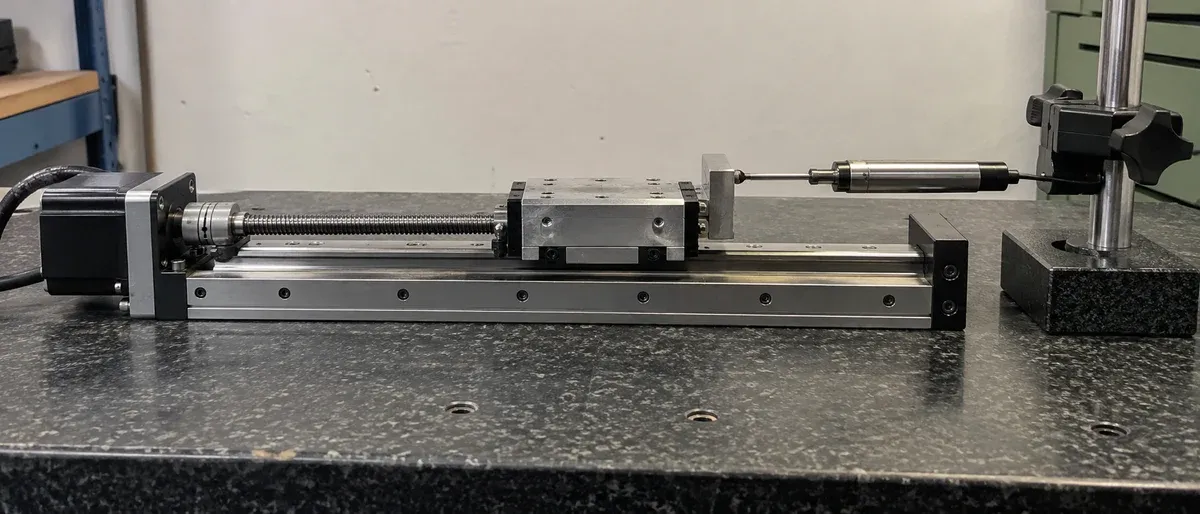
A stage crossing its target once is not necessarily ready for an exposure, dispense or measurement. A useful settling-time requirement specifies how close the observed point must be to its intended position and how long it must remain there. It also states when the timing begins.
Aerotech’s motion-functions documentation illustrates an in-position condition based on distance and time parameters. That is a controller-specific example. The test plan for an application must still identify the actual measured signal and the physical point whose stability matters.
Write the timing rule before collecting traces
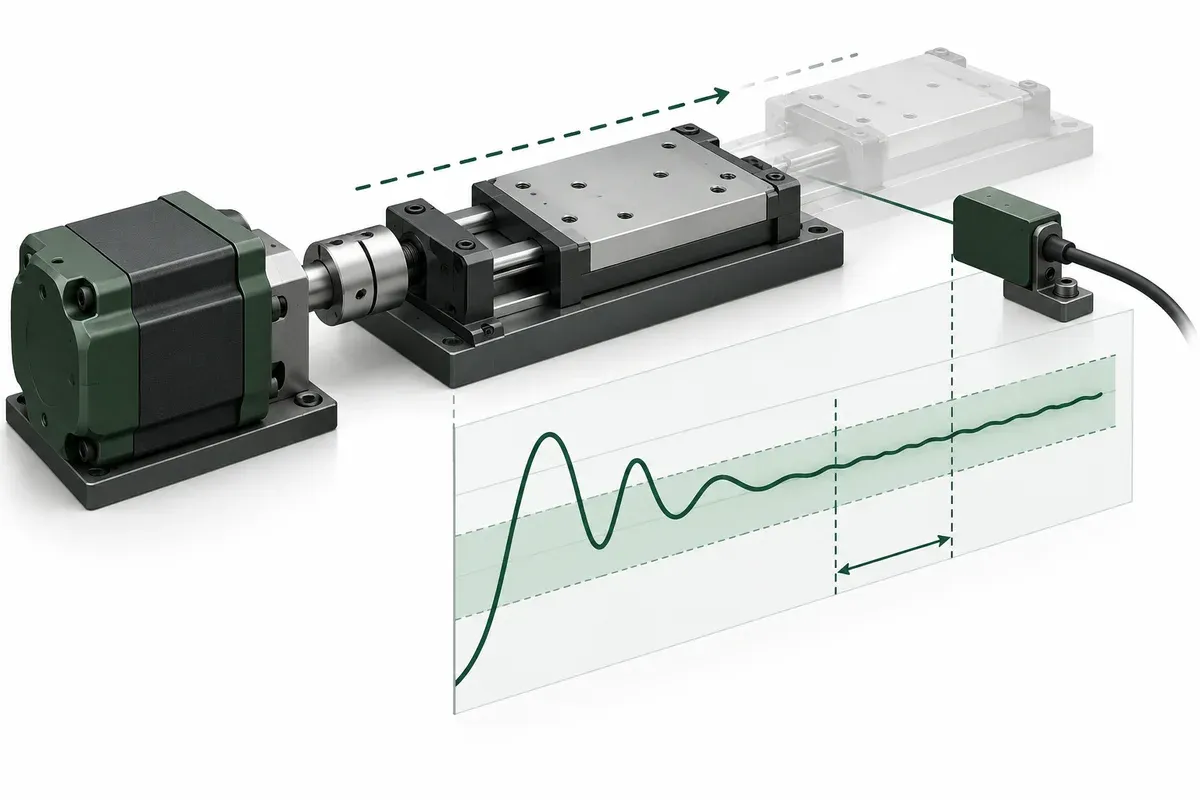
Define the target or reference line, the tolerance band’s units and whether its width is total or plus-or-minus. Specify the continuous dwell required inside the band. Then define the time origin: command issue, trajectory completion or another observable event. These choices change the reported duration, so they belong beside the result.
Decide what happens if the trace leaves the band after an initial entry. A rule might restart the dwell timer or mark the move unsuccessful within the observation window. Agree the rule in advance. Do not stop recording at the first favorable crossing and silently assume the point remained stable afterward.
State the maximum observation interval and how an unsettled move is reported. A timeout is not a settling-time measurement equal to the timeout duration. It is evidence that the defined condition was not established within that window. Preserve the complete trace so the reviewer can distinguish overshoot, vibration, drift and acquisition problems.
Match measurement bandwidth to the process
Record sample rate, sensor bandwidth, filtering and any averaging. A heavily smoothed trace may appear to settle sooner than the original observations. Conversely, a sensor noise floor can make a band impossible to assess. Explain why the acquisition settings are appropriate for the event the application needs to begin.
Measure at the relevant workpiece or sensor location when practical. A controller’s following-error channel and an external displacement measurement can be useful together, but they do not necessarily observe the same point. Keep both channels labeled and synchronized. Do not use the command trajectory itself as evidence that the physical load has stopped moving.
Define the move profile, distance, direction, payload, orientation and mounting. Include cable and hose configuration when it affects the installed process. Test representative moves rather than only the easiest short excursion. A single best-case time does not characterize a machine that performs a range of trajectories.
Hypothetical example: triggering a camera
Imagine a camera exposure scheduled after each indexing move. The team proposes an illustrative band of ±2 µm at the camera’s relevant measurement point and a continuous 20 ms dwell. These are hypothetical planning values, not recommended thresholds or claims about any stage. The time origin is explicitly set to commanded trajectory completion.
A trace enters the band, briefly exits, and then remains inside. Under the proposed rule, the earlier entry does not qualify; the continuous dwell starts again after re-entry. The team separately checks whether stability persists during the exposure interval. A controller flag can be recorded for comparison, but it does not replace the camera-point observation.
Practical checklist for settling-time evidence
- State the time origin and how it is synchronized to acquisition.
- Define the band, units and plus-or-minus versus total-width convention.
- Specify continuous dwell and behavior after a band exit.
- Identify the physical observation point and signal channel.
- Preserve raw and processed traces with their filter settings.
- Record the complete move profile and installed payload configuration.
- Report timeouts and failed observations explicitly.
Keep uncertainty in position and timing visible; NIST’s reporting guidance provides a reporting framework. Refer to the specification guide for the distinct static positioning terms. Settling verification adds a time-dependent acceptance question, and its answer is meaningful only with the band, dwell and measurement conditions attached.
Questions
Is the first entry into a tolerance band the settling time?
Only if that is the agreed definition. A useful plan commonly also requires a continuous interval inside the band to reject brief crossings.
Does an in-position flag prove a camera is stable?
Not by itself. The flag uses the configured control-system signal; the camera or workpiece may need independent observation.
Can settling time be compared across different move lengths?
Only with the move profile and other conditions made explicit. Different trajectories can answer different application questions.
Sources & scope
Sources support the specific points described below. General engineering guidance and third-party examples do not establish a catalogue model's performance or suitability.
- Aerotech Automation1: Motion Functions
Aerotech describes in-position behavior using both distance and time parameters.
Accessed - NIST TN 1297: Reporting Uncertainty
Uncertainty and its basis should be stated for reported measurements.
Accessed
Related engineering resources
Continue reading
Accuracy & Metrology
Accuracy, repeatability and resolution: three separate acceptance questions
Turn accuracy, repeatability and resolution into separate acceptance requirements, with a worksheet for evidence, conditions and decisions.
Verification guide · 4 min read ·Accuracy & Metrology
Assessing velocity stability and following error during a scan
Plan scan-motion measurements with explicit trajectory definitions, acquisition bandwidth, payload and processing for velocity and following error.
Verification guide · 4 min read ·From requirements to a quotation
Review your stage requirements
Share the motion envelope, payload, orientation and acceptance criteria. Request confirmation of the exact configuration before ordering.
Request a Quote