Key takeaways
- A right-angle bracket does not establish vertical suitability.
- Review the complete load path and loss-of-power behavior separately.
- Use approved installation information for the exact axis and orientation.
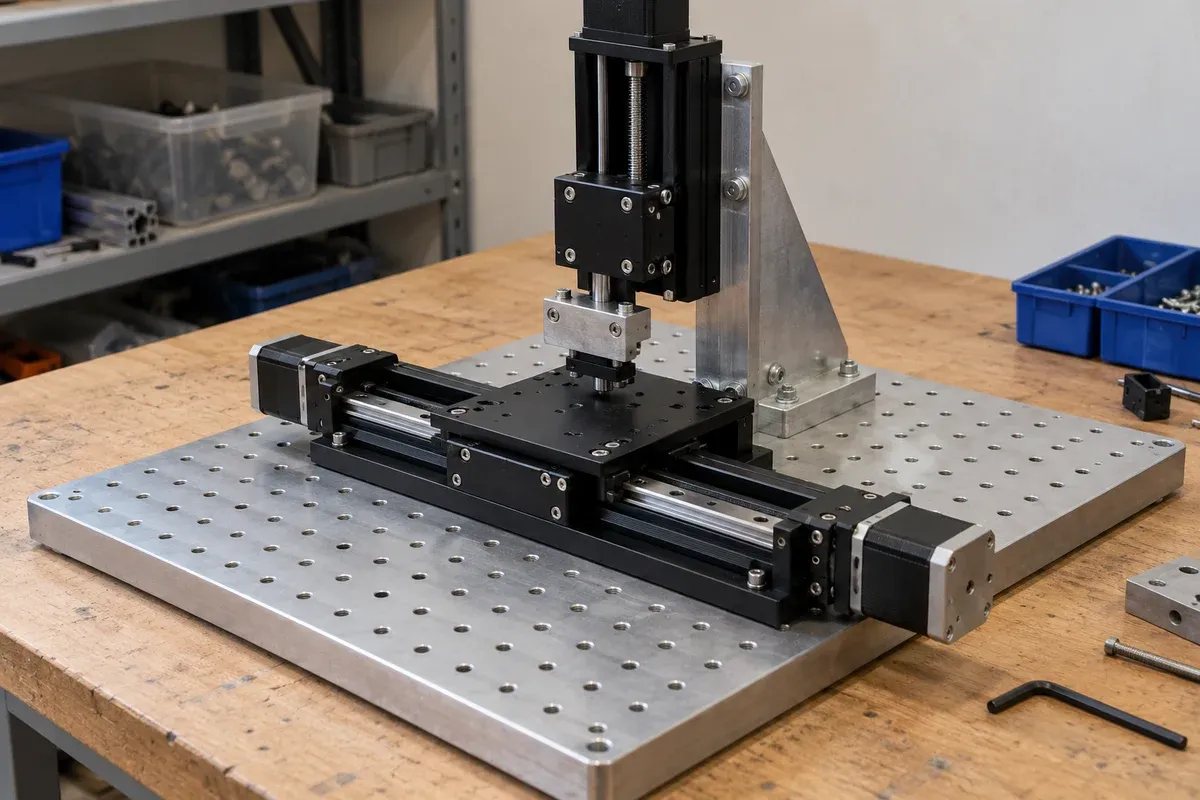
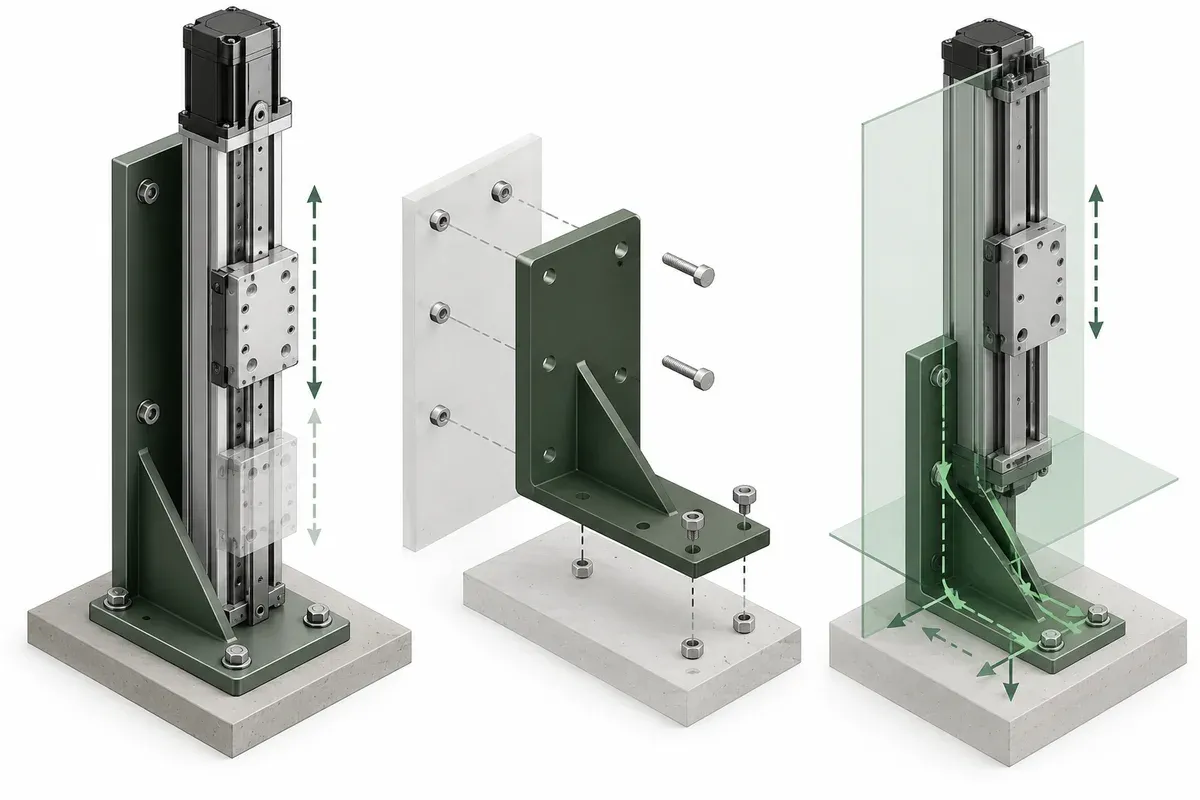
A right-angle bracket turns an attachment face through an angle; it does not convert every horizontal stage into an approved vertical axis. Before detailing the bracket, separate three questions: whether the stage is suitable for the orientation, whether the support structure can carry the proposed assembly, and whether the complete machine addresses gravity-related risks.
Confirm the orientation before designing around it
Send the proposed stage orientation and payload arrangement for review at the concept stage. Include which platform moves, where the motor sits and how the assembly is supported. A generic statement that a stage is capable of motion is not evidence of suitability for lifting or holding a particular payload.
Request the relevant installation and loading documentation. If the available catalogue provides only a general load figure, keep vertical suitability unresolved. Do not infer it from screw type, motor size or the appearance of an existing product photograph. A dedicated vertical-lift architecture may be worth comparing, but it also needs configuration-specific assessment.
Trace the bracket’s complete load path
Draw the path from workpiece through holder, moving platform, stage base, bracket and supporting structure. Include every joint. A strong-looking upright plate can still be connected through an unsuitable base interface or carry the load at a large offset.
Provide the mechanical reviewer with geometry, materials under consideration, mass distribution and intended motion. Identify external process forces if present. The reviewer should establish the structural and joint requirements; this article supplies neither a bracket thickness nor a fastener torque. Treat preliminary CAD as a concept until those requirements are resolved.
Keep installation and service access visible
The bracket must permit the approved mounting method for both its faces. Show fastener entry directions, head clearances and tool approaches. Include access to connectors, covers and the components that must be inspected or replaced. A gusset or reinforcing feature can occupy exactly the space a mounting tool requires.
Model-specific translation-stage brackets illustrate that vertical arrangements rely on defined interfaces. They are examples of documentation practice, not compatibility evidence for another manufacturer’s stage or a custom bracket.
Avoid writing an informal assembly sequence that asks someone to support a suspended payload while adjusting a joint. Installation, handling and maintenance procedures must be developed by qualified personnel for the actual equipment and its risks.
Vertical-bracket review checklist
- Confirm exact stage identity and proposed mounting orientation.
- Obtain applicable loading and installation requirements.
- Draw every joint from the payload to the fixed support.
- Include all carried masses, offsets and external forces.
- Show fastener access and service-removal space on both faces.
- Identify gravity-related behavior requiring system-level assessment.
- Record structural-review ownership and unresolved assumptions.
- Compare a dedicated lift if it offers a more suitable layout.
The design record should distinguish mechanical support from controlled motion and holding. Approval of a bracket drawing is not automatically approval of the drive’s behavior when power is removed or when a fault occurs. Those topics need explicit ownership in the overall machine review.
The fixed support deserves the same attention as the bracket. Identify where it attaches to the machine and whether its drawings and inspection records are available. If that structure belongs to another team, establish an interface owner before releasing the bracket. A local bracket calculation cannot independently approve a machine frame, its joints or the way the complete assembly is installed. Include the support attachment in the interface register, with its drawing revision and unresolved requirements clearly identified for the responsible structural reviewer.
Hypothetical example: a side-mounted focus axis
Imagine a camera focus concept with a small linear stage mounted on the upright face of an L-shaped bracket. The initial CAD model fits within the enclosure. Review reveals that the camera holder projects well forward and that a reinforcing rib blocks access to a stage mounting screw.
The team revises the interface concept and asks for vertical-orientation information before selecting the stage. It also assigns the gravity-related system questions to the machine designer. This hypothetical example demonstrates a review sequence, not a validated bracket or a safe installation procedure. A resolved package must connect geometry, loading, installation and system behavior for the exact configuration.
Questions
Can any linear stage be mounted vertically on a bracket?
No. Vertical suitability and loading must be confirmed for the exact stage, drive and configuration.
Can a thicker bracket solve every concern?
No. Joint behavior, support attachment, offsets, clearance and the axis itself remain part of the assessment.
Does a bracket prevent a payload from descending after power loss?
A bracket does not establish holding behavior. That question requires a separate system-level review and documented provisions.
Sources & scope
Sources support the specific points described below. General engineering guidance and third-party examples do not establish a catalogue model's performance or suitability.
- Thorlabs translation-stage mounting interfaces
Illustrates that mounting plates and brackets have model-specific interfaces; does not establish compatibility with this catalogue.
Accessed
Related engineering resources
Continue reading
Mounting & Mechanical Integration
Checking the support surface before installing a precision stage
Organize a support-surface readiness review around documented requirements, contact geometry, surface condition and traceable inspection evidence.
Integration guide · 4 min read ·Mounting & Mechanical Integration
Choosing the order of an XYZ stack
Compare XYZ stack arrangements through moving mass, payload offsets, working height and access before selecting a mechanical layout.
Integration guide · 4 min read ·From requirements to a quotation
Review your stage requirements
Share the motion envelope, payload, orientation and acceptance criteria. Request confirmation of the exact configuration before ordering.
Request a Quote