Key takeaways
- Agree the incoming test and decision rule before delivery.
- Measure the relevant payload point with documented reference instrumentation.
- Preserve raw observations, setup details and unresolved deviations.
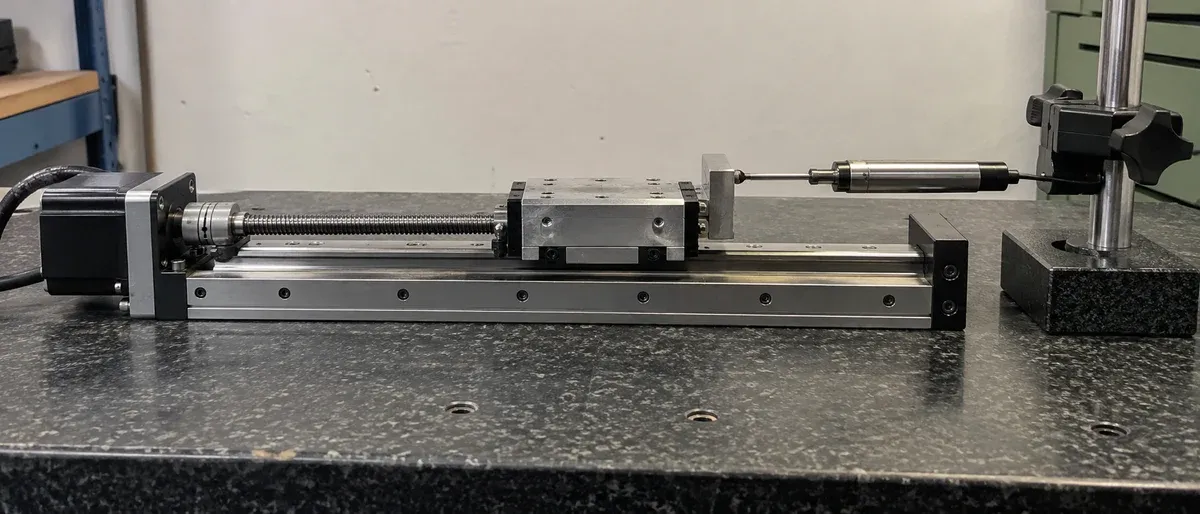
Agree what incoming acceptance will establish
An incoming test can establish whether an identified stage and controller configuration meet an agreed requirement under recorded conditions. Begin with the purchase requirement, then choose the measurement and decision rule. A shipping inspection does not establish positioning accuracy, repeated-return behavior or the smallest useful physical motion; each needs its own evidence.
Use the catalogue basis guide and current quotation to separate documented values, derived values and unconfirmed claims. Agree the working range, payload point, responsibilities and unresolved requirements before delivery. The two worksheets below are original planning aids to adapt with the responsible engineer, not a certified test procedure.
Build an acceptance matrix before running the stage
Give each selected characteristic its own requirement identifier, agreed limit and decision rule. Leave an untested characteristic marked not evaluated, even if adjacent checks pass. The matrix specifies what to agree; it supplies no universal limits or repetition count.
| Characteristic | Procedure and conditions to agree | Evidence and decision boundary |
|---|---|---|
| Received condition and configuration | Compare model, serial numbers, accessories, hardware, firmware and compensation files with the order before changing settings. | Received-condition photographs and configuration snapshot; resolve discrepancies separately from motion performance. |
| Safe functional travel | Define the permitted motion envelope, approach and stopping allowances, limit behavior and operating settings using the applicable documentation. | Motion and event log for the agreed envelope; successful travel alone is not an accuracy result. |
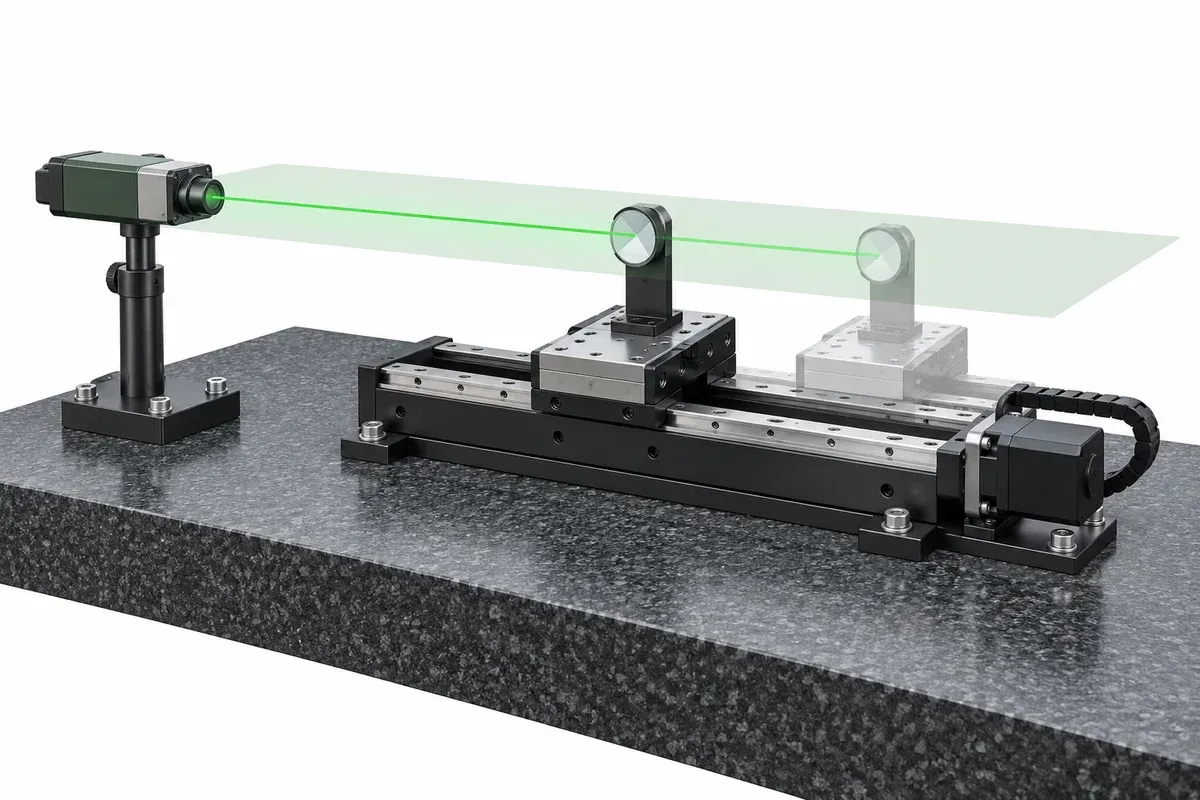
| Positioning error | Agree target coordinates, arrival direction, load, measurement line, settling/acquisition method and independent physical reference over the required region. | Preserve command and reference readings with their coordinate transformation; compare the defined error metric using the agreed uncertainty treatment and decision rule. |
| Repeated-return behavior | Return to the same targets under a declared approach policy; distinguish same-direction arrivals from reversals and keep the homing policy fixed. | Retain every return reading and the agreed summary of their spread; a narrow spread does not establish a small positioning error. |
| Homing or restart behavior | Define the restart sequence, which reference is re-established and which configuration is retained; evaluate it separately from uninterrupted returns. | Before/after physical-reference readings linked to restart events; conclude only for the restart sequence actually tested. |
| Resolution and small physical motion | Distinguish the command increment from measured response; agree local position, step sequence, acquisition and reference capability for the intended motion. | Record requested increments and independently observed displacement; a changing display does not establish physical motion. If the setup cannot resolve it, mark that characteristic not evaluated. |
Prepare the fixture and reference chain
Record the received condition before commissioning makes a discrepancy indistinguishable from a later change. Select reference instrumentation for the required range, uncertainty and physical measurement location. A full-travel positioning experiment and a local small-motion experiment may need different arrangements.
Name the functional point on the workpiece or payload, the fixed reference base, and the sensing line’s direction and offset from that point. Save a dimensioned setup sketch or annotated photograph. If the fixture permits measurement only at a substitute point, explain the relation to the functional point and what remains unverified. The controller’s encoder readback is useful diagnostic information; it is not an independent physical reference at the workpiece.
Prepare a safe motion envelope with approach and stopping distance. Confirm units and total travel: a ±15 mm coordinate range spans 30 mm total. A nominal travel figure does not authorize motion into hard stops. Check permitted controller settings against the applicable documentation before an automated sequence.
Write a reproducible sequence and raw observation register
Specify warm-up, environmental recording, load, orientation and cable routing. Choose targets that represent the agreed working region and application-critical locations. Define arrival direction, speed, acceleration, dwell and acquisition interval. Agree the repetition count and its rationale for the intended conclusion; there is no single count suitable for every requirement.
Keep homing and compensation policy explicit. A baseline with one initial reference, a test with repeated homing and a restart test answer different questions. Label them separately. Record whether compensation is enabled and retain the file identity rather than comparing undocumented configurations.
Use one observation identifier to join the following fields. These are register fields, not example measurements. Keep native files as well as any analysis export.
| Register group | Fields to retain | Why they belong in the report |
|---|---|---|
| Run and configuration identity | Run ID, operator, stage/controller serials, firmware, settings snapshot and compensation-file identity. | Connects readings to one reproducible configuration. |
| Geometry and coordinate basis | Workpiece/payload point, sensing line and offset, reference base, coordinate zero, sign convention and any transformation. | Shows where and in which coordinate frame position was measured. |
| Commanded position | Target ID, command value, unit and command time. | Records the requested position without presenting it as a measurement. |
| Controller readback | Raw value, channel/encoder identity, unit and acquisition time; state when unavailable. | Keeps internal feedback distinct from the command and independent reference. |
| Independent physical reference | Raw reading, unit, acquisition time, instrument identity, calibration reference and uncertainty-budget version. | Preserves the physical evidence used in the stated position or displacement calculation. |
| Motion and conditions | Cycle/return index, arrival direction, speed, acceleration, dwell, homing/restart event, load and environment record. | Allows comparisons only between compatible conditions. |
| Validity and disposition | Valid/invalid status, reason, interruption or deviation, original-file link, analysis revision and linked retest ID. | Makes exclusions and later decisions traceable without deleting observations. |
Keep invalid runs, failures and retests distinguishable
Define invalid-run conditions before testing, such as lost reference acquisition or an unplanned fixture disturbance. Preserve the affected data and explain the reason and affected interval. An unfavorable reading from an otherwise valid run is not a reason to invalidate it. If a stop or interruption prevents completion, report the missing scope instead of treating it as passed.
Agree who may authorize a retest, the cause to address and which sequence to repeat. Link the retest to the original run and report both. A changed mounting, load, cable route, firmware, settings or compensation file needs a new configuration identity and a decision about which affected characteristics require re-evaluation; do not silently combine readings from before and after the change.
Separate raw observations, calculated summaries and acceptance conclusions. Following NIST’s uncertainty-reporting guidance, state either combined standard uncertainty u_c or expanded uncertainty U with its coverage factor k, and explain the components and evaluation basis. Do not infer a coverage probability from k alone. The uncertainty statement supports interpretation; the contractual decision rule still determines how the result is judged. Use distinct dispositions for pass, fail, inconclusive and not evaluated, with the reason and remaining action stated.
Hypothetical example: a short inspection window
Suppose a machine uses only the central portion of a longer stage for inspection. The buyer proposes local acceptance there plus a basic motion check over the remaining permitted stroke. These are separate objectives: the local measurement does not establish full-travel positioning performance. No measured value or acceptance threshold is implied.
Before delivery, supplier and buyer agree whether that scope is sufficient and identify the camera mounting height and intended cable loop. If the fixture changes before installation, the incoming report describes only its recorded setup; the installed process may need its own verification. The responsible engineer must confirm the actual method and applicable contractual or standards requirements.
Questions
Is a shipping inspection the same as an accuracy test?
No. Damage and configuration checks are useful first steps, but they do not quantify positioning performance.
Must every test cover the full travel?
Coverage should match the agreed requirement. Clearly label any test restricted to a local working region.
Can the controller position readout be the only reference?
It may support diagnostics, but it is not independent evidence of physical position at the payload point.
Sources & scope
Sources support the specific points described below. General engineering guidance and third-party examples do not establish a catalogue model's performance or suitability.
- NIST TN 1297: Reporting Uncertainty
Archival guidance on reporting uncertainty and its basis; not an acceptance test or decision rule.
Accessed
Related engineering resources
Continue reading
Accuracy & Metrology
Accuracy, repeatability and resolution: three separate acceptance questions
Turn accuracy, repeatability and resolution into separate acceptance requirements, with a worksheet for evidence, conditions and decisions.
Verification guide · 4 min read ·Accuracy & Metrology
Assessing velocity stability and following error during a scan
Plan scan-motion measurements with explicit trajectory definitions, acquisition bandwidth, payload and processing for velocity and following error.
Verification guide · 4 min read ·From requirements to a quotation
Review your stage requirements
Share the motion envelope, payload, orientation and acceptance criteria. Request confirmation of the exact configuration before ordering.
Request a Quote