Key takeaways
- Support, damping and isolation address different mechanical relationships.
- Define disturbance source, transmission path and process receiver before comparing treatments.
- Resonance can amplify response; passive or active labels do not establish performance.
- Require frequency, payload, geometry and measurement definitions with the installed-system evidence.
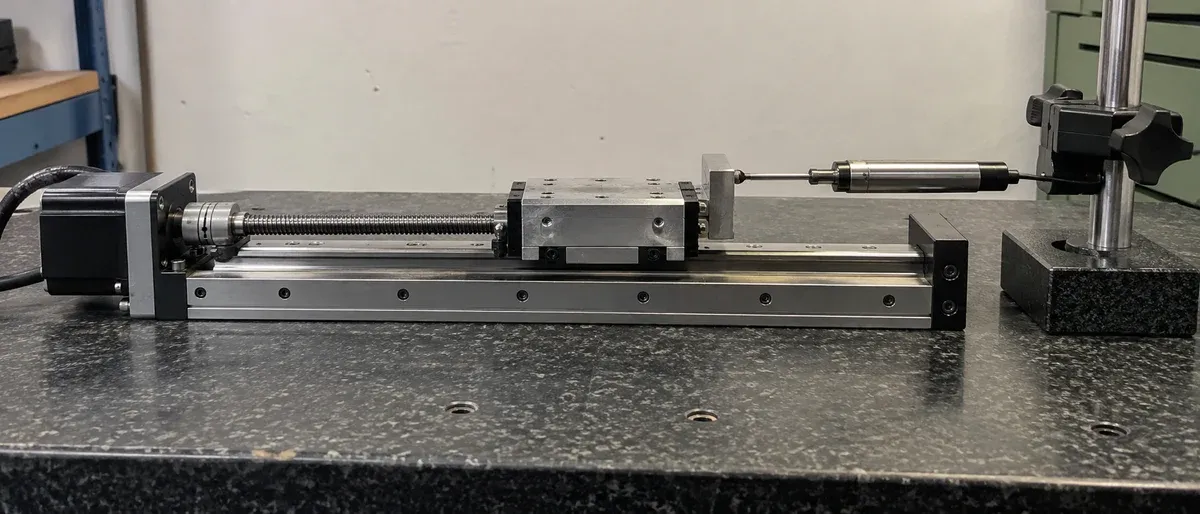
Stage fixtures depend on a chain of structures: floor or machine frame, support, baseplate, stage, adapter and workpiece. A disturbance can enter at several points, and the useful measurement may be relative motion between the workpiece and a probe or optical reference. Calling the entire problem “vibration” does not identify which relationship needs improvement.
This guide develops a buyer’s requirements brief for stage-support vibration control. It does not recommend an isolator model, guarantee an attenuation or settling result, diagnose a motor fault or provide an installation procedure.
Define support, damping and isolation separately
Support carries the load and maintains the intended geometry. Its stiffness describes resistance to deformation under force or moment. Flatness, alignment and attachment remain important, but a flat support does not establish its response during motion or disturbance.
Damping dissipates mechanical energy and affects how oscillation decays. Isolation reduces transmission between a source and a receiver over a stated range of conditions. A damping treatment within a structure and an isolating interface under it therefore address different relationships, although one assembly can contain both.
A vibration isolation system is the supported equipment, its isolating elements, supporting foundation and relevant connections considered together. An active version also includes sensing, control and actuation. The label on one mount is not a description of the complete system. The Newport vibration-control tutorial distinguishes structural response, damping and isolation rather than treating them as interchangeable remedies.
Identify the source, path and receiver
Start with an observable process problem: unstable probe readings during a nearby machine cycle, image movement during exposure, or oscillation after the stage stops. Record when it occurs and what is being measured. A controller’s in-position signal is not automatically evidence that the workpiece-to-instrument relationship is stable.
Draw suspected paths from floor, enclosure, utilities and moving equipment to the functional point. Include connections that cross the proposed isolation boundary. A stiff cable restraint or service hose can introduce another force or transmission path. This drawing is a review input, not proof that a particular path dominates.
Distinguish incoming environmental disturbance from forces generated by the fixture itself. A support treatment intended to reduce floor transmission may respond differently to a stage accelerating on top of it. Ask how the workpiece and measurement reference are supported relative to each other; movement common to both can have a different consequence from movement between them.
Describe frequency, amplitude and measurement meaning
Frequency states how rapidly a component oscillates; amplitude describes the size of the reported motion or other measured quantity. A useful disturbance record retains both time behavior and frequency content where appropriate. “The bench vibrates” is not sufficient for comparing solutions.
Record whether observations are displacement, velocity or acceleration, their directions and locations, and whether amplitudes are peak, peak-to-peak or RMS. Include bandwidth, filtering, acquisition duration, sensor mounting and operating state. A value collected at the floor is not automatically the value at a raised probe tip.
Have the measurement specialist choose a method appropriate to the process. A spectrum can identify frequencies worth investigating, but a peak alone does not identify its source or establish a structural mode. Correlate observations with relevant machine states and retain uncertainty and resolution limits. Do not prescribe an improvised impact or excitation test from a general article.
Understand why resonance changes the decision
Mechanical resonance is a strong dynamic response associated with a system’s natural modes when it is excited in a relevant way. Natural frequencies depend on the installed mass, stiffness and boundary conditions. Changing a fixture, support or payload can therefore change the response even when the stage model stays the same.
ASHRAE’s sound-and-vibration fundamentals explains a simplified supported-mass model in which an isolator can amplify transmission near resonance rather than reduce it. Its building-equipment context supports that physical caution; it does not supply a stage-fixture design or acceptance limit.
Ask the supplier which model and test configuration underlie its curves. A real fixture can have several translational, rocking and structural modes. One vertical natural-frequency entry cannot establish response in every direction. More compliance is not a universal improvement, and increased damping can change response across frequencies rather than improve every part of an isolation curve.
Compare passive and active approaches by function
Passive isolation uses mechanical properties such as mass, compliance and damping without a sensor-driven corrective force for vibration cancellation. An isolator may still need a utility supply or a leveling mechanism. “Passive” does not mean that installation, load distribution or maintenance are irrelevant.
Active vibration control uses measured signals, control electronics and actuators to apply corrective forces. Park Systems describes this detector-controller-actuator arrangement for its isolation products. That functional example does not justify transferring its claimed bandwidth, settling or amplification results to another platform.
For either approach, ask which disturbance directions and frequencies the evidence covers, where the response was measured and under what payload. For active equipment, also ask about actuator authority, sensor range, operating modes, power interruption and interaction with the moving apparatus. A leveling function is not, by itself, evidence of active vibration cancellation. The words “active” and “passive” cannot replace a measured comparison against the process requirement.
Request curves with a declared configuration
Transmissibility compares a stated response with a stated input as a function of frequency. Specify whether the supplier means displacement, velocity, acceleration or force, and identify both measurement locations. Do not combine an incoming-motion curve with an outgoing-force curve as if their definitions were identical.
The payload record should include total supported mass, center-of-mass position, mounting footprint and relevant axis positions. Include the instrument reference, brackets, service routes and supporting floor or machine frame. Ask how closely the evidence represents that installed configuration, including its loading distribution and movement sequence.
This original enquiry matrix makes the comparison reviewable:
| Question | Evidence required |
|---|---|
| What needs to remain stable? | Functional-point and measurement-reference drawing; process observation interval and acceptance quantity. |
| What excites the assembly? | Disturbance observations, direction, operating state, time history and relevant frequency information. |
| What does the proposed treatment change? | Identified support, damping or isolation function and its intended boundary. |
| What was tested? | Payload, geometry, foundation, service connections, sensor locations and curve definitions. |
| What occurs during motion? | Representative moves, recovery observations and effects on the measured process relationship. |
| What remains unresolved? | Evidence gap, responsible supplier or integrator, and condition for acceptance. |
Evaluate the installed process, including transients
In a hypothetical inspection bench, vibration is observed while a nearby pump operates and a second disturbance follows each stage move. Selecting a soft support from a catalogue curve would not establish that both problems are solved. The team first separates the two operating states and measures the relevant workpiece-to-probe relationship.
A proposed passive or active system is then evaluated with the actual moving assembly and service layout. The trial retains observations during operation and after moves, together with the imaging or probe criterion. This example assumes no measured improvement and identifies no suitable product; it shows why an incoming-disturbance specification and motion settling need distinct evidence.
Agree acceptance criteria before evaluating candidate results. Retain unsuccessful conditions and the configuration used. A quieter-looking trace at one sensor location may be useful, but it does not automatically qualify the process at another location or after a payload change.
Close the support enquiry at the correct boundary
Use the specification basis guide to separate catalogue values from measured installed-system evidence. Request stage mounting requirements from the stage supplier, support/isolation evidence from the relevant provider, and integrated verification from the responsible machine team.
Do not infer isolation hardware, a damped base or validated vibration performance from a stage photograph or quotation. Preserve the support drawing, payload and operating conditions with the acceptance record. A later change to tooling, service routing or the measurement reference should trigger a review of which evidence still applies.
Questions
What is vibration isolation in a stage fixture?
It is reduction of vibration transmission across a stated boundary over a stated set of conditions. Assess the supported equipment, isolating elements, foundation and connections together; a mount label alone is not system evidence.
Are a rigid support, damping treatment and isolator interchangeable?
No. Support carries and locates the assembly, damping dissipates mechanical energy, and isolation addresses transmission between source and receiver. One assembly may contain all three functions.
Can an isolator increase vibration?
It can amplify relevant response near a system resonance. Ask for the applicable loaded response and measurement definition instead of assuming improvement at every frequency.
Is active isolation always preferable to passive isolation?
No universal ranking follows from the label. Compare measured response, payload, disturbance spectrum, operating modes, utilities and integration obligations against the same process requirement.
Does this guide diagnose a vibrating stepper motor?
No. It defines fixture support and disturbance evidence. Identifying a motor or drive resonance needs its own configuration-specific investigation rather than an assumed isolation remedy.
Sources & scope
Sources support the specific points described below. General engineering guidance and third-party examples do not establish a catalogue model's performance or suitability.
- Newport: Vibration Control Catalog, Fundamentals Tutorial
Tutorial and glossary distinguish structural vibration, damping, transmissibility and resonance. Qualitative physics only; no vendor performance, design threshold or installation recipe adopted.
Accessed - ASHRAE Handbook: Sound and Vibration
The simplified isolation model shows natural-frequency dependence, possible amplification near resonance and limitations of a rigid-foundation assumption. HVAC examples are not a stage-fixture design standard.
Accessed - Park Systems: Principles of Active Vibration Isolation Technology
Describes sensor signals, control electronics and electrodynamic actuators as an active-isolation example. Its numerical and broad performance claims are not generalized.
Accessed
Related engineering resources
Continue reading
Mounting & Mechanical Integration
Choosing the order of an XYZ stack
Compare XYZ stack arrangements through moving mass, payload offsets, working height and access before selecting a mechanical layout.
Integration guide · 4 min read ·Mounting & Mechanical Integration
Integrating a vertical lift under an existing inspection fixture
Assess a vertical-lift retrofit through installed height, carried assembly, access, travel envelope and evidence needed to preserve inspection function.
Integration guide · 4 min read ·From requirements to a quotation
Review your stage requirements
Share the motion envelope, payload, orientation and acceptance criteria. Request confirmation of the exact configuration before ordering.
Request a Quote