Key takeaways
- A retrofit must include the existing fixture and its interfaces.
- Check minimum installed height as well as available travel.
- Revalidate the inspection relationship after changing its support.
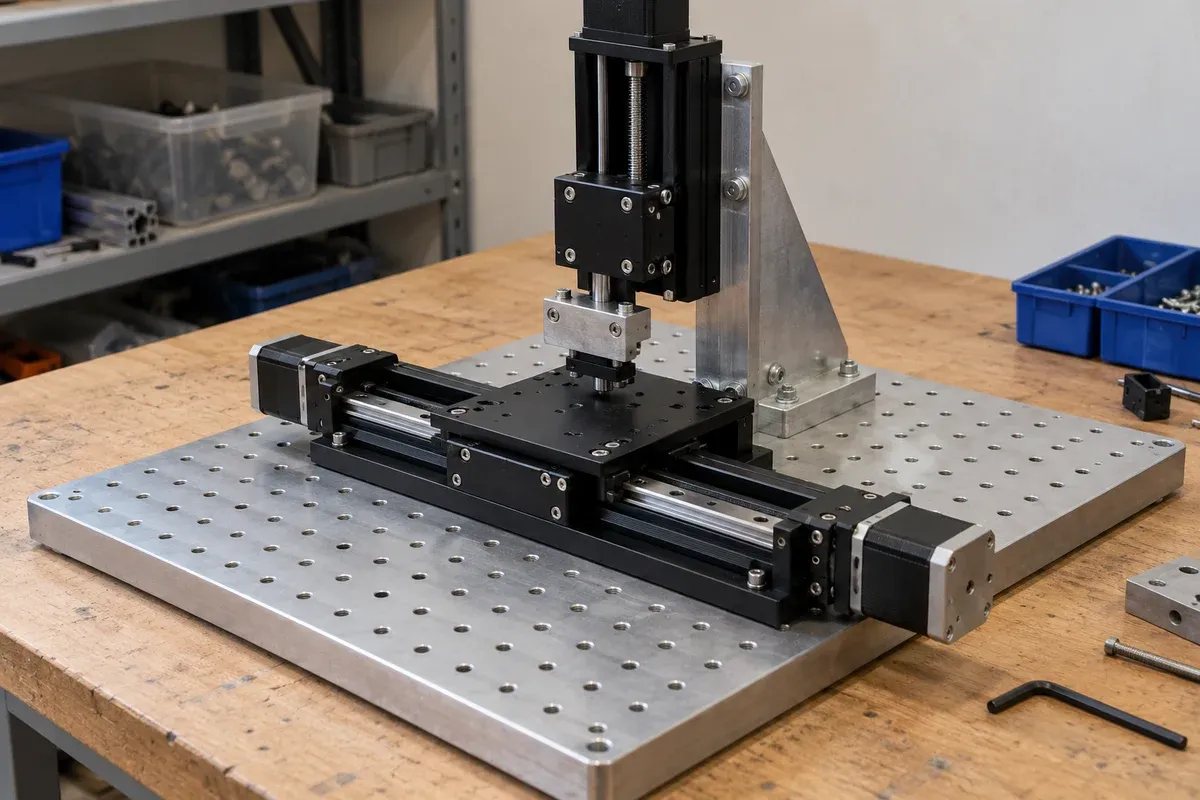
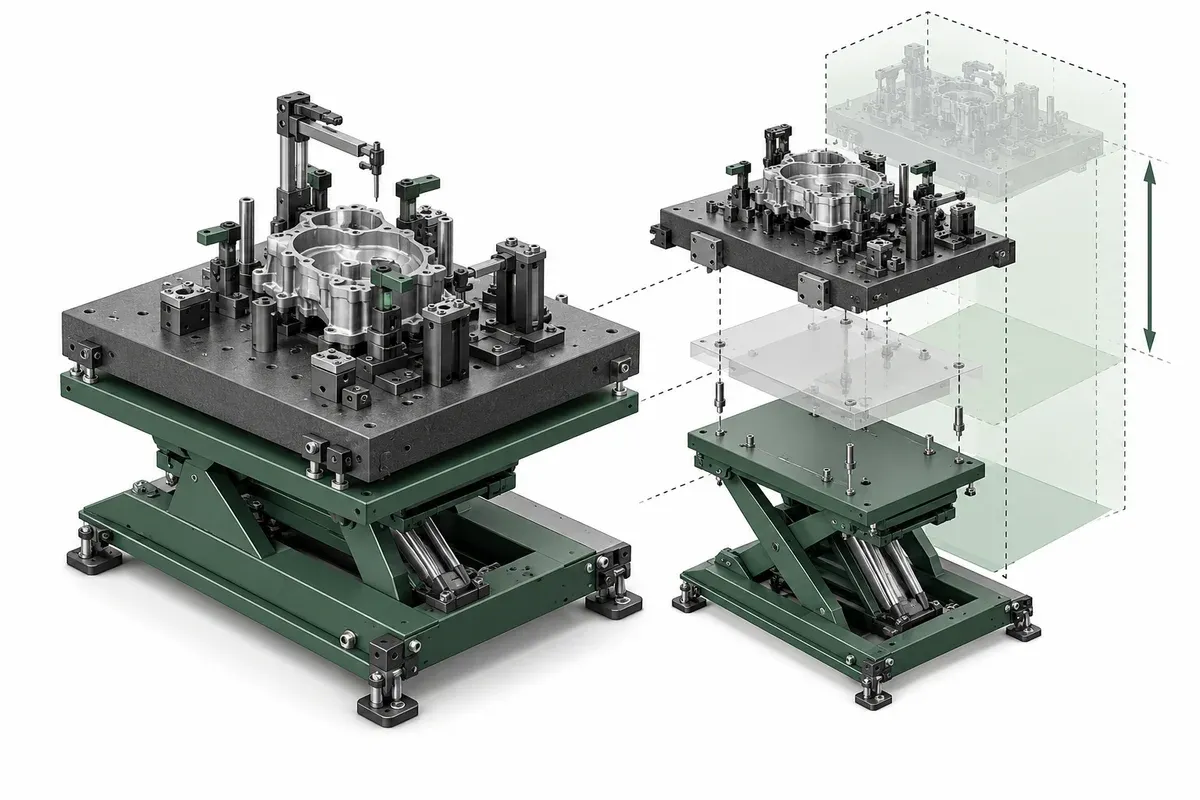
Adding height adjustment beneath an existing inspection fixture can be attractive because it appears to preserve the rest of the equipment. In practice, the new lift changes the support path and the position of everything above it. Treat the retrofit as a revised assembly with defined interfaces, rather than an accessory inserted into an otherwise unchanged machine.
Capture the existing arrangement before changing it
Record the fixture’s current mounting face, attachment pattern, functional reference and installed height. Include the workholder, inspection device and services that depend on the existing geometry. Where drawings are incomplete, identify the information that must be verified rather than reconstructing dimensions from memory.
Document the current inspection task and the conditions under which it is considered acceptable. This creates a baseline for deciding what the retrofit must preserve. A convenient new height range is not useful if the change makes the original part-loading or measurement arrangement impractical.
Compare installed heights and required adjustment
Identify the lowest and highest working configurations needed by the application. Then include the lift’s documented installed geometry, adapters and fixture in the proposed height chain. Travel alone cannot answer whether the lowest required position remains reachable.
Keep process adjustment separate from clearance or tooling exchange. If different workpieces need different heights, list them explicitly. Include the surrounding inspection optics, probe reach or camera working arrangement in the review without assuming that a mechanical height match establishes instrument compatibility.
The vertical-lift catalogue contains candidate architectures. Exact-model drawings and configuration information are needed to determine whether one can fit the existing interfaces and required range.
Review the complete carried assembly
The lift may support more than the original workpiece: include the full fixture, any horizontal stages, holders, adapters and attached services. Describe their mass distribution and operating positions. If an upper axis moves the workpiece sideways, show how the carried geometry changes.
Ask for loading assessment in the proposed orientation and operating context. Do not equate a catalogue load entry with approval of an offset retrofit assembly. Likewise, do not assume the lift provides a particular holding behavior when power is removed. System behavior and gravity-related risks require explicit review by the responsible machine designer.
Retrofit assessment checklist
- Capture the existing mounting and functional-reference geometry.
- Identify the required lowest and highest working positions.
- Include all adapter and fixture height contributions.
- Inventory the entire assembly carried by the lift.
- Check enclosure, loading and service access throughout travel.
- Review cable and hose transitions created by the new motion.
- Define which inspection checks must be repeated after integration.
- Record approval ownership for the modified configuration.
A multi-axis accuracy discussion distinguishes component behavior from assembled geometry. Applied narrowly here, that means the old inspection result should not be treated as automatic evidence for the modified fixture. The actual functional relationship needs a suitable verification plan.
Review the consequences for existing calibration or setup records. The retrofit may alter a reference relationship even when the same camera and workholder remain installed. Identify which records describe the old configuration, retain them as the baseline and define the evidence needed for the revised one. Do not silently relabel earlier results as measurements of the modified assembly. Record who authorizes return to the intended inspection use after those checks.
Hypothetical example: adding focus adjustment under a part nest
Suppose a fixed part nest sits below a camera, and a team proposes inserting a lift beneath it to handle parts of several heights. The lift has enough nominal travel, but the added installed height would place the tallest part too close to the camera at the lowest position.
The team compares a revised support structure with other layout options and reviews the complete load and service arrangement. It also plans to repeat the relevant inspection checks after the change. This fictional example supplies no suitable model, safe clearance or focus-performance claim. It illustrates why travel and installed height must be considered together.
The useful retrofit enquiry includes the existing arrangement, proposed change and conditions that must remain satisfied. That package allows the discussion to focus on integration feasibility rather than selecting a lift solely by its stroke.
Questions
Can a lift be added without changing the inspection setup?
Do not assume so. It changes height, loading and the mechanical reference path, which may affect the inspection arrangement.
Is travel the only dimension needed for a retrofit?
No. Installed height, support footprint, attachment geometry and the surrounding envelope also matter.
Does the existing fixture approval cover the lift?
Usually it addresses a particular configuration. The change needs review against the original approval scope and application requirements.
Sources & scope
Sources support the specific points described below. General engineering guidance and third-party examples do not establish a catalogue model's performance or suitability.
- Zaber multi-axis accuracy guide
Supports the narrow general principles that reference frames, assembly alignment and tool-point offsets matter; no system performance is inferred.
Accessed
Related engineering resources
Continue reading
Mounting & Mechanical Integration
Evaluating support, damping and vibration isolation for stage fixtures
Define stage-fixture vibration problems through support, damping, isolation, disturbance paths and configuration-specific measurement evidence.
Integration guide · 7 min read ·
Mounting & Mechanical Integration
Checking the support surface before installing a precision stage
Organize a support-surface readiness review around documented requirements, contact geometry, surface condition and traceable inspection evidence.
Integration guide · 4 min read ·From requirements to a quotation
Review your stage requirements
Share the motion envelope, payload, orientation and acceptance criteria. Request confirmation of the exact configuration before ordering.
Request a Quote