Key takeaways
- Describe the operating task before naming a preferred stage.
- Separate confirmed requirements, provisional assumptions and unanswered questions.
- Request configuration-specific evidence and an itemized supply scope.
Start with the operation the stage must perform
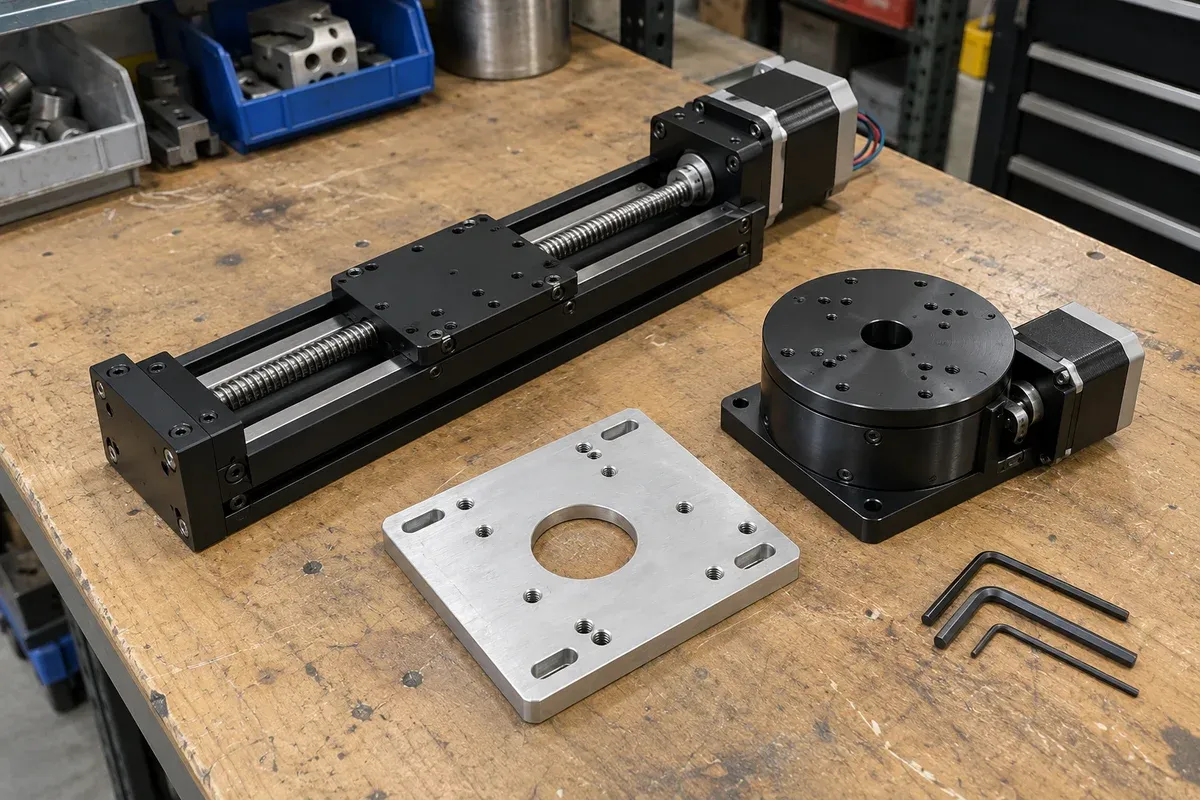
A useful request for quotation lets another engineer reconstruct the task without guessing. Open with one paragraph describing what moves, what remains fixed, and why motion is needed. Include a sketch showing the work point and the available mounting space. A statement such as “position a sample beneath a fixed inspection head” is more informative than “need a precise XY stage,” because it makes the functional relationship visible.
Then distinguish requirements from preferences. A chamber opening may impose a hard width limit; a preferred motor type might be negotiable. Mark provisional values explicitly, and give each unresolved input an owner. This prevents a convenient assumption from quietly becoming the basis of the quoted configuration.
Fill in the motion and geometry block
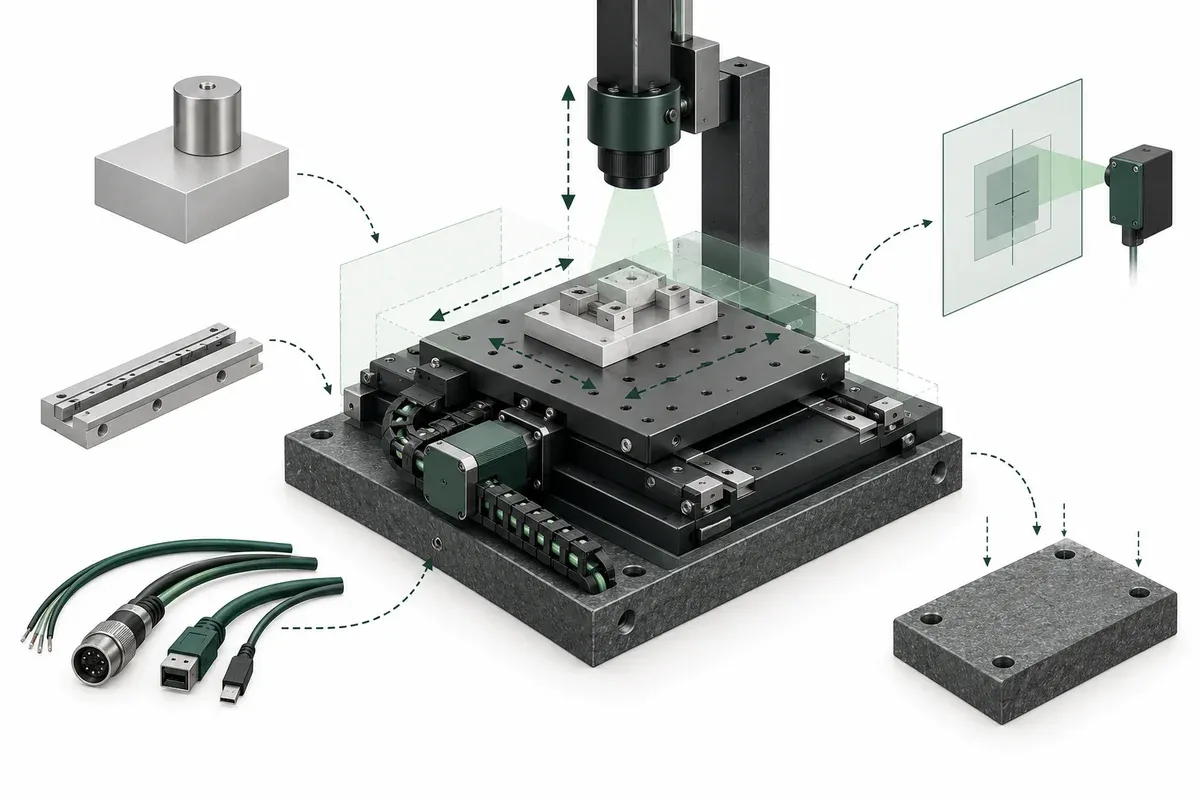
For each axis, provide the required motion direction, total working range, and any loading or clearance positions outside that range. Use one coordinate system throughout the sketch and text. Explain whether angular motion means a bounded adjustment or repeated turns. Do not use “360 degrees” as a substitute for a cable-routing description.
A buyer-fillable motion block can contain:
- Task and work point: what is being positioned, relative to what reference?
- Axis directions: which translation and rotation directions are needed?
- Process positions: where does useful work occur?
- Service positions: where must the mechanism move for loading or access?
- Envelope: what stationary and moving objects limit the installation?
- Sequence: do axes move together, sequentially, or only during setup?
Add a simple sequence of operations. It is easier to assess a concrete sequence than a maximum-speed target detached from move distances and waiting periods.
Describe the complete moving assembly
Provide mass and center-of-mass location for the assembly carried by each axis. A lower axis may carry the upper axis and its motor as well as the final fixture. Show the installation orientation relative to gravity and identify external forces from contact, hoses or cables. If rotary motion is involved, include available inertia information and state the coordinate axis about which it was calculated.
As a hypothetical example, an inspection fixture may carry a 1.2 kg part, a 0.8 kg clamp and a 0.5 kg adapter. Its initial payload entry is 2.5 kg, before adding other carried components. That arithmetic says nothing about whether a particular stage is suitable: offset, orientation and motion requirements remain separate inputs. Attach the calculation rather than leaving the supplier to infer what “payload” includes.
Specify performance at the work point
Write the process need first. Does the mechanism revisit a taught position, move accurately between widely separated coordinates, or search for a signal maximum? Those tasks call for different evidence. On this site, resolution, repeatability and positioning accuracy are distinct terms; the specification guide explains the labels accompanying catalogue values.
Ask where the displacement is measured, which direction the target is approached from, and what load and environment apply. If acceptance depends on a mounted sample, say so. A measurement at a bare platform and one at an elevated fixture are different test arrangements. Specify the result you need to demonstrate without pretending the test procedure has already been agreed.
Include interfaces and the delivery boundary
List the host system, intended command interface, available power arrangements and any existing controller you hope to reuse. Request written compatibility confirmation for the exact hardware and software revisions. A shared connector shape or motor description is not enough information for an integration decision.
Ask the quotation to identify the stage, motor, drive, controller, cables, power supply, mounting adapters and documentation separately. Add the expected drawing revision, deliverable inspection records and any application review still outstanding. Keep shipping arrangements and schedule assumptions visible so that the technical proposal and commercial proposal refer to the same package.
Send a reviewable package
Before issuing the RFQ, have someone unfamiliar with the design read the sketch and complete a short reconstruction: name the moving parts, trace the travel, locate the work point and identify the acceptance measurement. Any question they cannot answer belongs in the package.
Use the stage selector to find possible families, then send the requirements with the shortlist. The outcome should be a documented recommendation with exceptions, not just a part number. Preserve the original RFQ revision alongside the quotation so later changes in payload or layout trigger a deliberate recheck.
Questions
Do I need a final CAD model before requesting a quote?
No. A dimensioned sketch can start the review if it identifies the mounting plane, work point, payload envelope and provisional dimensions. Mark unresolved details clearly.
Should I put only the workpiece mass in the RFQ?
Include the fixture, adapters, carried axes and anything else moving with the platform. Identify cable forces separately where relevant.
Can a catalogue rating become my acceptance criterion?
Only after its definition and operating conditions match your requirement. Agree on the test method and supplied configuration rather than copying a number without its basis.
Sources & scope
Sources support the specific points described below. General engineering guidance and third-party examples do not establish a catalogue model's performance or suitability.
- How to read the specifications
Definitions and the catalogue, derived and not-confirmed labels used on this site.
Accessed - Zaber linear-stage selection guide
Identifies minimum stroke, physical envelope, moving mass and mass-center location as selection inputs. The RFQ structure and example here are original planning guidance.
Accessed
Related engineering resources
Continue reading
Stage Selection & Buying Guides
Compare quotations by included components, options and responsibilities
Compare stage quotations by separating included hardware, optional components, customer responsibilities and the evidence needed for acceptance.
Selection guide · 4 min read ·
Stage Selection & Buying Guides
Choosing a vertical lift instead of mounting a linear stage vertically
Compare a dedicated vertical lift with a vertically mounted linear stage by checking layout, gravity loading, support and configuration-specific evidence.
Selection guide · 4 min read ·From requirements to a quotation
Review your stage requirements
Share the motion envelope, payload, orientation and acceptance criteria. Request confirmation of the exact configuration before ordering.
Request a Quote