Key takeaways
- Choose one optical reference and relate every branch to it.
- Nominal height and height variation across motion are separate checks.
- Reserve adjustment deliberately rather than using travel to hide an unknown stack.
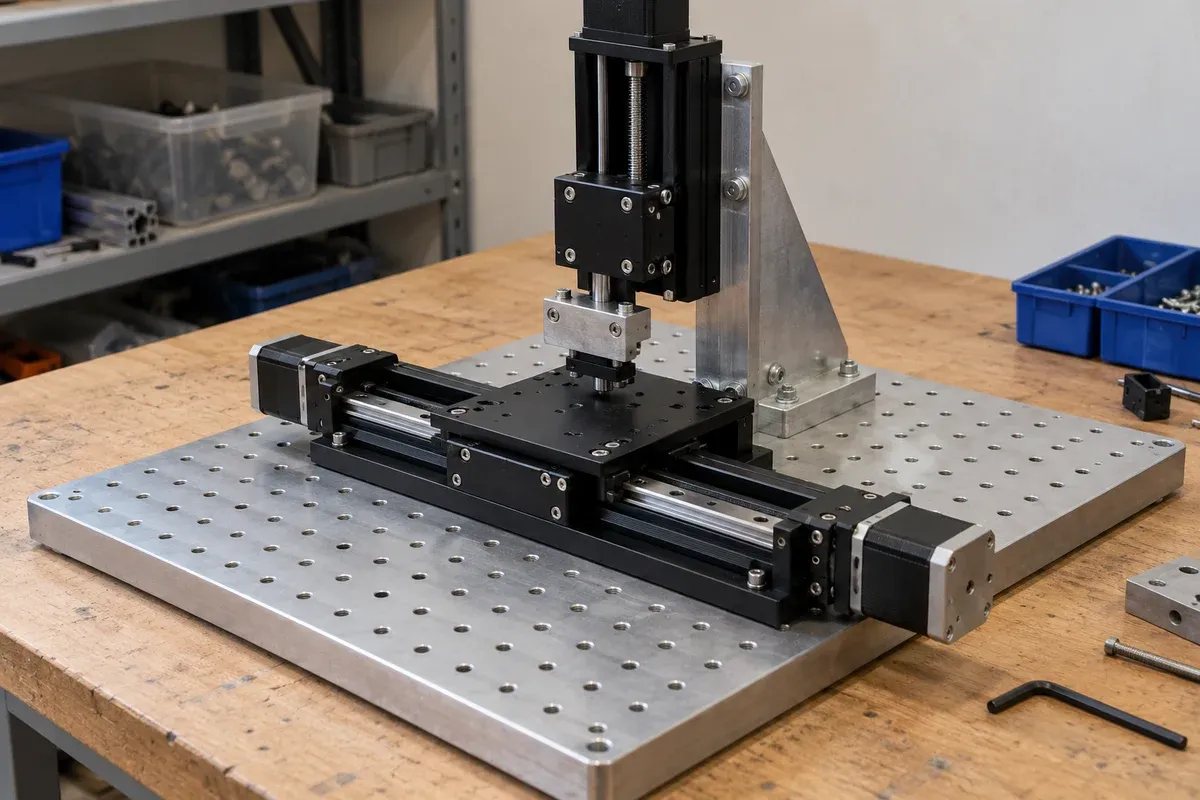
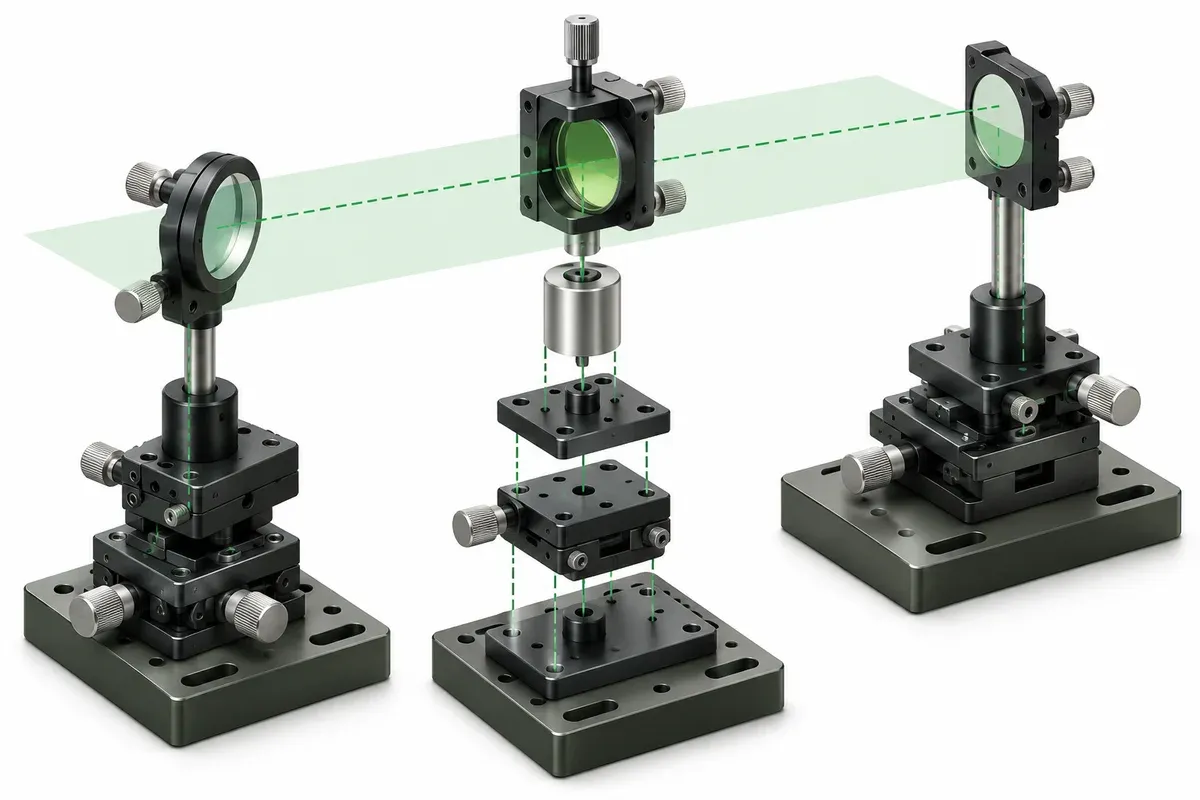
An optical fixture often contains several mechanical branches: a source on one support, a sample on a stage stack and a detector on another. Each can be correctly assembled while their functional heights disagree. A working-height budget connects these branches to one reference and makes the remaining adjustment requirement visible before the parts are built.
Define the optical reference in physical terms
Name the line, plane or feature that establishes the intended working height. It might be a beam axis, a sample surface or an instrument’s documented working reference. Do not use the top of a convenient mounting plate as a substitute unless its relationship to the optical reference is defined.
For each component, identify where its functional reference lies relative to its mounting face. A housing center is not necessarily the optical center. Obtain the relevant drawing or instrument information and mark unknown relationships as open items. The height budget should be traceable to geometry, not inferred from product photographs.
Build a separate height chain for each branch
Starting at the shared mechanical reference, list each base, adapter, stage and holder in sequence. Record the nominal contribution and the applicable configuration. Include pockets, recesses and downward offsets instead of adding every dimension as a positive height.
For adjustable components, distinguish the reference setting from the available adjustment. A stage at an unspecified position does not provide a defined nominal height. State the intended working position and show the adjustment needed on either side for the process, without assuming all nominal travel is available after collision and access constraints.
A height chain is also a useful change-control tool. Replacing a holder may affect only one branch, but it can change the relationship between every optical component. Identify who owns that relationship when different teams design different supports.
Separate nominal alignment from motion-related variation
Matching nominal heights at one position does not establish alignment throughout the work envelope. Ask whether the task depends on height while translating, tilting or changing a workpiece. Define the point of interest and the configurations that need evaluation.
The multi-axis accuracy reference discusses evaluating geometry at the functional point. For this height review, the practical implication is to examine the optical feature rather than only an accessible platform surface. No assembled flatness or optical performance is inferred from the individual stage specifications.
Plan the required measurement with suitable references and agreed acceptance criteria. Do not treat a successful visual alignment at the center position as evidence that all operating positions meet the process requirement.
Optical-height budget checklist
- Name the optical line, plane or feature of interest.
- Establish its relationship to a common mechanical reference.
- List every height contribution in each support branch.
- Mark the reference setting of adjustable components.
- Identify dimensional uncertainties and workpiece variations.
- Reserve the adjustment required by the actual process.
- Review clearance at the proposed working heights.
- Define the positions where assembled height must be verified.
Use the budget to decide which missing dimension matters next. It is more effective to resolve a holder’s unknown optical offset before machining a base than to discover that all available adjustment has been consumed after assembly.
Keep nominal dimensions and their evidence in separate fields. A provisional holder height can be useful for layout, but should remain visibly different from a verified instrument reference. This distinction makes the budget a review aid rather than a collection of numbers that appear equally certain.
Hypothetical example: source and detector on separate supports
Imagine a source mounted on a fixed post and a detector carried by an XY assembly. Both drawings specify the same nominal platform height. The detector’s adapter and holder raise its functional reference above the source line, but those contributions were omitted from the comparison.
The team creates separate height chains, defines the detector’s working reference and compares revised support concepts. It also asks whether the optical relationship must hold across the full XY region. This hypothetical example does not claim optical compatibility or a particular alignment tolerance; it shows how a shared height record exposes a preventable mismatch.
For an optical-module fixture concept, include this height budget with the motion requirements so mechanical and optical discussions use the same reference.
Questions
Is stage platform height the same as optical working height?
No. Holders, adapters and the optical component’s functional reference contribute to the complete height.
Can Z travel compensate for every height mismatch?
Do not assume so. Required range, clearance, loading and the remaining useful adjustment must all be reviewed.
Why check height across XY travel?
The application may depend on the feature’s height throughout motion, not only at one nominal position.
Sources & scope
Sources support the specific points described below. General engineering guidance and third-party examples do not establish a catalogue model's performance or suitability.
- Zaber multi-axis accuracy guide
Supports the narrow general principles that reference frames, assembly alignment and tool-point offsets matter; no system performance is inferred.
Accessed
Related engineering resources
Continue reading
Mounting & Mechanical Integration
Choosing the order of an XYZ stack
Compare XYZ stack arrangements through moving mass, payload offsets, working height and access before selecting a mechanical layout.
Integration guide · 4 min read ·
Mounting & Mechanical Integration
Evaluating support, damping and vibration isolation for stage fixtures
Define stage-fixture vibration problems through support, damping, isolation, disturbance paths and configuration-specific measurement evidence.
Integration guide · 7 min read ·From requirements to a quotation
Review your stage requirements
Share the motion envelope, payload, orientation and acceptance criteria. Request confirmation of the exact configuration before ordering.
Request a Quote