Key takeaways
- Angular coverage and repeated unrestricted turns are different requirements.
- Describe the actual angle sequence, including return and recovery moves.
- Confirm routing and control behavior for the complete assembly.
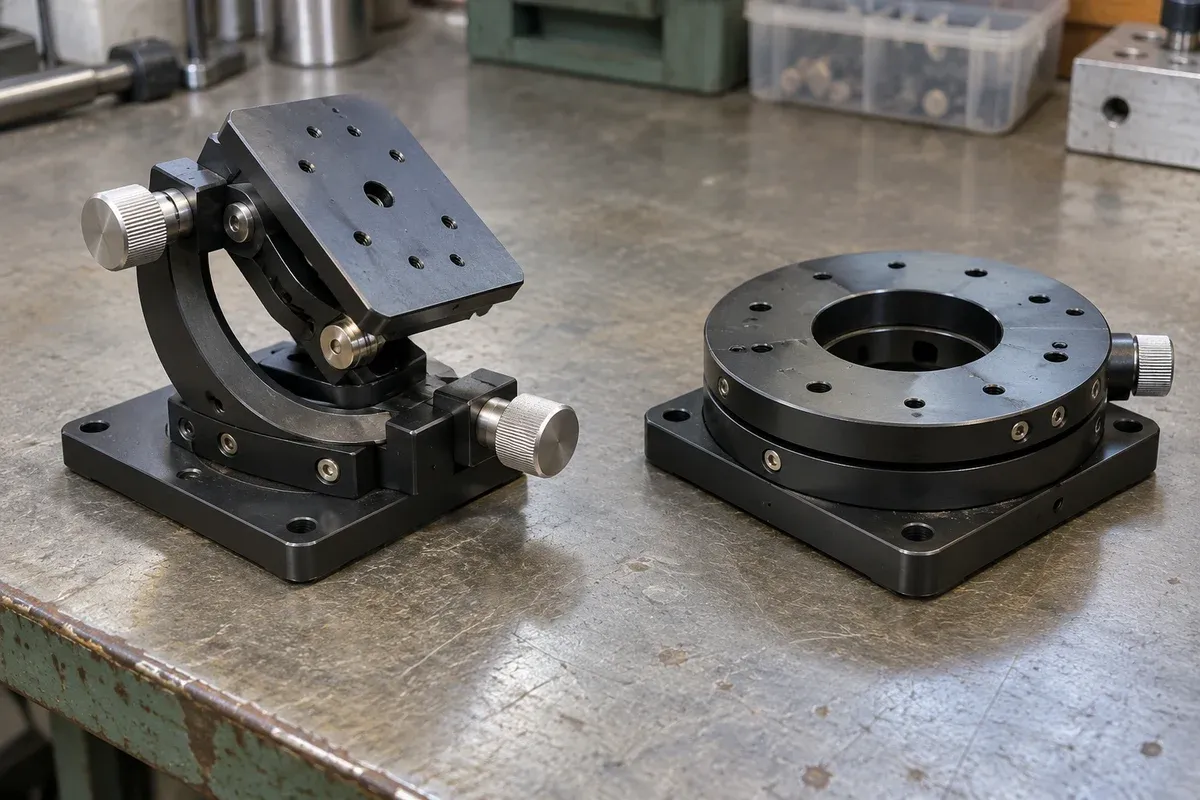
Write the angle sequence before choosing the mechanism
A rotary task is more than a maximum angle. Describe the ordered positions, the permitted direction between them and what happens after the final position. This exposes whether the process needs a small adjustment, a bounded scan, indexing around a circle or repeated full turns.
The rotary-stage family includes both limited-arc and continuous 360-degree models. The useful selection question is which motion sequence the installed assembly can perform. A catalogue range is the beginning of that discussion, not a complete description of the process or its connections.
Separate coverage, accumulated turns and return path
Coverage describes the angles the process must reach. Accumulated turns describe how much rotation builds up without reversing or resetting the routing arrangement. Return path describes how the mechanism gets from the final process angle back to the next starting condition. Keep these as separate fields in the requirement.
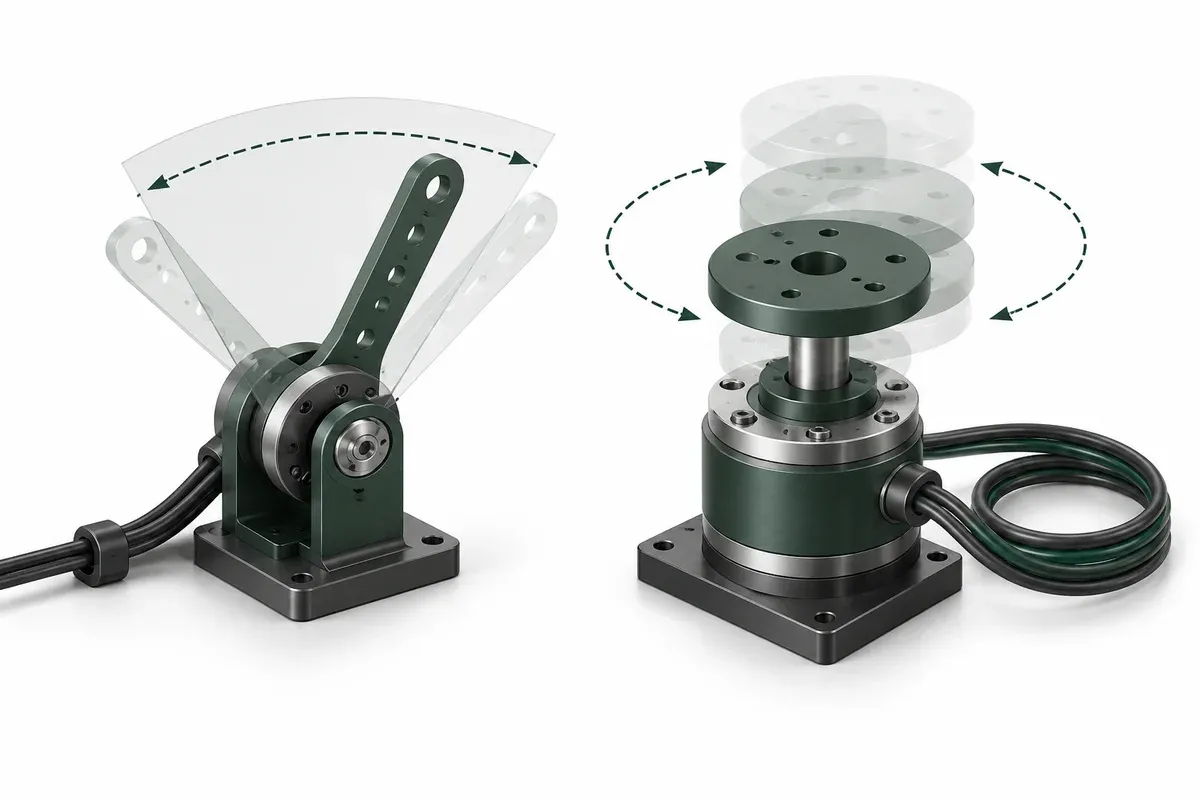
For a hypothetical inspection sequence, suppose a part is viewed at 0, 90, 180 and 270 degrees. One implementation returns from 270 degrees to zero by reversing; another advances through the remaining quarter turn. Both visit the same inspection orientations, but they create different routing and path requirements. Repeating the latter sequence can accumulate turns in attached services unless the design accommodates them.
This example does not prescribe a control strategy. It shows why a request for “four positions over 360 degrees” leaves important questions unanswered. Include the transition sequence in the supplier review.
Identify every connection crossing the rotating interface
List electrical cables, optical fibers, hoses, shafts and any other services connected to the moving fixture. For each one, identify the stationary endpoint, rotating endpoint and proposed path. Ask the component supplier for the permitted motion and environmental conditions rather than inferring them from flexibility or appearance.
A hole through a table can provide access, but it does not itself establish an unlimited-turn connection. Routing through the axis and transferring a service across a rotating interface are different design tasks. If the architecture includes additional transfer hardware, identify its requirements and who validates it. Do not assume such hardware is included with the rotary stage.
Review the complete assembly for obstructions during the allowed path. A fixture may clear at the inspection angles while passing too close to a stationary bracket between them.
Evaluate limited-angle motion on its actual task
For an alignment operation, write the smallest and largest required angles and include setup adjustments. Identify any recovery position needed after a part change. A limited-angle candidate can remain on the shortlist if the verified usable interval covers the complete task and the other requirements are satisfied.
Do not assume that a larger angular range automatically makes a better selection. Compare installed geometry, loading, evidence and the work sequence. Conversely, do not squeeze an unresolved setup requirement into a nominally sufficient limited range just to keep an existing part number.
Record whether the drawing and catalogue express a total angle or a plus/minus half-range. The two notations can describe the same span, but they should be reconciled explicitly.
Ask the control questions without inventing settings
Identify how the application represents position: an orientation within one revolution, an accumulated angle, or another agreed convention. Ask how the proposed system reports and references position after startup or interruption. Confirm the required behavior with the actual controller and configuration.
A review checklist can be brief:
- Ordered target angles and permitted transition directions.
- Number of turns before any return or routing reset.
- Required starting and recovery conditions.
- Services crossing the rotating interface.
- Verified obstruction-free path for the whole fixture.
- Controller behavior and documentation still to confirm.
These are requirements to review, not machine-specific motion commands or safety settings.
Freeze a sequence, not just an angle value
Attach the approved sequence and routing sketch to the quotation request. Ask the supplier to identify any exception for the selected model and delivered components. If the production sequence later changes from reversing scans to repeated forward indexing, reopen the review even if the workpiece and nominal angular coverage stay the same. A complete rotation specification captures how the assembly moves through time as well as where it can point.
Questions
Does a 360-degree rating mean unlimited turns with cables attached?
No. A rotational range description does not establish that attached electrical, optical or fluid connections can tolerate repeated turns.
Can a limited-angle stage serve an alignment task?
It may be a candidate when the complete required angle sequence fits its confirmed usable range. Include setup and recovery positions, not only the nominal process adjustment.
Should an index sequence always use the shortest return path?
That is a system-specific decision. Routing, obstacles and control behavior can constrain the permitted direction. Define the required path and obtain confirmation.
Sources & scope
Sources support the specific points described below. General engineering guidance and third-party examples do not establish a catalogue model's performance or suitability.
- Rotary stages
The catalogue distinguishes limited-arc models from continuous 360-degree rotary models. It does not establish the capability of user-installed cable or fluid connections.
Accessed
Related engineering resources
Continue reading
Stage Selection & Buying Guides
Comparing screw, linear-motor, piezo, flexure and air-bearing stages
Compare stage actuation, guidance, feedback and support separately, then request configuration-specific evidence for the intended movement and load.
Selection guide · 8 min read ·Stage Selection & Buying Guides
Goniometer or rotary stage for a tilt-adjustment task?
Choose tilt geometry by locating the desired pivot, checking rotation-center height and tracing the workpiece path before comparing angular specifications.
Selection guide · 4 min read ·From requirements to a quotation
Review your stage requirements
Share the motion envelope, payload, orientation and acceptance criteria. Request confirmation of the exact configuration before ordering.
Request a Quote