Key takeaways
- Reversal error is an observation before it is a diagnosis.
- Keep approach groups, timestamps and setup geometry visible.
- Change one suspected influence at a time during investigation.
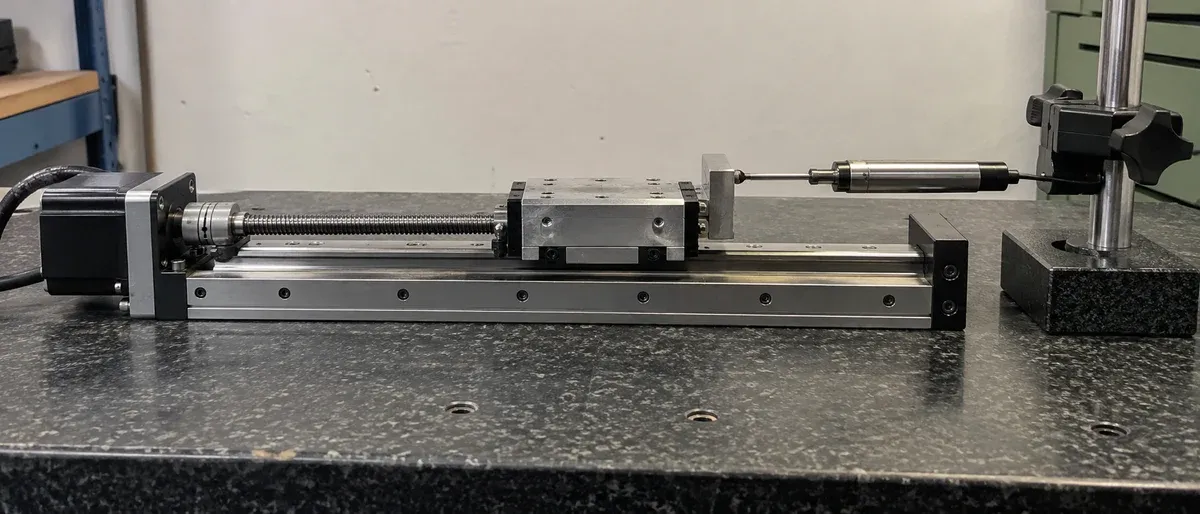
Measure the difference before naming its cause
When opposite approaches reach different measured positions, it is tempting to write “backlash” on the report. That label may be premature. Start by recording the direction-dependent observation and its conditions. A useful investigation keeps the measurement result separate from the mechanism proposed to explain it.
Newport’s terminology guide distinguishes reversal error, backlash and hysteresis. This article proposes a diagnostic workflow rather than a mechanical classification rule. Use the site’s specification page to keep the separate questions of accuracy, repeatability and resolution clear throughout the investigation.
Establish a direction-controlled baseline
Choose a safe target within the working range, with sufficient clearance for approaches from both sides. Define the excursion, final approach speed, acceleration, dwell and measurement interval. Record the actual sequence, including any controller overshoot, take-up move or automatic compensation. A nominal negative command may still end with a positive final approach.
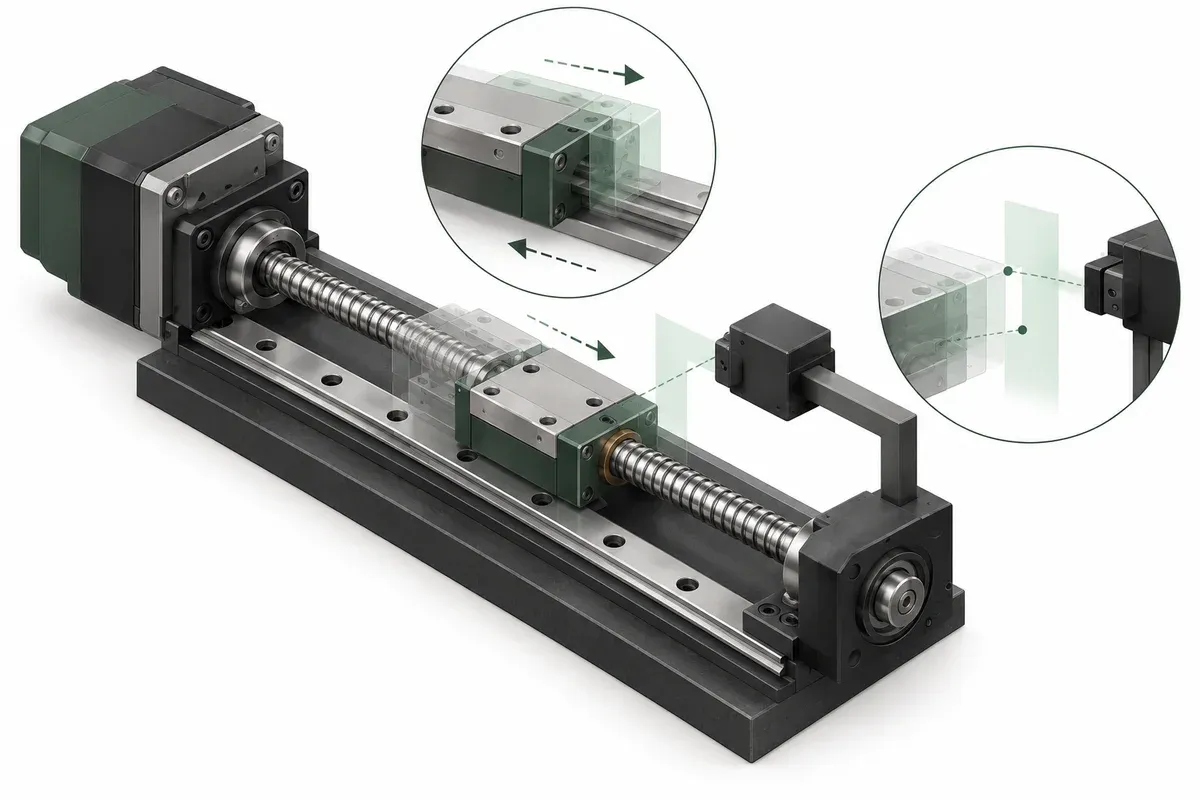
Measure repeated arrivals from each side without changing the reference or sensor zero between groups. Keep timestamps so thermal drift can be considered alongside direction. Plot the two groups separately and retain their individual observations. A single combined spread can hide a consistent offset between groups, while a difference between two isolated observations says little about repeatability.
Document the sensing point, fixture stiffness, cable routing and payload. If a contact probe is used, consider its orientation and contact force within the measurement assessment. Check for an independent reference movement or fixture motion that could influence the reading. Do not assume the measurement stand is stationary merely because it is outside the moving carriage.
Investigate one influence at a time
After preserving the baseline, choose one controlled variation that addresses a specific hypothesis. A longer dwell investigates whether the observation changes with settling time. A different excursion investigates sensitivity to recent motion history. A revised cable support investigates whether cable loading contributes. Each variation needs its own identifier and a repeat of the original baseline where practical.
Avoid immediately altering mechanical preload or controller compensation. Such changes may require supplier guidance, affect safety or invalidate the original configuration record. First confirm that units, scale, sign and timestamps are correct. Then compare external measurement with available feedback channels, while recognizing that the channels may observe different physical locations.
A position-dependent reversal pattern deserves measurements at additional targets. A time-dependent pattern deserves environmental and warm-up records. Neither pattern, by itself, identifies a failed component. Record candidate explanations and the evidence needed to distinguish them rather than replacing an uncertain diagnosis with confident wording.
Hypothetical example: the direction gap changes with dwell
Imagine an inspection axis whose opposite-direction arrivals appear separated in an early reading, but the separation is smaller after a longer observation interval. No numbers or actual product results are assumed. The first conclusion is simply that the measured behavior depends on when it is observed.
The engineer checks the time trace, controller state and fixture response before deciding whether the effect is mechanical clearance, elastic behavior, residual motion or a measurement artifact. The production dwell remains part of the requirement. A favorable reading after a much longer delay would not automatically satisfy a process that acquires data immediately after arrival.
Practical checklist for a reversal investigation
- Label the final approach direction of every observation.
- Preserve one unchanged baseline before modifying any settings.
- Keep sensor zero, reference establishment and timing explicit.
- Check fixture, probe and cable influences before assigning a component fault.
- Change only one experimental condition per diagnostic comparison.
- Repeat at relevant target positions when the effect varies with travel.
- Separate observed differences from proposed causes in the report.
Include uncertainty and the chosen statistic when reporting the directional difference. NIST’s uncertainty guidance supports stating how that uncertainty is expressed. A credible report may conclude that the present setup cannot isolate the cause. That is still useful: it prevents an unsupported mechanical diagnosis and identifies the next experiment needed before changing the machine or accepting a compensation strategy.
Questions
Is every difference between opposite approaches backlash?
No. The observed difference can include multiple mechanical, control, thermal and measurement influences.
Can compensation remove the need to measure reversal?
No. Record the compensation state and verify the resulting behavior under the intended sequence.
Why does probe mounting matter?
A flexible or poorly aligned sensing arrangement may contribute a direction-dependent reading that is not solely stage motion.
Sources & scope
Sources support the specific points described below. General engineering guidance and third-party examples do not establish a catalogue model's performance or suitability.
- Newport: Motion Basics Terminology and Standards
Reversal error can include backlash and hysteresis; these terms are not interchangeable.
Accessed - NIST TN 1297: Reporting Uncertainty
Document the basis of measurement uncertainty.
Accessed
Related engineering resources
Continue reading
Accuracy & Metrology
Accuracy, repeatability and resolution: three separate acceptance questions
Turn accuracy, repeatability and resolution into separate acceptance requirements, with a worksheet for evidence, conditions and decisions.
Verification guide · 4 min read ·Accuracy & Metrology
Assessing velocity stability and following error during a scan
Plan scan-motion measurements with explicit trajectory definitions, acquisition bandwidth, payload and processing for velocity and following error.
Verification guide · 4 min read ·From requirements to a quotation
Review your stage requirements
Share the motion envelope, payload, orientation and acceptance criteria. Request confirmation of the exact configuration before ordering.
Request a Quote