Key takeaways
- Separate observed prototype behavior from contractual requirements.
- Freeze interfaces and operating conditions before requesting acceptance evidence.
- A successful laboratory trial does not establish production or environmental qualification.
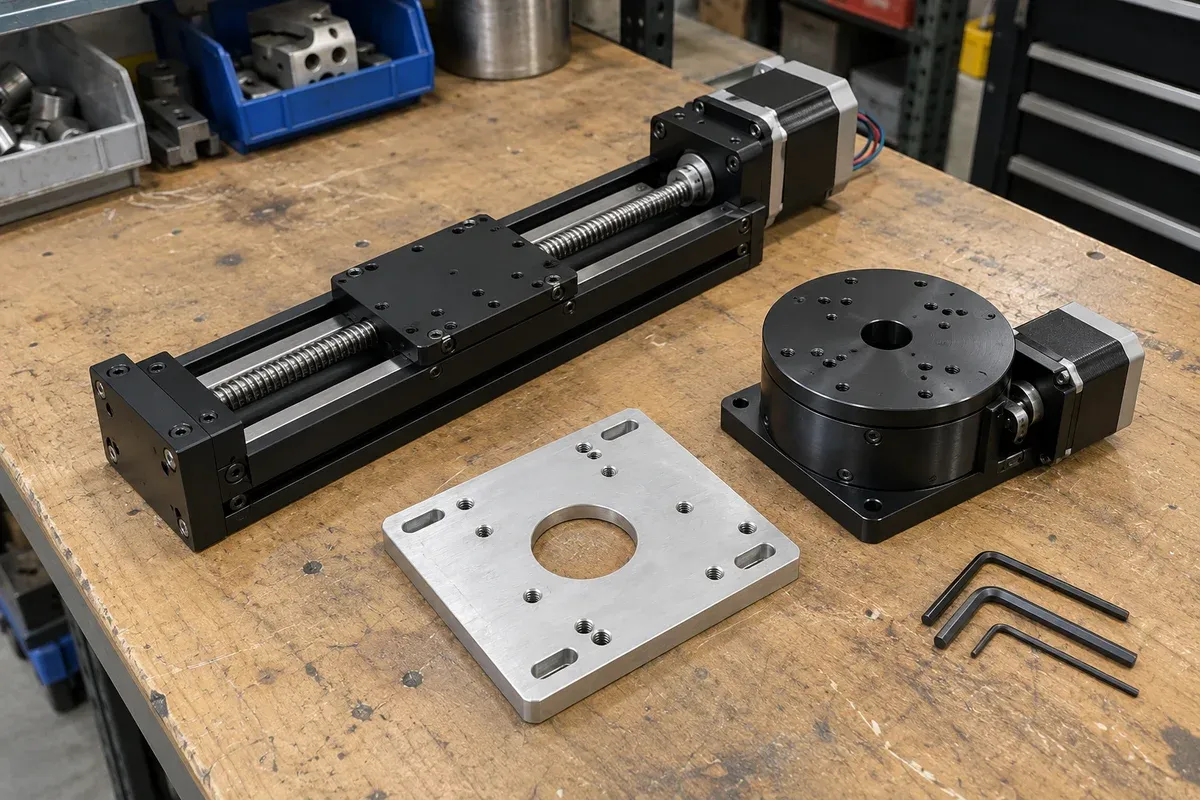
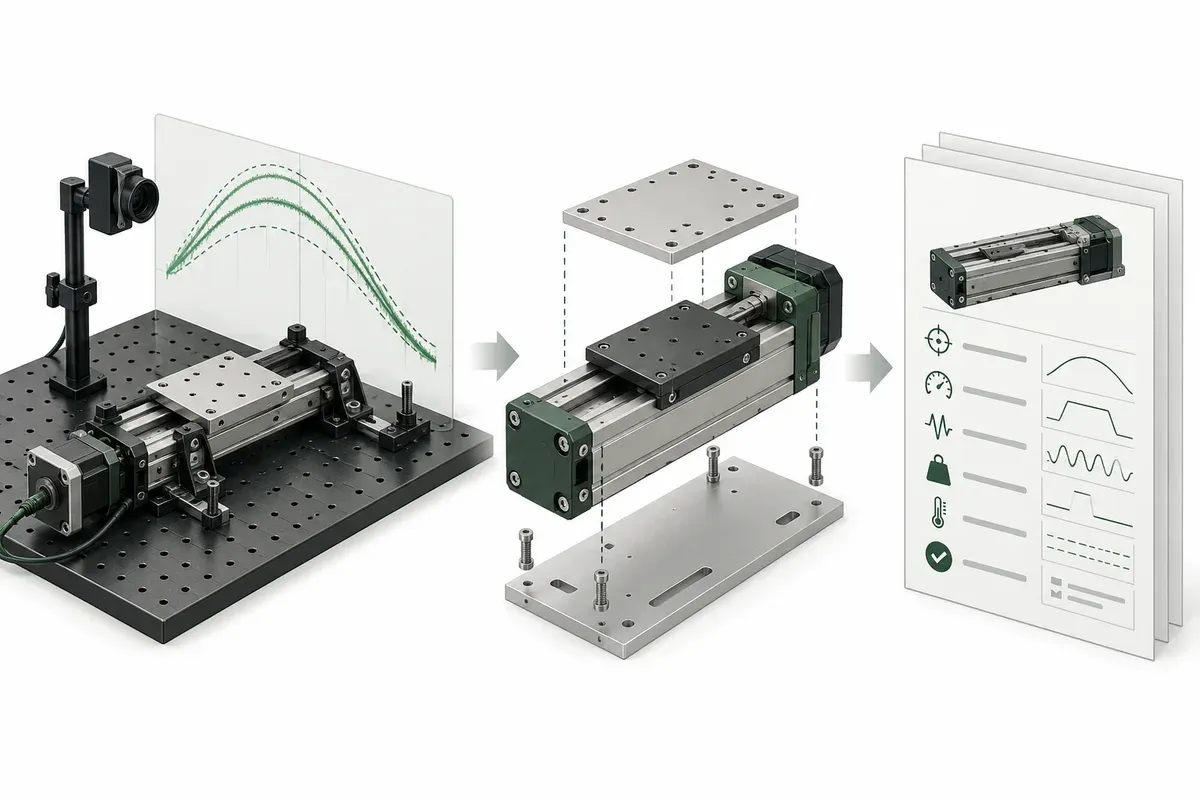
A laboratory prototype shows that a concept may be worth developing. An OEM requirements package explains what must be supplied, how it will connect and what evidence will establish acceptance. Moving between those stages requires more than replacing a bench drawing with a production part number.
This article proposes a documentation process. It does not claim that any catalogue stage is qualified for semiconductor throughput, medical use, cleanrooms, vacuum service or another specialized production environment.
Separate observations from requirements
Start with a record of what the prototype actually did. Include configuration, payload, mounting orientation, measurement method and relevant conditions. Preserve unsuccessful trials and workarounds as well as useful results.
Then write the requirement the product genuinely needs. An observed result may suggest that a target is feasible, but it does not automatically define the correct contractual limit. Conversely, a laboratory result obtained under favorable conditions does not establish behavior across all intended operating conditions.
Newport’s motion terminology reference distinguishes motion specifications. Use clear terms in the package: commanded increments, repeatability and positioning accuracy should not be substituted for one another.
Freeze interfaces at useful boundaries
Create controlled drawings for the mounting surface, moving payload, adapter and service connections. Identify dimensions that matter to the functional point, not just the outer envelope. Include the required space for installation and replacement.
Record controller, cable and software interface assumptions. Distinguish documented functions from prototype scripts or manual actions that someone performed during testing. A production requirement must state whether those actions will remain manual, be automated or be removed through a design change.
Capture configuration identifiers and revisions. If the proposed unit differs from the tested prototype, show the differences explicitly so that the review can decide which evidence remains applicable.
Replace vague duty claims with an operating profile
Describe the intended sequence of moves, holds, loading events and idle periods. State the relevant payload and orientation for each part of the sequence. The supplier needs more than a requested maximum speed to evaluate the application.
Identify environmental and service requirements separately. If vacuum, cleanliness or another special condition matters, request explicit configuration-specific evidence. Do not infer compatibility from material names, surface treatment or a successful ambient bench trial.
Zaber’s rotary selection guidance illustrates that load geometry and motion requirements belong in selection. Its product capabilities do not establish duty or life ratings for the mechanisms in this catalogue.
Practical OEM handoff checklist
- Archive the tested prototype configuration and measurement records.
- Separate observations, design targets and contractual acceptance limits.
- Freeze mounting, payload, cable and controller interface revisions.
- Describe the representative operating sequence and duty assumptions.
- List environmental qualifications that still need explicit evidence.
- Define acceptance tests, instruments, conditions and required records.
- Assign owners and closure criteria to unresolved requirements.
Keep a change-impact record. A replacement motor, revised holder or different cable route can affect the relevance of earlier evidence even when the product’s outward appearance is unchanged.
Hypothetical example: the bench needed an operator
Suppose a prototype completes a positioning task successfully, but an engineer manually checks the part reference after each loading operation. The proposed OEM system is expected to run without that intervention. Copying the prototype’s move sequence would omit an important function.
The requirements package records the manual check, identifies its purpose and asks the team to define an acceptable production method. It may lead to improved tooling, an added measurement or a different workflow, but the example does not presume which solution will work. No production rate or reliability result is claimed.
Make acceptance reproduce the requirement
For each important requirement, state the evidence that will demonstrate it under the intended conditions. Separate supplier component tests from tests of the integrated machine. Identify which must occur before shipment and which need the final installation.
Use the specification basis guide when interpreting catalogue fields, and attach the completed package to a quotation request. The objective is a reviewable agreement about configuration and evidence, not an unsupported promotion of a laboratory success into a production qualification.
Include an explicit disposition for failed acceptance tests, identifying who reviews the evidence and which changes require renewed verification before delivery.
Questions
Can a successful prototype be specified by its part number alone?
No. Preserve the configuration, interfaces, operating conditions and acceptance requirements that made the prototype useful.
Does a short trial establish service life?
No. Life and sustained-duty claims require suitable evidence under defined conditions.
How should an unknown production requirement be recorded?
Mark it as unresolved, assign an owner and define the evidence needed to close it instead of turning an assumption into a rating.
Sources & scope
Sources support the specific points described below. General engineering guidance and third-party examples do not establish a catalogue model's performance or suitability.
- Newport: Motion Basics Terminology and Standards
Defines distinct motion specifications and measurement concepts; does not establish this catalogue performance.
Accessed - Zaber: Selecting a Motorized Rotary Stage
Primary rotary-stage selection discussion covers geometry, load and central access as configuration questions.
Accessed
Related engineering resources
Continue reading
Applications & System Design
Building a positioning brief for an optical-power search experiment
Define a bounded optical-power search experiment with measurement validity, pose association and stop criteria before specifying motion hardware.
Application guide · 4 min read ·
Applications & System Design
Field-of-view calculator and calibration for stage motion
Use the field-of-view calculator for camera and microscope coverage, check calibration and turn the usable field into a stage-motion brief.
Application guide · 8 min read ·From requirements to a quotation
Review your stage requirements
Share the motion envelope, payload, orientation and acceptance criteria. Request confirmation of the exact configuration before ordering.
Request a Quote