Key takeaways
- An angular correction must be defined relative to channel geometry.
- Track individual channels instead of relying on one combined reading.
- Pivot offsets can require translation as well as rotation.
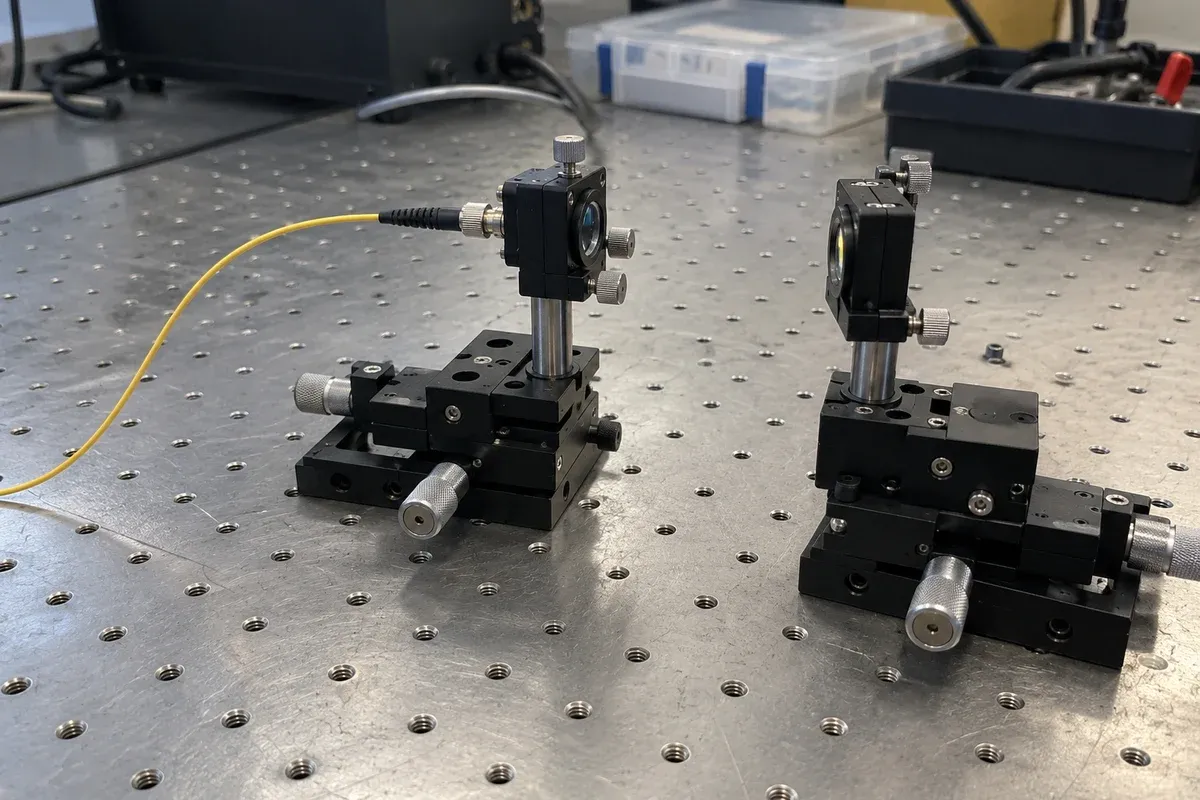
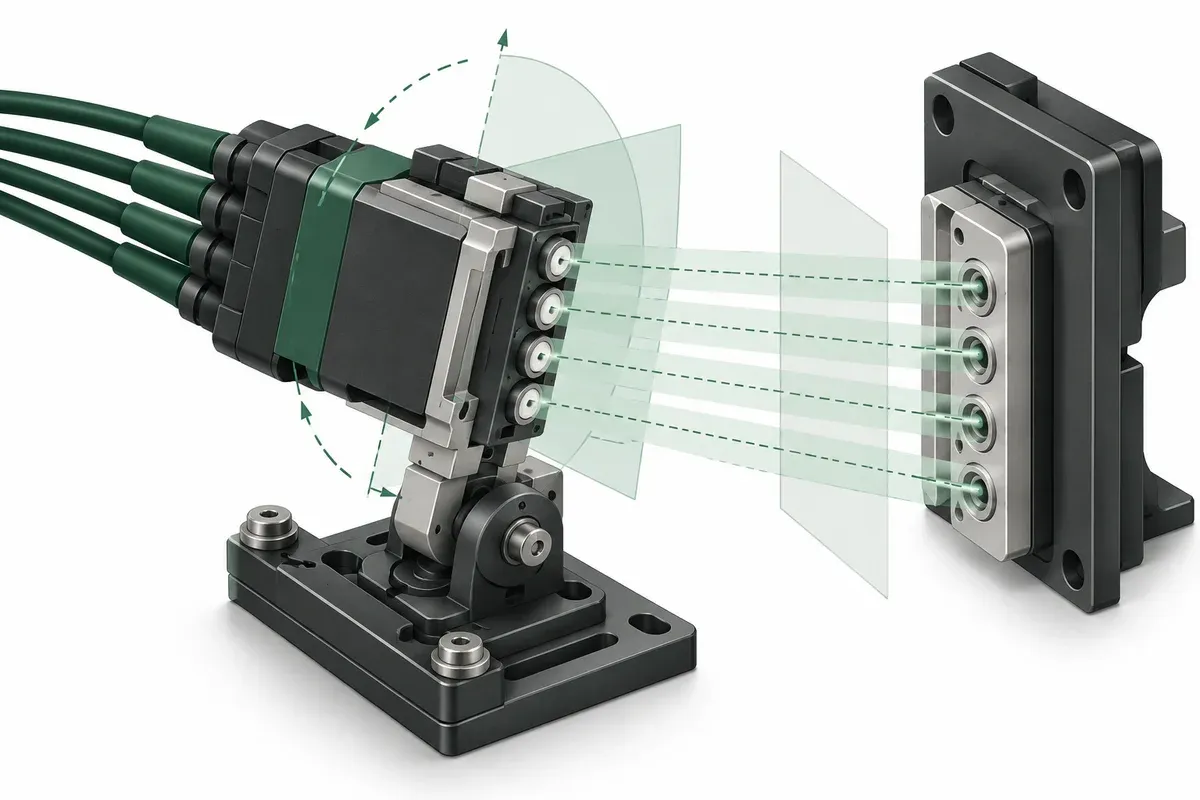
A multichannel connector has spatial extent. Aligning one point on its face does not automatically establish an acceptable relationship across the entire channel pattern. Before evaluating an angular mechanism, describe the channel arrangement, the intended pivot and the information available from the optical measurements.
This is a planning method for a prospective experiment. It is not evidence of a qualified connector assembly process, nor a recommendation that catalogue rotary or goniometer stages can meet a particular coupling requirement.
Start with the channel map
Create a drawing that numbers the channels and locates them relative to mechanical references on the connector. Include the mating interface and the feature used to establish orientation. If the channel map comes from a supplier drawing, preserve its revision and coordinate convention.
Distinguish a nominal layout from measured part geometry. An alignment algorithm cannot be specified intelligently if the team has not decided which geometrical relationships are trusted and which must be discovered during the experiment. Identify any missing information as an input needed from the connector designer.
The map should also indicate which channels can be observed independently. Limited measurement access is a system constraint: it may affect what the team can conclude about an angular correction, even when the mechanical motion itself is available.
Choose and document the pivot
State where the intended rotation axis intersects the connector geometry. Then show the actual axis produced by the proposed stage and adapter. If the two do not coincide, identify the accompanying translation of the interface and the means of accommodating it.
PI’s array-alignment discussion provides a third-party example of rotational and translational alignment being related. Its integrated control approach is not implied by selecting separate mechanisms from this catalogue.
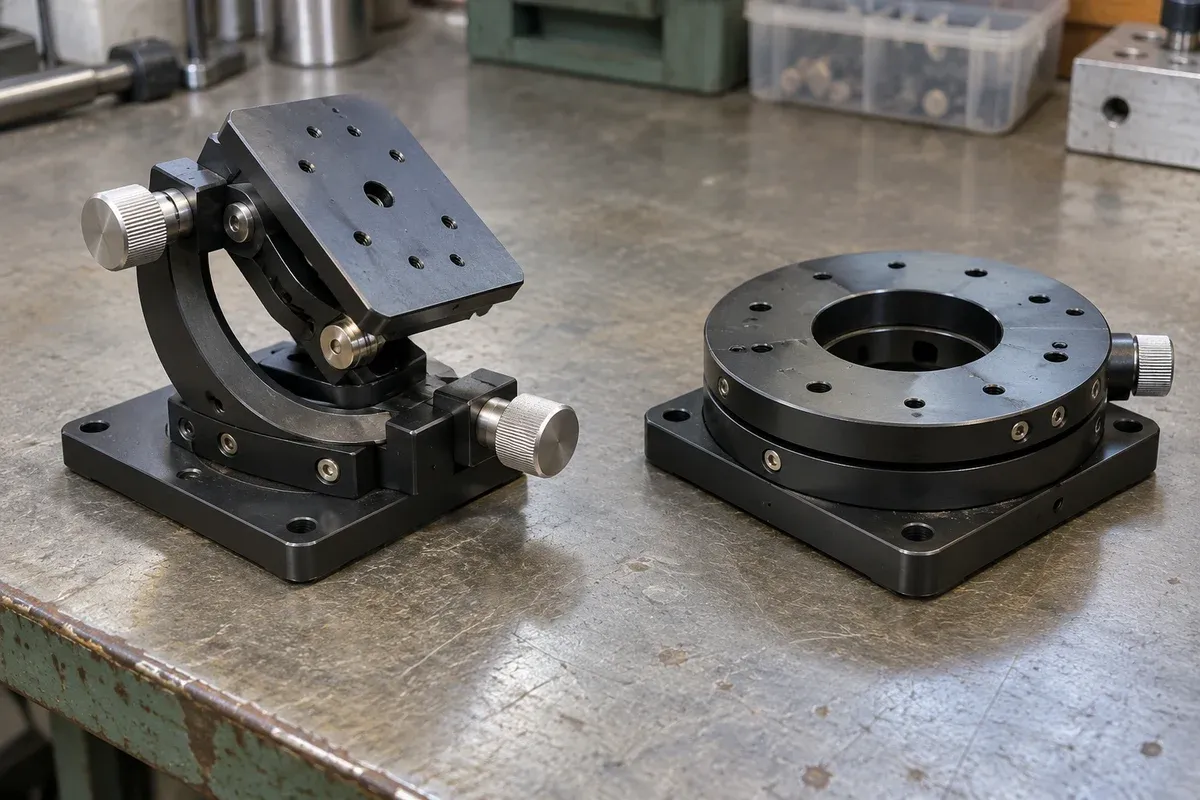
For an angular shortlist, compare the geometry first. A rotary table and a goniometer place the rotation axis differently. The correct choice depends on the fixture’s reference point, available space and required motion, not merely on which listing shows the smallest angular figure.
Keep the channel objective visible
Specify how each observed channel contributes to the alignment decision. If every channel must pass, record every channel’s criterion. If a different objective is justified by the product design, state it explicitly and explain what remains unverified.
Also define whether readings are simultaneous or sequential and how the acquisition sequence relates to the pose. Do not assume a changing measurement represents an angular effect until the measurement team has addressed repeatability and relevant environmental variation.
The review should identify any coupling between angular adjustment and other variables, such as transverse position. This does not require promising a particular optimization algorithm. It requires making the control problem visible before purchasing individual components.
Practical angular-review checklist
- Attach a numbered channel map and connector datum drawing.
- Mark the intended pivot and the proposed mechanism’s actual axis.
- Show connector, cable and tool envelopes throughout the allowed motion.
- List the channels available to the measurement system and their validity states.
- Write the channel-level acceptance rule and observation sequence.
- Identify translations that may be needed after an angular correction.
- Define the verification method for the assembled pivot and final optical result.
Ask the supplier to review load offsets and angular geometry using the complete holder. A centered component alone is not an adequate representation of a connector with a stiff cable and an offset strain-relief bracket.
Hypothetical example: improving one edge at the other’s expense
Consider a proposed connector experiment with channels near both ends of a linear array. A candidate angular change improves the measured result at one end. Without the other end’s reading, the team cannot conclude that the connector is better aligned overall.
The revised brief requires channel-resolved observations and a documented translation strategy when the pivot does not coincide with the selected optical reference. No optical tolerance or achieved yield is assumed. The example simply shows why the channel map belongs in the motion requirements package.
Close the loop with fixture evidence
The finished package should connect a physical angular movement to an interpretable optical observation. Use goniometer and rotary-stage pages to identify candidate geometries, then request exact drawings and condition-specific evidence. A successful mechanical angular test is necessary evidence about motion; it cannot replace the connector-level acceptance trial.
Questions
Should rotation be centered on the middle channel?
That is a design choice to evaluate from the connector geometry and alignment objective, not a universal requirement.
Can a summed power reading verify every channel?
Not by itself. A sum can conceal an individual channel that fails its criterion.
Does full angular travel mean the whole range is usable in the fixture?
No. The connector body, cable bend and nearby tooling can restrict the assembled motion envelope.
Sources & scope
Sources support the specific points described below. General engineering guidance and third-party examples do not establish a catalogue model's performance or suitability.
- PI: Case Study, Photonic Array Device Assembly
Third-party example of optical feedback, coupled alignment axes and attachment; no performance transfer to this catalogue.
Accessed
Related engineering resources
Continue reading
Applications & System Design
Specifying a goniometer fixture for angle-dependent optical measurements
Define the angular variable, elevated pivot and detector geometry for an optical measurement concept before choosing a goniometer fixture.
Application guide · 4 min read ·Applications & System Design
Building a positioning brief for an optical-power search experiment
Define a bounded optical-power search experiment with measurement validity, pose association and stop criteria before specifying motion hardware.
Application guide · 4 min read ·From requirements to a quotation
Review your stage requirements
Share the motion envelope, payload, orientation and acceptance criteria. Request confirmation of the exact configuration before ordering.
Request a Quote