Key takeaways
- The stage opening is only one section of the usable access path.
- Separate stationary pass-through objects from rotating components.
- A clear bore does not provide unlimited cable rotation.
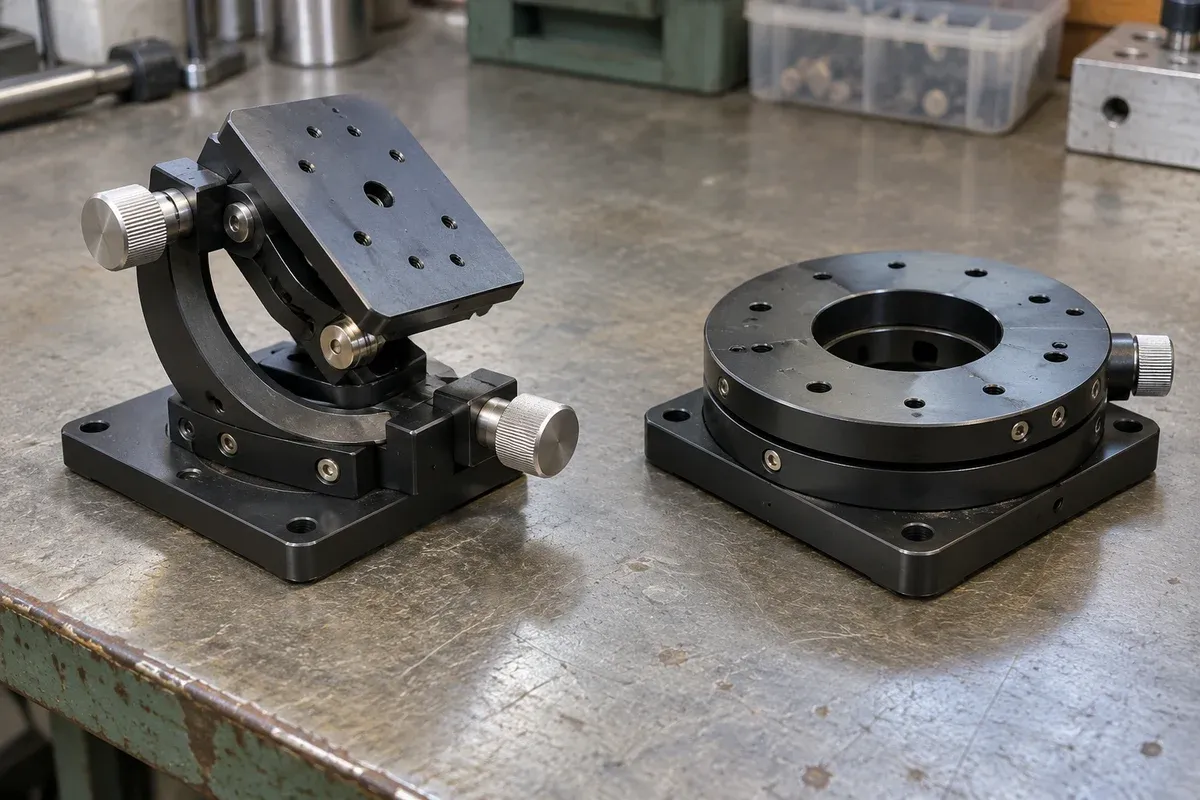
A hollow rotary table creates a useful opening through the stage, but the finished fixture may not preserve that opening. Adapters, fasteners, part holders and service connectors can intrude into the same volume. Treat central access as a continuous three-dimensional path with a defined purpose, rather than a single diameter copied from a product page.
Define what must pass through the assembly
State whether the opening is intended for a light path, stationary probe, cable bundle, tube or another component. Record the required path shape and its relationship to the rotation axis. A round opening may be convenient for one item and insufficient for another whose connector or assembly tool is wider than its operating body.
Separate operating clearance from installation access. A thin cable can fit through an aperture after its connector has been removed, but that does not establish a practical or permitted assembly method. Include the component in the form in which it will actually be installed and serviced.
Review the full axial path
Create a section through the stage, support structure, adapters, holder and workpiece. At each layer, identify the clear region and the parts that restrict it. The narrowest or most offset region may be in the fixture above the table rather than in the table itself.
Show fastener heads, protruding hardware and connector backshells where they can enter the path. If the workpiece changes between variants, review the central access for each relevant variant. Do not assume a through-hole label means all associated components share a continuous free aperture.
The rotary-stage selection guide treats stage geometry as an application consideration. Here the application question is the complete access path; no dimensions or ratings from that reference are transferred to this catalogue.
Distinguish fixed and rotating services
Color or label each object as fixed, rotating or otherwise moving. A stationary optical tube passing through a rotating holder creates a different interface from a cable attached to the rotating payload. The latter must accommodate relative rotation somewhere in its route.
A hollow center is not evidence of a slip ring, rotary union or unlimited-rotation cable system. Such components, when needed, require their own selection and compatibility assessment. For limited angular movement, a service route still needs its applicable bending or torsion requirements checked. Geometric passage alone does not establish electrical, optical or fluid-service suitability.
Aperture-preservation checklist
- Define the object or optical path that needs central access.
- Include its connector, installation and removal envelopes.
- Section every layer from the support to the workpiece.
- Identify fixed, rotating and translating components separately.
- Check hardware intrusions and eccentric openings.
- Review the intended angular range and service transition.
- Record requirements for any separate rotary connection.
- Confirm access for each relevant workpiece configuration.
Assign ownership of the access path to one assembly drawing or interface record. Otherwise, separate designers may each preserve a nominal hole while their combined components produce an unusable route. Changes to an adapter or holder should be checked against that shared record.
For optical access, distinguish the mechanical opening from the required light path. State whether the application needs an unobstructed viewing cone, a straight beam path or another geometry. That definition belongs to the optical design owner; the mechanical review should preserve the agreed volume without claiming that a clear opening proves optical performance.
Hypothetical example: a central inspection probe
Suppose an inspection concept places a stationary probe through a hollow rotary assembly while the part rotates around it. The table opening appears sufficient. A section view then reveals that the workholder’s lower fastening flange occupies part of the probe’s installation path.
The team reviews alternative holder interfaces and the probe’s removal direction. It also checks which cables remain stationary and which follow the workpiece. This hypothetical case does not establish a safe probe clearance or a validated rotary inspection system. It shows why the access review must cover the complete assembly and its intended use.
Use the hollow rotary table range to identify candidates, then request verified dimensional information for the chosen model. Submit a sectioned fixture layout so the discussion concerns usable access rather than the stage opening in isolation.
Questions
Can a cable simply pass through the center during unlimited rotation?
A central opening does not remove cable twist. The complete service transition and angular duty require a specific design review.
Why can the usable aperture be smaller than the stage opening?
Adapters, holders, fasteners, connectors and the required clearance can occupy part of the path.
Does an open bore guarantee optical access?
No. The optical path must be checked through the complete fixture, including angular positions and surrounding components.
Sources & scope
Sources support the specific points described below. General engineering guidance and third-party examples do not establish a catalogue model's performance or suitability.
- Zaber rotary-stage selection guide
General distinction between rotary geometry, loading and application requirements; not evidence of our product ratings.
Accessed
Related engineering resources
Continue reading
Mounting & Mechanical Integration
Checking the support surface before installing a precision stage
Organize a support-surface readiness review around documented requirements, contact geometry, surface condition and traceable inspection evidence.
Integration guide · 4 min read ·
Mounting & Mechanical Integration
Choosing the order of an XYZ stack
Compare XYZ stack arrangements through moving mass, payload offsets, working height and access before selecting a mechanical layout.
Integration guide · 4 min read ·From requirements to a quotation
Review your stage requirements
Share the motion envelope, payload, orientation and acceptance criteria. Request confirmation of the exact configuration before ordering.
Request a Quote