Key takeaways
- A symmetric ± value describes half the end-to-end span.
- Preserve source notation alongside the normalized total travel.
- Resolve ambiguous endpoints before treating a catalogue value as usable stroke.
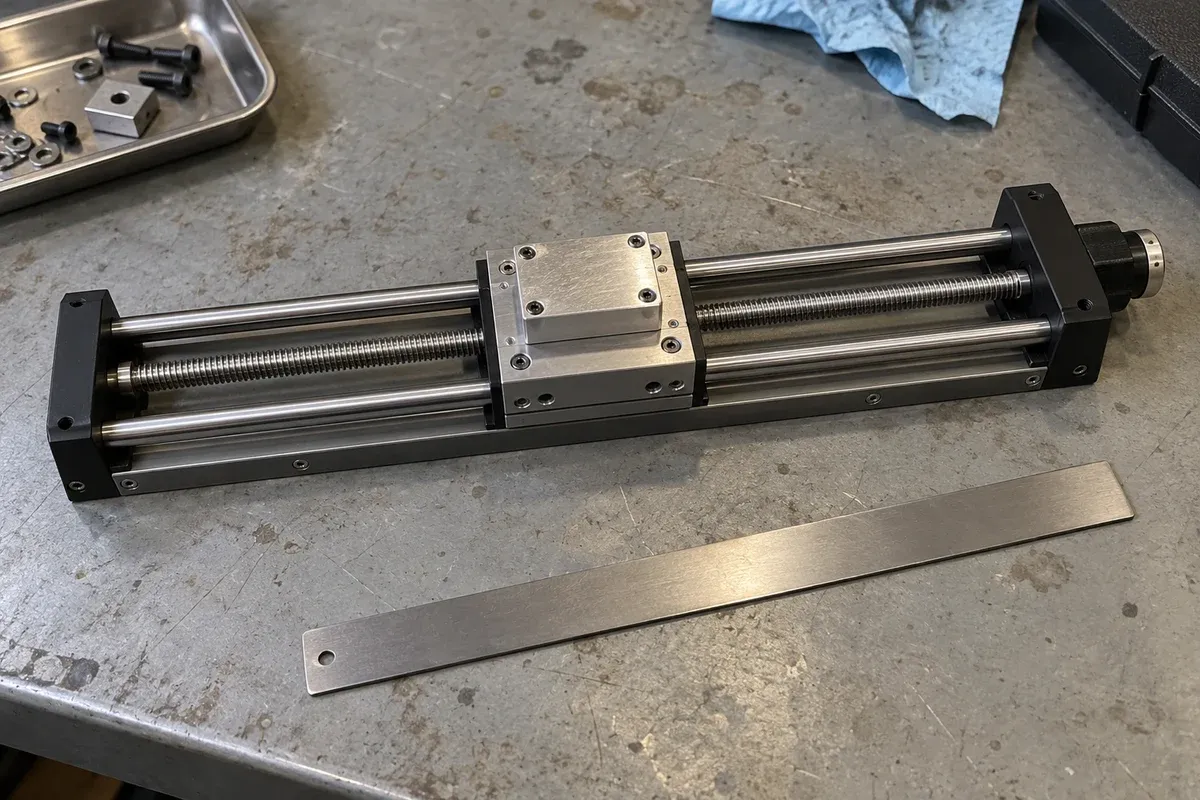
Read the quantity before reading the sign
A plus/minus symbol can describe several different things on a technical page. It may identify a symmetric travel range, a dimensional tolerance or a positioning performance value. Start by reading the row label and unit. Multiplying every plus/minus number by two would be just as misleading as treating every one as a total stroke.
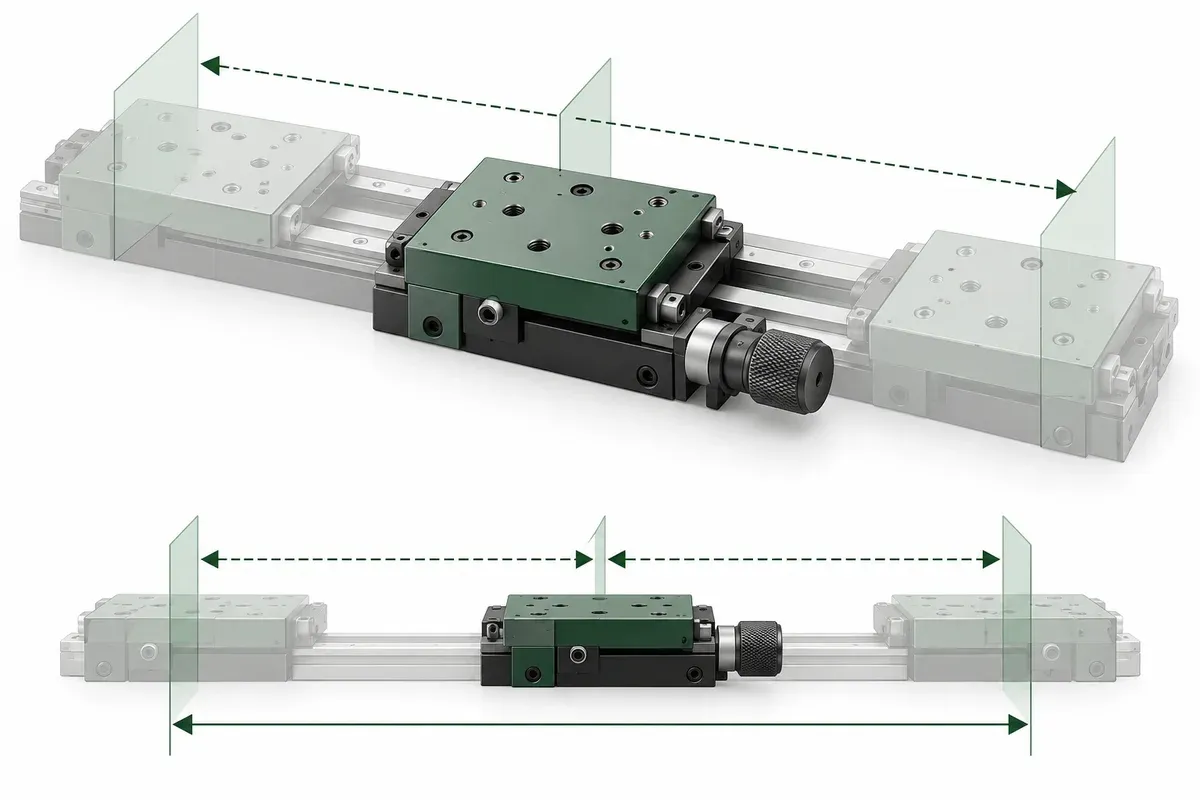
For travel expressed symmetrically around a reference, the two endpoints determine the total. A hypothetical range from minus 7.5 mm to plus 7.5 mm spans 15 mm. A separate statement of 15 mm total travel describes the same span, provided the endpoint conditions match. Neither notation alone tells you where the installed fixture’s process origin lies.
Preserve the original and normalized values
The safest comparison worksheet has separate entries for the source wording, normalized total, reference and document revision. Do not overwrite the original notation after conversion. Keeping it visible allows another reviewer to check the arithmetic and find a mismatch later.
For example, a hypothetical worksheet might record “source: ±12 mm; normalized total: 24 mm; reference: midpoint shown on drawing.” Another candidate might say “source: 25 mm travel; normalized total: 25 mm; reference: endpoint convention to confirm.” The second candidate is not automatically better: the usable range and physical layout still have to match the task.
The PositioningStages specification guide states that linear travel on this site is normalized to total millimetres. It also explains that the supplied source uses both half-range and total notation. That site-specific rule should not be generalized into a decoding rule for unrelated catalogues.
Keep coordinates separate from available stroke
An application coordinate system can place zero wherever the design requires. A stage with a given total travel might operate with positive coordinates only, coordinates on both sides of zero, or an offset imposed by the controller. Those labels do not change the physical end-to-end span.
Likewise, a home sensor or reference routine establishes something different from the notation used to describe travel. Do not infer that a symmetric range homes at its midpoint. Ask for the reference arrangement and approved motion procedure for the complete control system. Selection documentation should describe the required positions without inventing machine-specific settings.
Consider a hypothetical process using positions from 10 mm to 28 mm in a fixture coordinate system. Its process span is 18 mm. It does not require a stage advertised as “±28 mm” merely because the largest coordinate is 28. Additional approach or loading positions may increase the requirement, but coordinate offset by itself does not.
Reconcile three documents before ordering
Check the catalogue entry, dimensioned drawing and quotation against the same exact configuration. Record whether each states total travel or symmetric half-range. If a drawing labels a dimension as stroke, inspect its reference points rather than assuming it is the same as the overall length or carriage length.
A useful reconciliation checklist asks:
- Is the number a travel range, tolerance or performance specification?
- Are the units linear or angular?
- Are both endpoints explicit?
- Does the quoted configuration match the drawing revision?
- Is the required usable range confirmed, including application restrictions?
- Has any conflict been answered in writing?
If a value is ambiguous, keep it unresolved. Choosing the larger interpretation because it makes the shortlist work is not a valid engineering assumption.
Keep the reconciliation sheet with the application sketch. A reviewer should be able to trace the selected total back to explicit endpoints without relying on a product name or an undocumented convention.
Use normalized values without losing context
Enter total linear travel into the stage selector and retain the source wording in the review record. For angular products, distinguish the extent of a limited range from a full-turn description; do not silently transfer the linear convention to every rotary entry.
The final purchasing note should be short and explicit: required coordinate span, selected nominal total travel, confirmed usable range and any remaining condition. This turns a notation exercise into a controlled selection decision. It also gives the person integrating the stage a way to recognize a mismatch before a software coordinate convention or a revised fixture hides it.
Questions
Does ±15 mm mean 15 mm of total travel?
For a symmetric range from minus 15 mm to plus 15 mm, total travel is 30 mm. Confirm that the notation describes travel rather than another parameter.
Can I use a part number to decode travel on any stage?
No. Naming conventions are supplier-specific. Use the controlled specification and drawing; a part number is only a cross-check when its convention is documented.
Does the midpoint have to be the machine home?
No. A symmetric range description does not establish the location or behavior of the home reference. Confirm homing separately for the selected system.
Sources & scope
Sources support the specific points described below. General engineering guidance and third-party examples do not establish a catalogue model's performance or suitability.
- How to read the specifications
Definitions and the catalogue, derived and not-confirmed labels used on this site.
Accessed
Related engineering resources
Continue reading
Stage Selection & Buying Guides
Compare quotations by included components, options and responsibilities
Compare stage quotations by separating included hardware, optional components, customer responsibilities and the evidence needed for acceptance.
Selection guide · 4 min read ·
Stage Selection & Buying Guides
Choosing a vertical lift instead of mounting a linear stage vertically
Compare a dedicated vertical lift with a vertically mounted linear stage by checking layout, gravity loading, support and configuration-specific evidence.
Selection guide · 4 min read ·From requirements to a quotation
Review your stage requirements
Share the motion envelope, payload, orientation and acceptance criteria. Request confirmation of the exact configuration before ordering.
Request a Quote