Key takeaways
- A result without its configuration may be impossible to reproduce.
- Record temperature over time and identify sensor locations.
- Describe payload geometry and orientation, not mass alone.
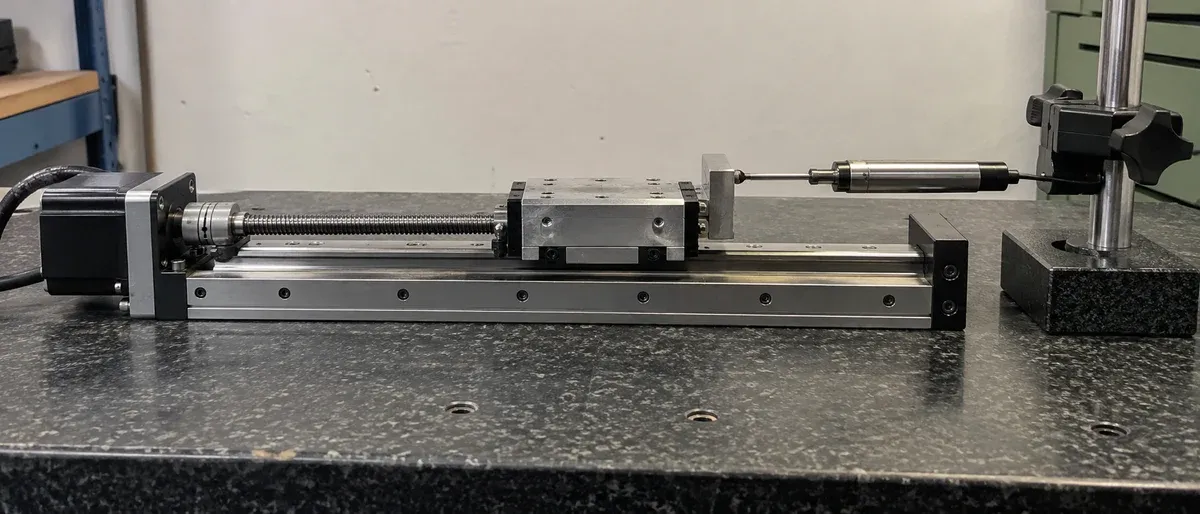
Treat conditions as part of the result
A measurement report should describe more than a stage model and a final number. Without a configuration record, another engineer may be unable to reproduce the test or decide whether it applies to the installed machine. The record should travel with the dataset rather than remain in a technician’s notebook.
Newport identifies thermal conditions and loading among influences on motion-system performance. This article proposes a practical reporting structure. It does not supply a universal allowable temperature range, payload limit or warm-up duration; those belong to the actual equipment documentation and acceptance agreement.
Create a thermal timeline rather than one reading
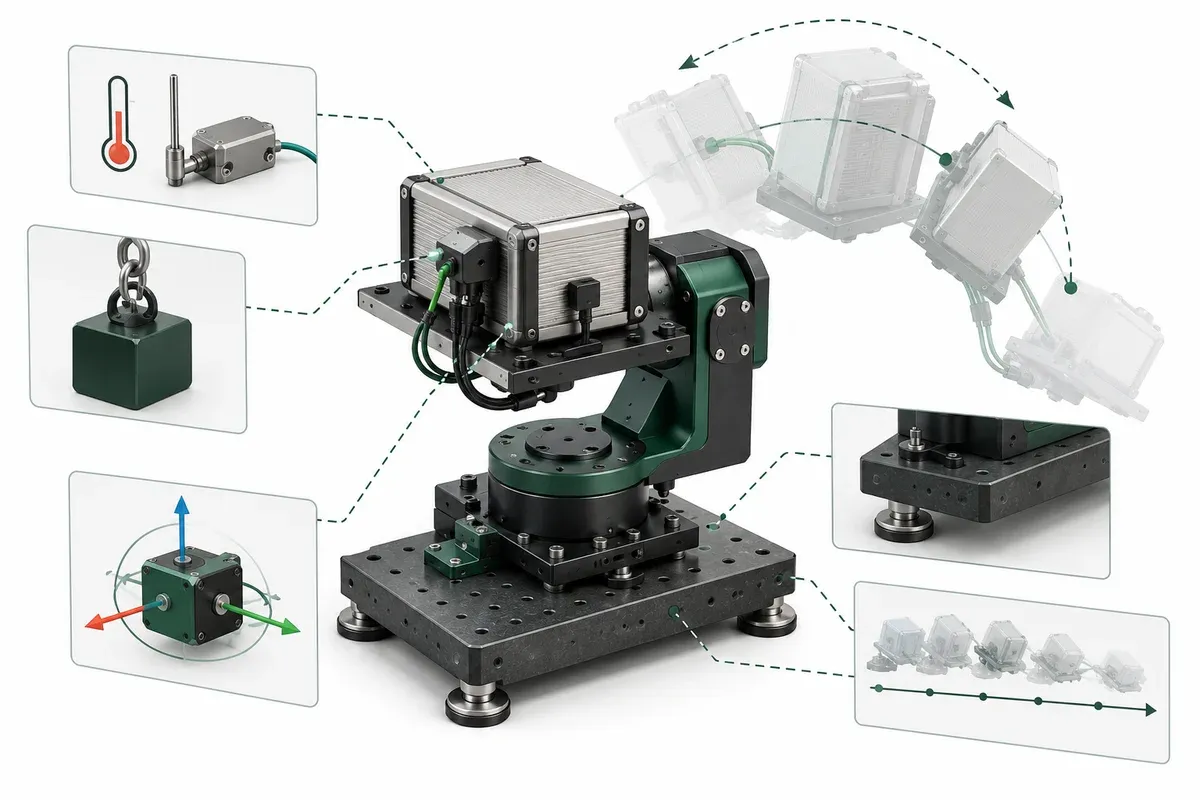
Record when the equipment entered the test environment, when power was applied and when motion began. Identify any warm-up sequence and its duration. Log temperatures during the measurement where practical, with sensor locations and timestamps. Distinguish room-air readings from base, fixture or payload temperatures rather than labeling all of them “temperature.”
Note relevant disturbances such as doors opening, nearby heat sources or a change in duty cycle. These observations do not automatically invalidate a run, but they can help explain time-dependent behavior. Preserve the original data before deciding whether a disturbance justifies exclusion or a repeat under an agreed rule.
If thermal compensation is applied, record the inputs and settings used. Do not assume a nominal material coefficient or a single air sensor fully represents the measurement chain. A temperature correction should have a stated model and uncertainty, not serve as an unexplained adjustment that makes the result closer to a desired value.
Describe the load as an assembly
Record payload mass, center-of-gravity location and mounting arrangement. Include fixtures, adapters, sensors and other items carried by the stage. For motion profiles where inertia matters, preserve the geometry or model used to assess it. A small concentrated mass and an extended fixture of the same mass are not interchangeable test descriptions.
State orientation relative to gravity with a drawing or unambiguous words. Identify which direction the axis travels and how the payload is supported. Never reuse a horizontal-load rating as a vertical capability without confirmation. Include cable and hose routing, attachment points and any external forces intentionally applied during the test.
Record mounting base, fastener pattern and relevant assembly instructions followed. If a test uses a temporary fixture instead of the production installation, label the difference. The report should let a reviewer understand whether an observed change followed a new payload, a new mounting condition or a controller change.
Hypothetical example: the same stage in two orientations
Imagine an axis tested horizontally with a compact inspection fixture, then installed vertically with an extended tool. Even if the nominal carried mass is unchanged, the configuration record reveals several differences: orientation, center of gravity, cable path and functional-point location. No performance result or allowable load is assumed in this example.
The earlier report remains useful historical evidence for its original setup. It does not automatically qualify the vertical installation. The engineer reviews the current product documentation and plans verification for the changed configuration, rather than labeling any difference between the two tests as random variation or a defective stage.
Practical checklist for the configuration record
- Record power-on, warm-up and measurement start and finish times.
- Identify temperature sensors, locations and time histories.
- List the complete carried assembly and its center-of-gravity information.
- Draw orientation, functional point and external force directions.
- Capture mounting interfaces and cable or hose routing.
- Save controller, firmware, tuning and compensation identifiers.
- Link each run to the exact configuration revision used.
Finish with a field for departures from the agreed plan and who reviewed them. Use NIST’s reporting guidance to document uncertainty and its basis. The site’s specification guide explains catalogue labels; the configuration record supplies the missing bridge between a published value and a specific experiment. It makes the result portable without pretending that it applies to every load, environment or installation.
Questions
Is room temperature alone an adequate thermal record?
Not always. Identify which temperatures were measured, where the sensors were located and how conditions changed during the test.
Can the same mass represent two different payloads?
The mass may match while center of gravity, stiffness, inertia and cable loading differ. Describe the actual configuration.
Should a changed orientation invalidate the earlier report?
The earlier report remains evidence for its recorded conditions. A new orientation requires a review of whether that evidence applies.
Sources & scope
Sources support the specific points described below. General engineering guidance and third-party examples do not establish a catalogue model's performance or suitability.
- Newport: Motion Basics Terminology and Standards
Thermal conditions and loading affect motion-system performance.
Accessed - NIST TN 1297: Reporting Uncertainty
Reporting guidance calls for sufficient information to interpret measurement uncertainty.
Accessed
Related engineering resources
Continue reading
Accuracy & Metrology
Accuracy, repeatability and resolution: three separate acceptance questions
Turn accuracy, repeatability and resolution into separate acceptance requirements, with a worksheet for evidence, conditions and decisions.
Verification guide · 4 min read ·Accuracy & Metrology
Assessing velocity stability and following error during a scan
Plan scan-motion measurements with explicit trajectory definitions, acquisition bandwidth, payload and processing for velocity and following error.
Verification guide · 4 min read ·From requirements to a quotation
Review your stage requirements
Share the motion envelope, payload, orientation and acceptance criteria. Request confirmation of the exact configuration before ordering.
Request a Quote