Key takeaways
- Test repeated positioning without resetting the reference first.
- Evaluate homing cycles as a separate workflow with independent position observations.
- Preserve offsets, startup settings and reference states in the report.
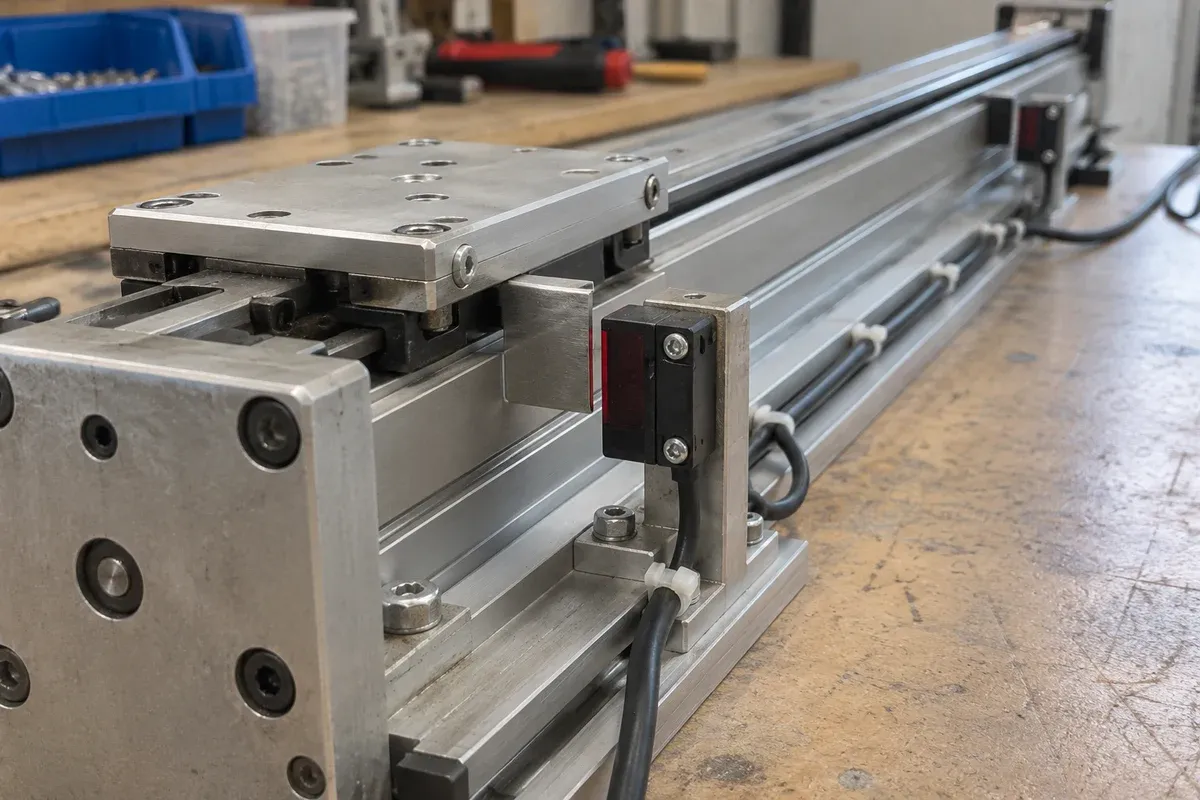
Ask two questions about returning to a coordinate
A machine can revisit a coordinate within one uninterrupted session yet behave differently after a reference reset. Incoming acceptance and process qualification should distinguish those cases. One experiment asks how the axis returns while its reference remains unchanged; another asks what happens when the reference-establishment workflow is repeated.
The Zaber protocol manual provides a concrete manufacturer example of a home command establishing a reference position. Its exact command behavior is product and configuration specific. Use the applicable manual for the equipment under test rather than copying another controller’s routine into a generic procedure.
Preserve an external reference for both experiments
Choose a stable external measurement arrangement and a safe target away from travel limits. Record the physical location of the target on the payload, not just the controller coordinate. Mark the measurement origin and keep it unchanged through the comparison. If the measurement system must be reset, document how the reference relationship is restored.
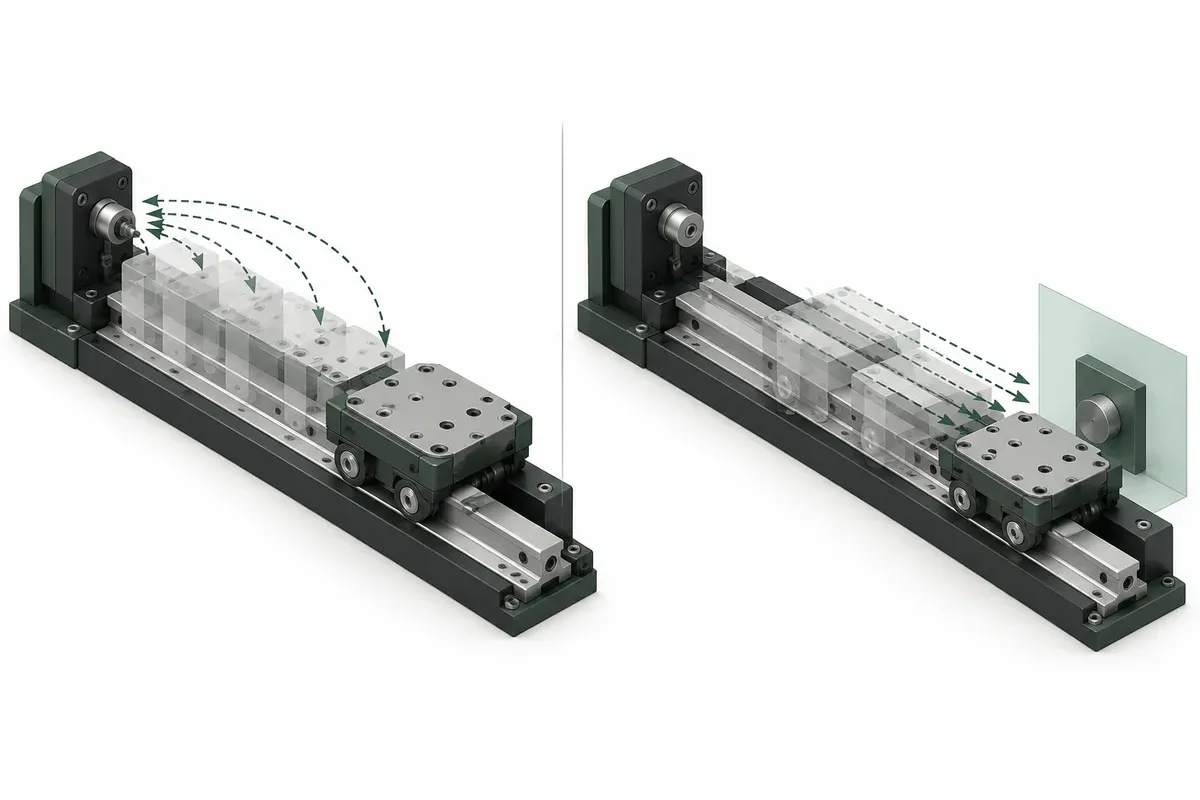
For the first experiment, establish the controller reference once, then repeatedly move away from and back to the target. Keep approach direction, excursion, speed and dwell fixed. This provides a fixed-reference positioning dataset. It does not, by itself, describe startup behavior, power-cycle recovery or homing performance.
For the second experiment, repeat the documented reference-establishment sequence before returning to the same nominal target. Preserve each home-cycle identifier and the external target reading. Do not zero the external instrument after each cycle: doing so could remove precisely the variation the experiment is intended to observe.
Reproduce the actual restart workflow
List the steps production performs after a restart. Does it home from a consistent location, search for an index, apply a home offset, load compensation or restore a saved coordinate? The test should record those states without assuming all systems use the same reference hardware. Distinguish a software home command from a full power cycle if both are operationally relevant.
Confirm safe homing clearance before repeating the workflow. A fixture or cable arrangement that allows normal production motion may obstruct the reference path. Check the permitted travel and reference direction in the actual documentation. Do not bypass limits merely to complete a test, and do not assume a saved position remains valid after unobserved physical motion.
Keep temperature, downtime and warm-up visible. Comparing a warm uninterrupted session with a cold startup may answer a practical production question, but it does not isolate the reference sensor alone. If diagnosis requires separating those effects, plan additional controlled runs instead of subtracting unrelated summary numbers and calling the remainder homing error.
Hypothetical example: overnight inspection recovery
Consider an inspection machine that revisits fiducials reliably during a shift but needs to relocate them after an overnight restart. The proposed plan creates two datasets: repeated returns during one referenced session, and returns following the complete startup sequence. This is an illustrative test design, not evidence of any specific stage’s performance.
The team records the camera mount, reference offset and compensation-file identity for both datasets. If the post-startup positions differ, the report does not immediately blame the home switch. It checks the complete reference workflow, environmental change and measurement chain. The relevant business outcome is reliable recovery of the inspection coordinates, so the installed-system test remains essential.
Practical checklist for reference-cycle verification
- Identify the documented reference mechanism and startup procedure.
- Keep the external measurement origin stable across home cycles.
- Collect a fixed-reference positioning dataset separately.
- Record home offsets, compensation state and reference-valid flags.
- Distinguish command-only re-homing from full power-cycle recovery.
- Confirm safe clearance throughout the complete reference path.
- Report environmental and downtime conditions with each cycle group.
Compare the datasets using the statistics agreed for their separate objectives. Include the uncertainty basis, consistent with NIST’s reporting guidance. The catalogue specification guide remains the place to distinguish resolution, positioning accuracy and repeatability. A successful reference-cycle test adds a further piece of evidence; it does not silently replace any of those requirements or establish a universal restart guarantee.
Questions
Can good positioning repeatability guarantee repeatable startup?
No. Re-establishing a reference introduces a different operation that needs its own evidence.
Should the external sensor be zeroed after every home?
Not when the objective is to observe reference-cycle variation; repeated zeroing may conceal the change being investigated.
Does every stage require the same homing sequence?
No. Use the documentation for the actual encoder, controller and reference hardware, including any absolute-reference or recovery behavior.
Sources & scope
Sources support the specific points described below. General engineering guidance and third-party examples do not establish a catalogue model's performance or suitability.
- Zaber ASCII Protocol Manual: Home
The documented home command establishes a reference position; behavior is configuration dependent.
Accessed - NIST TN 1297: Reporting Uncertainty
The uncertainty statement should identify its basis.
Accessed
Related engineering resources
Continue reading
Accuracy & Metrology
Accuracy, repeatability and resolution: three separate acceptance questions
Turn accuracy, repeatability and resolution into separate acceptance requirements, with a worksheet for evidence, conditions and decisions.
Verification guide · 4 min read ·Accuracy & Metrology
Assessing velocity stability and following error during a scan
Plan scan-motion measurements with explicit trajectory definitions, acquisition bandwidth, payload and processing for velocity and following error.
Verification guide · 4 min read ·From requirements to a quotation
Review your stage requirements
Share the motion envelope, payload, orientation and acceptance criteria. Request confirmation of the exact configuration before ordering.
Request a Quote