Key takeaways
- Approach clearance, optical feedback and attachment stability need separate requirements.
- Assign an observable exit condition to each assembly phase.
- A mechanical shortlist does not qualify an optical assembly process.
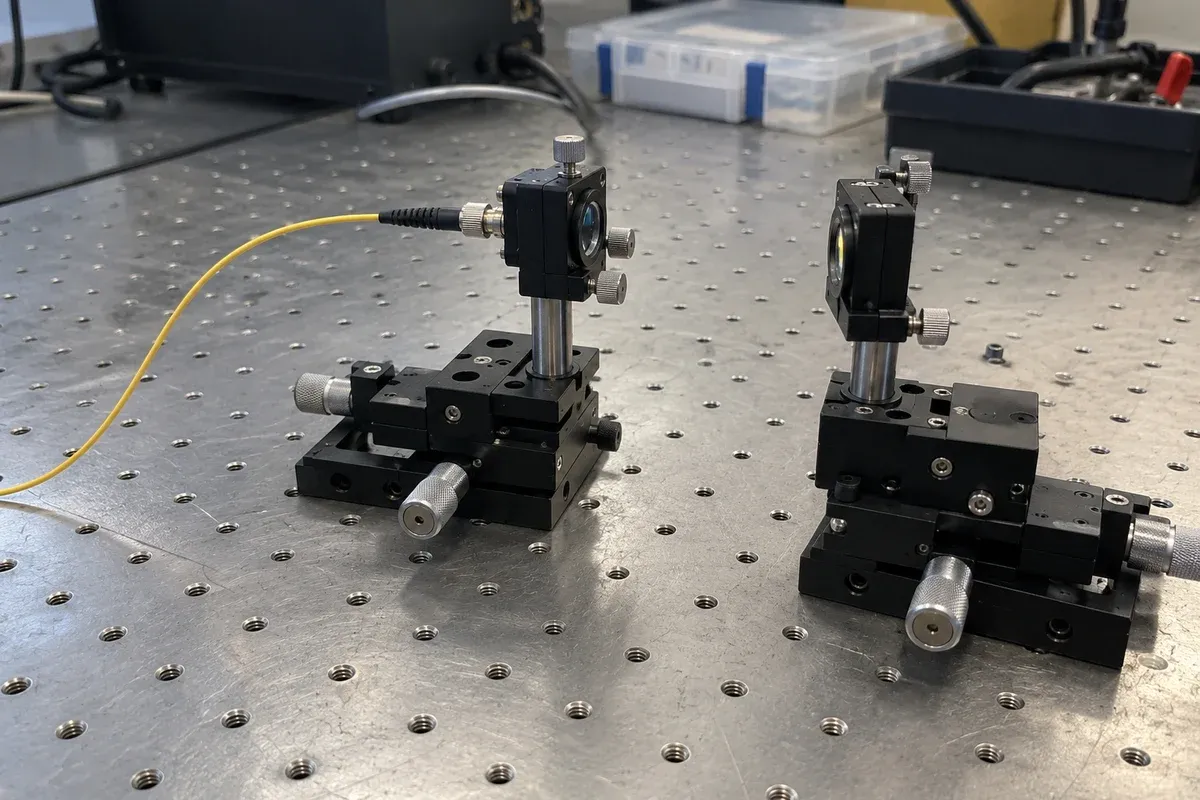
An optical-module assembly brief becomes easier to evaluate when it describes three different jobs: bringing components together, finding an acceptable optical relationship, and preserving that relationship during attachment. A single request for a “precision alignment stage” hides which job needs long travel, which depends on measurement feedback, and which must resist process disturbance.
This article proposes a requirements worksheet for a future bench. It does not describe an installed customer system or establish that a catalogue stage can perform fine fiber coupling. The optical assembly, control software and attachment method require their own evaluation.
Give approach its own work envelope
Draw the loading position, the first measurement position and the intended working position. Include the fiber holder, temporary handling tools, adhesive delivery hardware and the path used to remove a finished assembly. Mark keep-out volumes rather than showing only the two component centers.
For each move, record what is moving and what remains fixed. A fiber holder may be light while its strain-relief bracket and cable loop create a substantial moment. A coarse approach axis must be evaluated with that complete assembly, not with the optical component alone. Specify whether an operator establishes the starting pose or a separate locating feature does so.
The exit condition for this phase should be observable: for example, a verified pose within a measurement capture region. Reaching a motor coordinate alone does not prove that the optical surfaces have the expected separation.
Describe alignment by its measurement
PI’s photonic assembly case study illustrates optical-feedback alignment followed by attachment. Its reported implementation and performance belong to PI’s system. Use the workflow distinction, rather than the vendor’s numerical results, to structure the questions for a new bench.
Name the quantity that determines alignment acceptance. It might be a set of channel measurements rather than one summed value. Record the measurement interface, valid-reading indication and method for associating a reading with a pose. State what happens when the measurement is absent or ambiguous; an alignment routine should not silently declare success because it exhausted its search.
Allocate fine-motion requirements from the optical experiment. Do not substitute stage repeatability for acceptable coupling loss. If the experiment has not yet established the required correction range or sensitivity, identify these as open measurements rather than filling the worksheet with optimistic numbers.
Treat attachment as a disturbance-sensitive phase
List which tools enter the fixture after alignment and whether they introduce forces, heat or access conflicts. Specify when the alignment measurement is retained and when another measurement is taken. Separate “held in place” from “released from tooling”: a part can look acceptable before release and differ afterward.
The process owner should define material handling, cure and safety instructions. The motion brief only records their mechanical and timing consequences. It should not invent a curing recipe or imply that the stage supplier guarantees the completed bond.
Practical phase-handoff checklist
- Approach: supply an assembly drawing showing the loading pose, clearance corridor and measurement capture region.
- Alignment: identify every required optical channel, validity flag and acceptance decision.
- Attachment: identify tool access, potential disturbances and the final inspection point.
- Handoffs: name the signal or observation that permits each phase to begin.
- Recovery: describe the disposition of a partially attached or unmeasurable part.
- Evidence: request motion data under the proposed payload and process data from a representative assembly trial.
Keep a separate owner beside each unresolved item. A blank field assigned to an optical engineer is more useful than an unsupported assumption carried into a purchase order.
Hypothetical example: three different acceptance gates
Suppose a team proposes a bench for a small optical subassembly. Loading requires a wide clearance position, while alignment occurs in a compact region near a fixed chip holder. The team initially writes one requirement, “return to alignment position.”
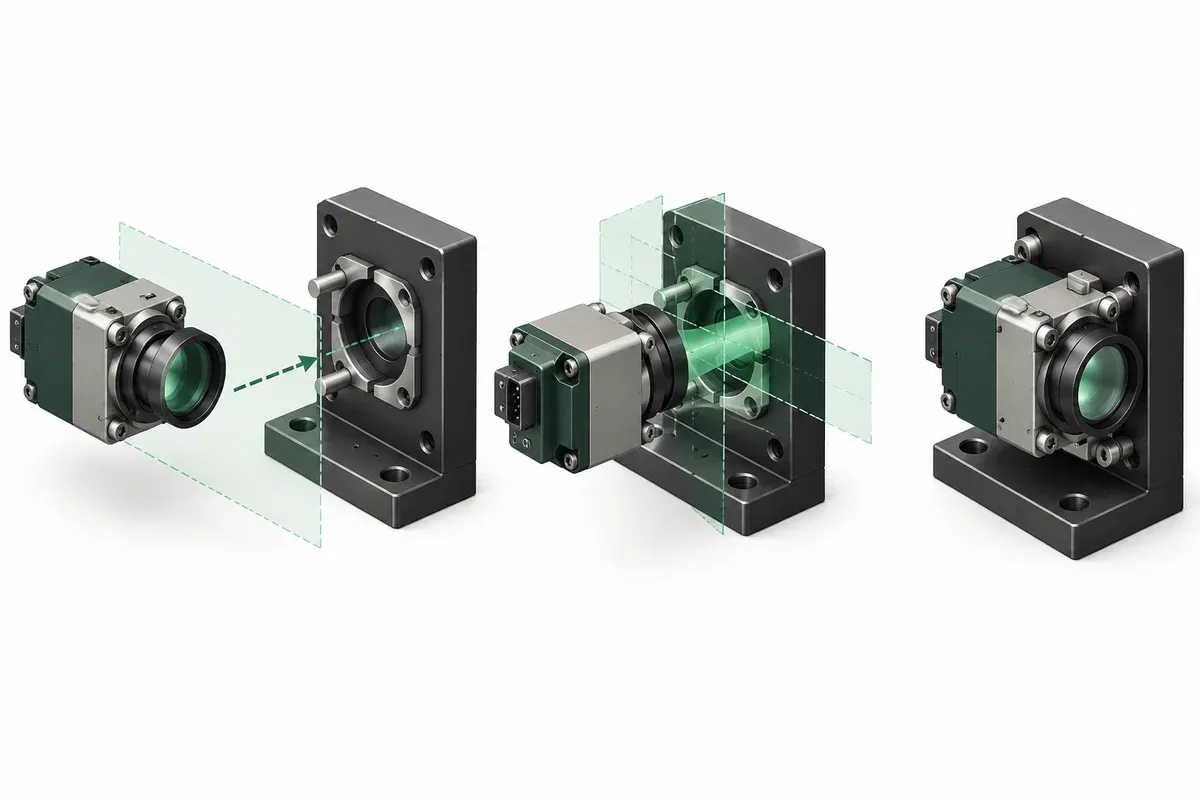
The worksheet replaces it with three gates. Approach must reach a verified, collision-free measurement region. Alignment must satisfy the selected channel criteria with valid measurements. Attachment must preserve the required result after the tooling releases the part. No numerical performance is assumed here, and no catalogue model is nominated.
The resulting request is more actionable: a motion supplier can evaluate geometry and load, the measurement engineer can evaluate feedback, and the process engineer can define attachment trials. Review the mechanical catalogue only after those responsibilities are visible. A passing stage test remains one input to a passing assembly process.
Questions
Can one stage perform every phase?
Possibly, but only a configuration-level review can establish the required travel, fine-motion behavior and attachment stability.
Does an aligned power reading establish bond quality?
No. Record optical performance again after attachment and the specified release or cure sequence.
What should be sent with the motion RFQ?
Include the phase worksheet, fixture drawing, load geometry, measurement interfaces and proposed acceptance evidence.
Sources & scope
Sources support the specific points described below. General engineering guidance and third-party examples do not establish a catalogue model's performance or suitability.
- PI: Case Study, Photonic Array Device Assembly
Third-party example of optical feedback, coupled alignment axes and attachment; no performance transfer to this catalogue.
Accessed
Related engineering resources
Continue reading
Applications & System Design
Building a positioning brief for an optical-power search experiment
Define a bounded optical-power search experiment with measurement validity, pose association and stop criteria before specifying motion hardware.
Application guide · 4 min read ·Applications & System Design
Choosing what must move in a benchtop laser-processing concept
Compare moving the sample and moving the process head in a laser-processing concept while keeping motion validation and safety responsibilities explicit.
Application guide · 4 min read ·From requirements to a quotation
Review your stage requirements
Share the motion envelope, payload, orientation and acceptance criteria. Request confirmation of the exact configuration before ordering.
Request a Quote