Key takeaways
- Motion completion and instrument readiness are separate conditions.
- A trigger request must be associated with the resulting measurement.
- Define timeout and duplicate-event handling before commissioning.
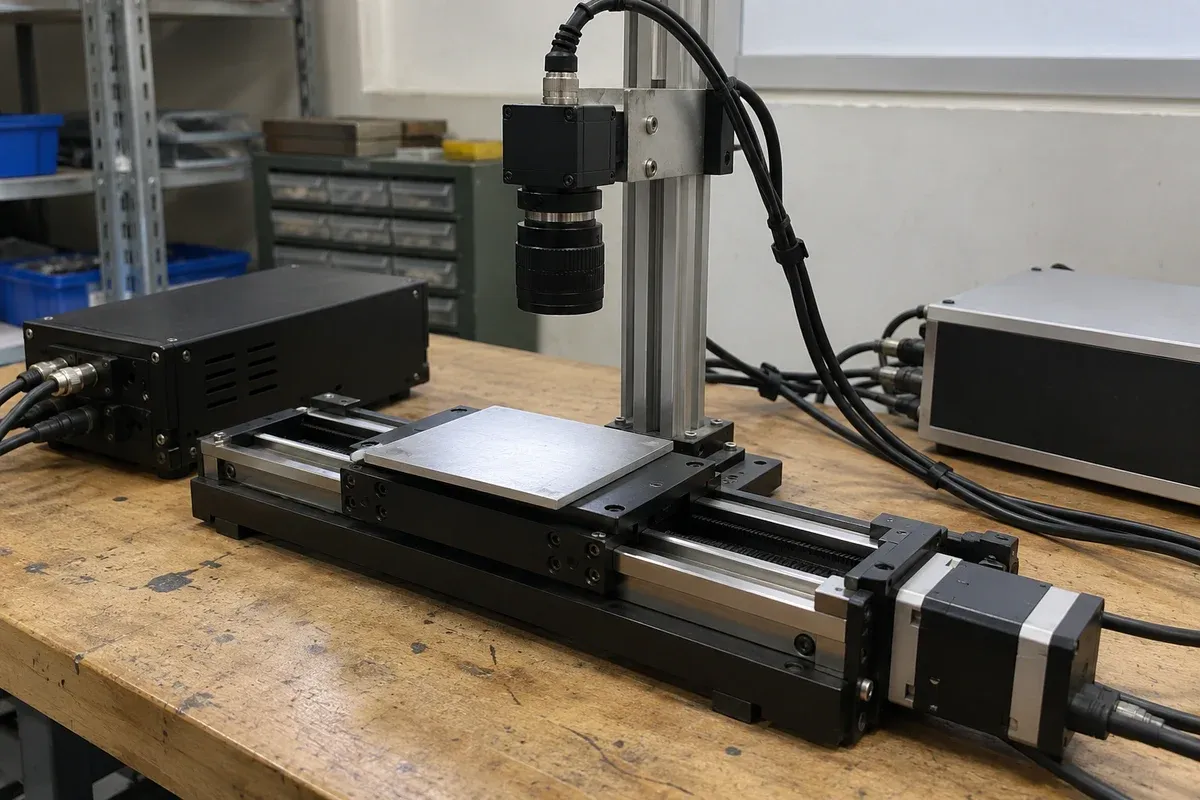
Connecting a positioning axis to a measurement instrument creates a small distributed system. The motion controller knows one set of states, the instrument knows another, and the host application must associate them correctly. A useful integration brief describes that relationship explicitly rather than saying only “trigger the instrument after the move.”
Identify the participants and event owners
Draw the host, motion controller, stage, instrument and any interface hardware. For each connection, identify who sends information and who receives it. Then assign ownership of motion readiness, instrument readiness, acquisition request and completed data.
The Zaber trigger article describes condition-and-action automation in its own system. That example helps distinguish an event from the action it initiates, but does not supply an interface specification for this catalogue or an arbitrary measurement instrument.
Ask which part of the system is authoritative for each state. If both host and instrument can initiate acquisition, define how conflicting requests are prevented. If a person can manually trigger the instrument, decide how that measurement will be identified in the data record.
Define the handshake in plain language
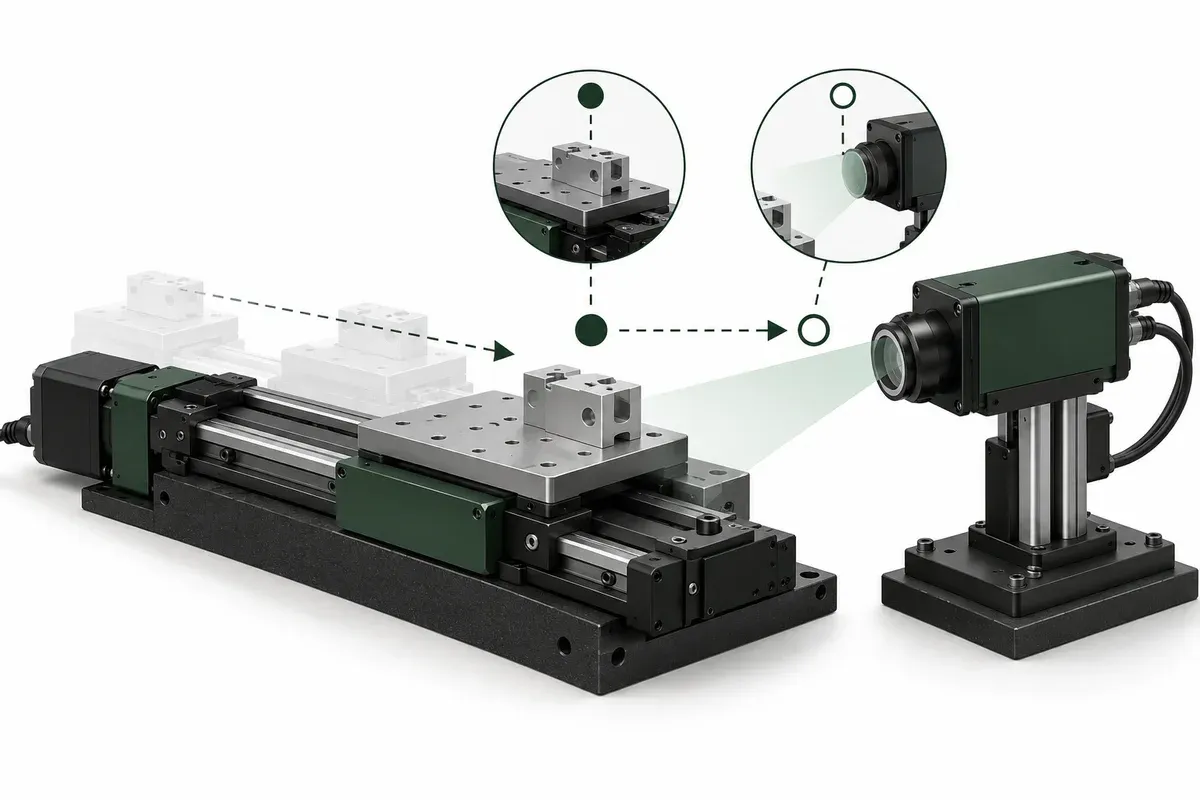
A conceptual sequence might require a valid position reference, verified motion readiness, instrument availability, an acquisition request, acceptance of that request and a completed measurement. These are requirements stages; the actual controller and instrument may implement them differently.
Specify the evidence for every transition. A digital edge may request acquisition but may not prove that acquisition occurred. A returned file may exist before its metadata are finalized. Request the manufacturer’s definitions rather than choosing a convenient signal and assigning it a stronger meaning.
Separate latency from uncertainty in latency. The application may compensate for a known relationship in some measurement designs, while variable timing can require a different approach. Do not assume a host-software timestamp is the instant at which a physical measurement happened.
Instrument-synchronization checklist
- Identify the owner and meaning of every readiness and completion state.
- Obtain the approved physical interface and communication documentation.
- State the required timing relationship to position or motion readiness.
- Give each acquisition a unique identifier linked to the motion operation.
- Define the instrument’s response when busy or when a request is duplicated.
- Specify timeout handling and how unresolved measurements are quarantined.
- Verify end-to-end association using a representative process test.
Include configuration versions and signal definitions with the checklist. Do not infer electrical levels, isolation needs or pin assignments from generic names such as “trigger in” and “ready out.”
Hypothetical delayed-measurement example
Imagine a fixture moving a sample to a measurement station. The host requests acquisition, but the instrument takes longer than expected to return a result. Meanwhile, a later motion operation has been prepared. If the application labels the delayed result using whichever position is currently displayed, it may assign the measurement to the wrong location.
The proposed design instead associates the result with the acquisition identifier created for the original station. It records the position basis and readiness evidence used at that time. If the result cannot be reliably matched, it remains unresolved rather than being attached to the next sample.
This example does not require a particular protocol or API. It requires an explicit association mechanism supported by the selected equipment and verified in the integrated application.
Test the entire association chain
Use a reviewed test to exercise normal acquisition, busy responses, delayed completion and communication interruption. Check the final data set, not only indicator lights or controller messages. Each accepted measurement should have an explainable relationship to its sample, location, configuration and acquisition event.
The optical application references demonstrate why motion and measurement belong to different parts of a process brief. Keep that separation in procurement as well: a suitable stage does not by itself include instrument communication software or a validated handshake.
The acceptance package should contain the agreed event definitions, interface evidence, test cases and unresolved limitations. That gives future developers a stable contract for modifying the host program without silently changing what each measurement means.
Also document how the application distinguishes a repeated message from a new physical acquisition, particularly when a connection is restored after a timeout.
Questions
Is an acquisition trigger proof that a measurement occurred?
No. Define what confirms acceptance and completion in the selected instrument.
Can the current displayed position label every incoming result?
Not safely when results can arrive late. Associate them with their original acquisition event and position basis.
Does the catalogue include instrument APIs?
No such capability should be assumed. Confirm software and interface scope for the proposed integration.
Sources & scope
Sources support the specific points described below. General engineering guidance and third-party examples do not establish a catalogue model's performance or suitability.
- Zaber: Using triggers to simplify automation
Only the distinction between trigger conditions and actions in the Zaber system; the handshake design is original requirements guidance.
Accessed
Related engineering resources
Continue reading
Motion Control & Automation
Choosing move-and-settle or continuous-scan operation
Compare stationary acquisition with continuous scanning by separating settling, dynamic motion, synchronization and throughput evidence.
Integration guide · 4 min read ·
Motion Control & Automation
Logging commands, status and errors for a reproducible motion test
Design a motion-test log that separates intent, controller status and measurement evidence while preserving timestamps and operation identity.
Integration guide · 4 min read ·From requirements to a quotation
Review your stage requirements
Share the motion envelope, payload, orientation and acceptance criteria. Request confirmation of the exact configuration before ordering.
Request a Quote