Key takeaways
- A command acknowledgement is not physical proof of a small displacement.
- Measure baseline noise and drift before testing increments.
- Report the conditions and detection criterion, not an unsupported universal minimum.
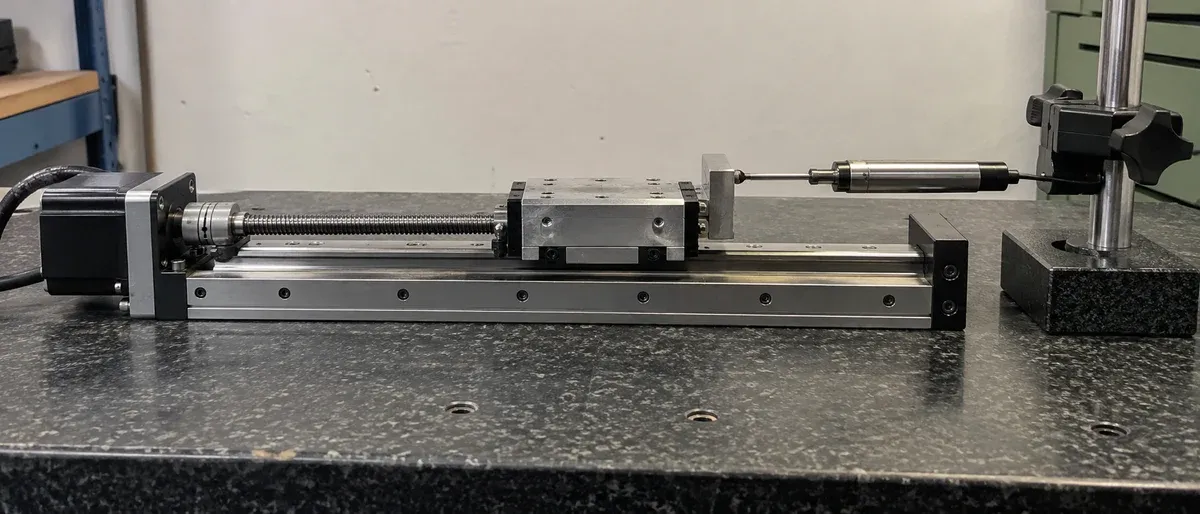
Define the physical claim you want to test
A controller accepting a tiny increment does not by itself show that the payload moved by that amount. The useful question is whether a specified command produces a distinguishable and repeatable physical response at a defined point, under the conditions of the application. That question needs a measurement plan rather than an additional decimal place on the display.
Newport explicitly separates resolution from minimum incremental motion. Use the site’s specification guide for the broader definitions, then write a testable statement for the intended fine adjustment. Keep that statement separate from absolute positioning accuracy across the full stroke.
Establish what the instrument can see
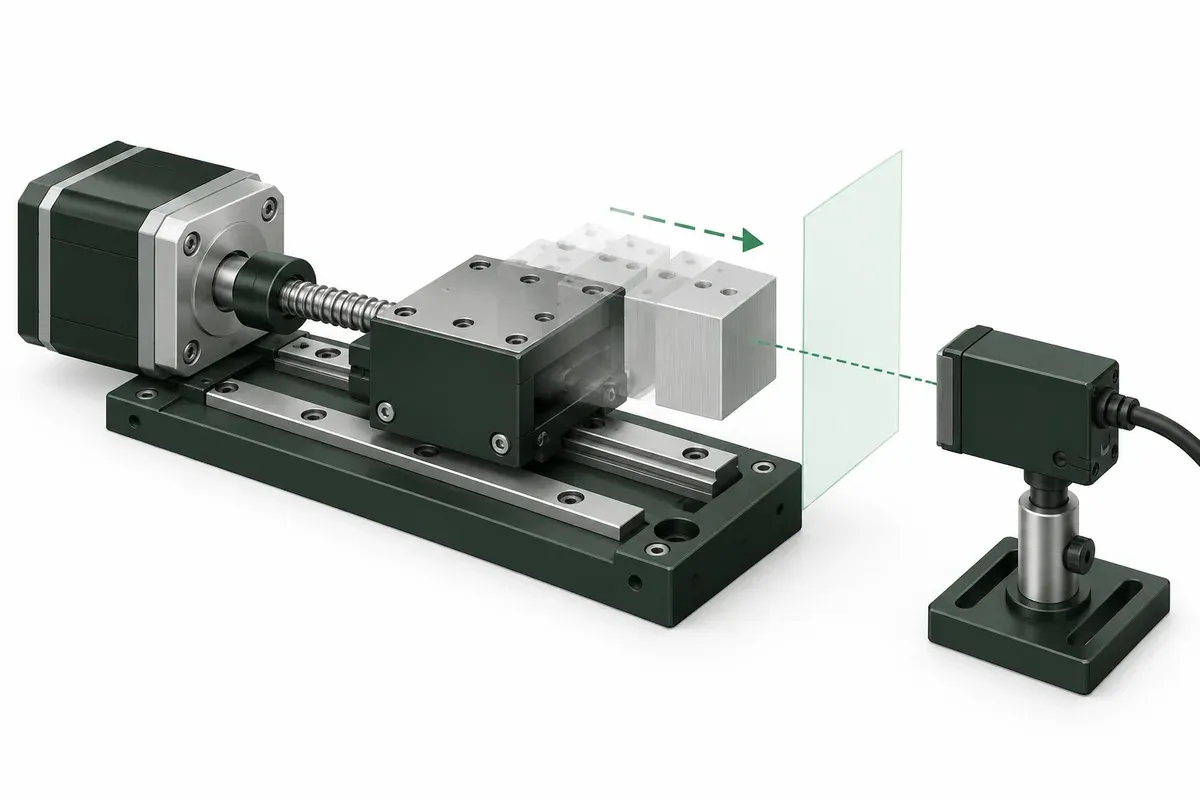
Choose a displacement measurement arrangement with appropriate range, noise behavior and uncertainty for the proposed increment. Record the target material and geometry, sensor alignment, bandwidth, filtering and sample timing. A sensor suitable for a large positioning move may not provide useful evidence for a much smaller local change.
Acquire a stationary baseline with the same electronics, payload and acquisition settings that will be used during motion. Record sufficiently long to reveal behavior on the time scale of the planned step sequence. Look for a drifting baseline, periodic disturbance or discontinuous readings. Do not subtract every inconvenient feature without a documented physical and analytical reason.
Define the criterion for a detectable response before looking at the step results. It should address both uncertainty in the displacement estimate and the variability of repeated responses. There is no universal threshold in this article. The application owner and measurement specialist should agree what constitutes useful evidence for this particular adjustment task.
Use a sequence that can reveal misleading responses
Begin with a safely observable command to check polarity, synchronization and scale. Then test the proposed increments in a documented sequence. Retain the individual command times and complete displacement trace, including dwell periods. A staircase drawn from command values must never be presented as a measured staircase.
Include repeated same-direction increments and a separate reversal sequence if the application uses both. Consider testing at more than one position within the working region. Record any automatic controller deadband, compensation or in-position behavior that could affect the response. Do not change several settings simultaneously and then attribute the difference to one of them.
Watch for delayed movement or accumulation: several commands may precede a larger observed change. Also check whether the final level persists during the application observation interval. These are patterns to investigate, not automatic diagnoses of friction, backlash or controller behavior. Correlate the external trace with available feedback without treating either channel as infallible.
Hypothetical example: an optical fine adjustment
Imagine an alignment routine requesting successive 0.2 µm commands. This is an illustrative command size, not a capability claim or acceptance limit. The engineer first records a no-motion trace, then applies the commands with timestamps and a fixed dwell. A second run reverses direction using the same settings.
If the external instrument cannot distinguish adjacent levels from its baseline variation, the conclusion is that this experiment has not resolved the requested motion. It is not proof that the stage never moved. The next step may be a better measurement arrangement, a larger test increment or a different process requirement. A successful trace at one location would likewise not establish full-travel accuracy.
Practical checklist for a small-motion report
- Identify the physical point and direction of the claimed displacement.
- Save an uncommanded baseline with matching acquisition settings.
- Verify scale and timing using a clearly observable safe move.
- Preserve command timestamps, feedback and external measurements separately.
- Document filtering, averaging, dwell and the motion-detection criterion.
- Include reversal behavior if the production adjustment reverses.
- Limit the conclusion to the increments, positions and configurations tested.
Report the measurement uncertainty and how it was expressed, following the principles in NIST’s reporting guidance. Avoid labeling a test “nanometer verified” merely because the software accepts nanometer units. The deliverable should show what was observed, what could not be distinguished, and which additional evidence would be needed before committing to the application’s fine-motion requirement.
Questions
Does a changing encoder count prove the payload moved by that amount?
It proves the reported feedback changed. Independent measurement at the payload point is needed for the specific physical-motion claim.
Why measure with no commands first?
A stationary baseline helps identify noise and drift that could otherwise be mistaken for a commanded response.
Should very small steps be averaged?
Averaging can help some analyses but changes bandwidth and may hide transient behavior. Retain the original trace and document the method.
Sources & scope
Sources support the specific points described below. General engineering guidance and third-party examples do not establish a catalogue model's performance or suitability.
- Newport: Motion Basics Terminology and Standards
Minimum incremental motion is different from controller or encoder resolution.
Accessed - NIST TN 1297: Reporting Uncertainty
Uncertainty should accompany reported measurement results.
Accessed
Related engineering resources
Continue reading
Accuracy & Metrology
Accuracy, repeatability and resolution: three separate acceptance questions
Turn accuracy, repeatability and resolution into separate acceptance requirements, with a worksheet for evidence, conditions and decisions.
Verification guide · 4 min read ·Accuracy & Metrology
Assessing velocity stability and following error during a scan
Plan scan-motion measurements with explicit trajectory definitions, acquisition bandwidth, payload and processing for velocity and following error.
Verification guide · 4 min read ·From requirements to a quotation
Review your stage requirements
Share the motion envelope, payload, orientation and acceptance criteria. Request confirmation of the exact configuration before ordering.
Request a Quote