Key takeaways
- Separate fixed-base features from moving-platform features.
- Record unresolved drawing details before releasing a fixture.
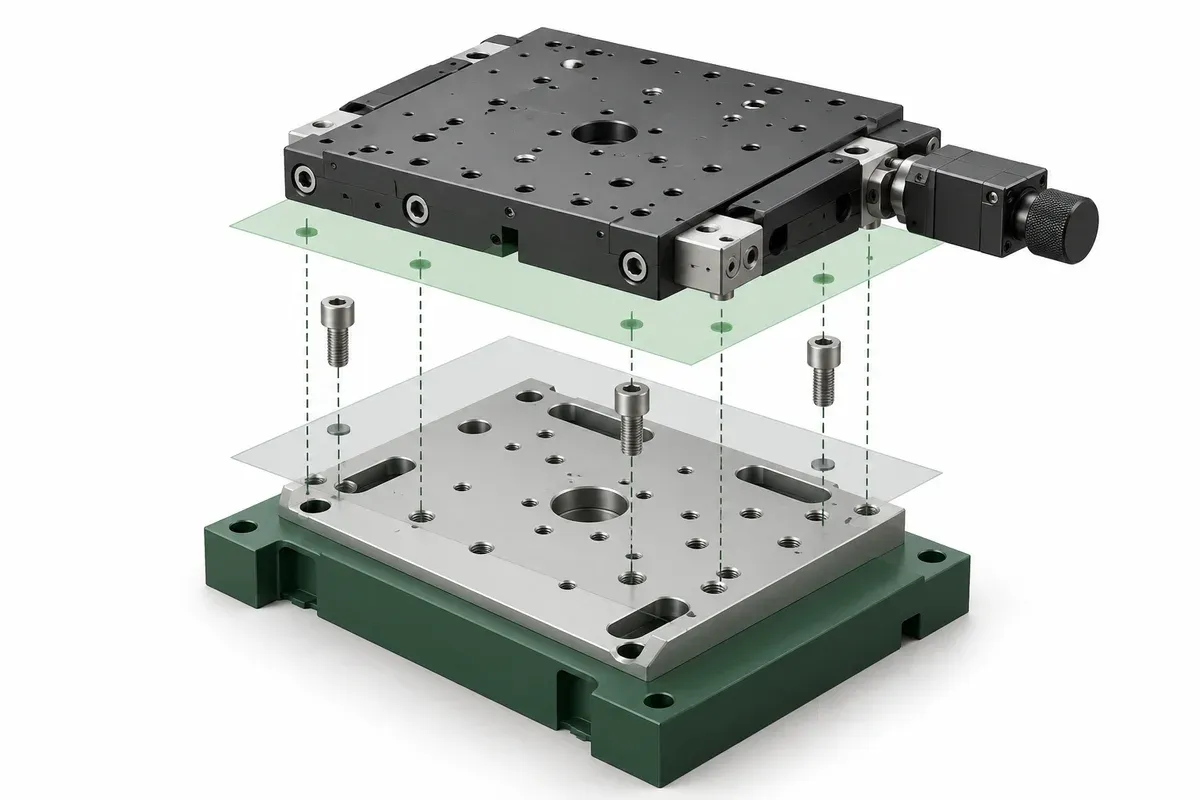
- A matching hole pattern alone does not establish an approved assembly.
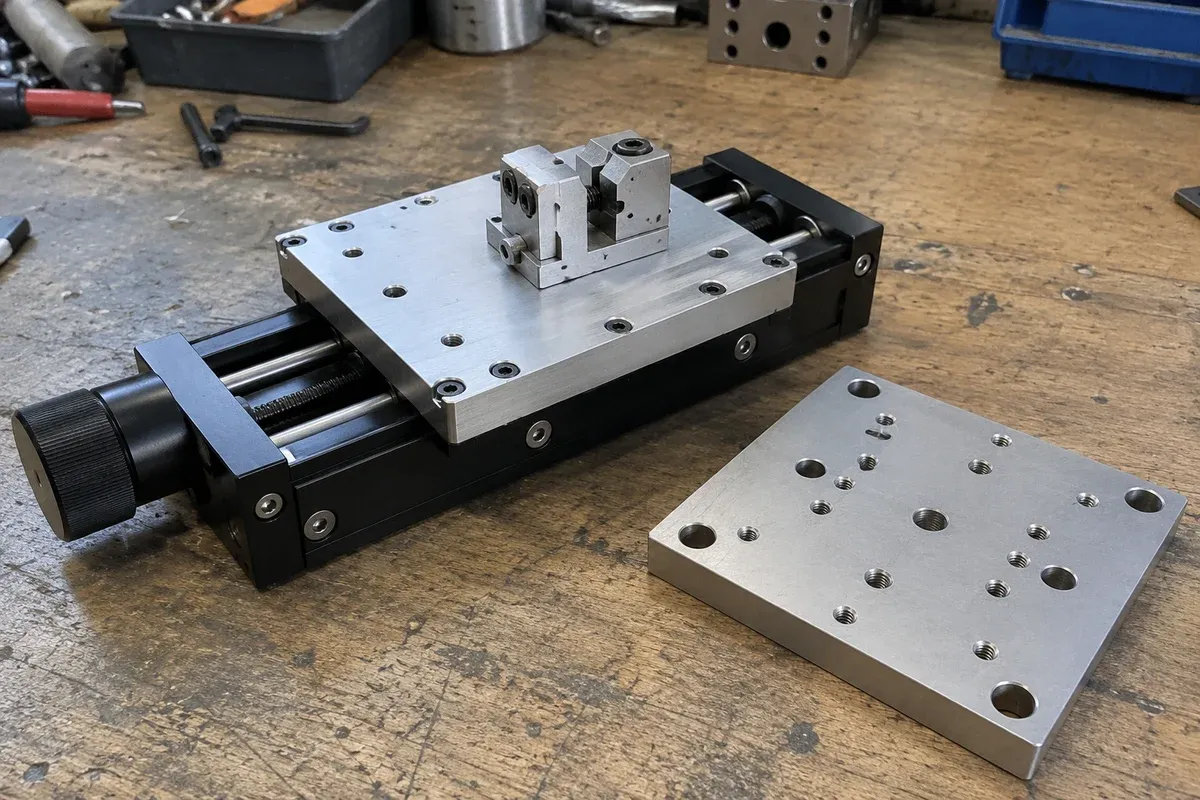
A stage drawing is a map of interfaces, not a complete assembly instruction. The useful output of reading it is a list of confirmed facts and open questions that another engineer can trace to the correct model and revision. Begin before the fixture plate is released for manufacture: resolving an ambiguous hole after machining usually means redesigning more than that hole.
Establish which part each view describes
Identify the fixed base, moving platform, motor housing and any removable cover. Then mark the intended support face and payload attachment face on your working copy. A hole shown near a platform edge might belong to the base in a different projection; assuming otherwise can produce a plate that attaches to the wrong component.
Record units, projection convention, revision and model designation. Check whether the drawing shows a neutral position or another travel position. Dimensions to a moving edge need a stated configuration. Treat an undimensioned illustration as a space-planning aid, not a machining authority.
Build a feature register
Give each interface feature a reference and a purpose. For holes, collect the pattern coordinates, thread designation where provided, through or blind condition, and relevant depth information. Separate the visible bore depth from permitted fastener engagement: those are different questions. For counterbores and countersinks, include head clearance and the face from which hardware enters.
Next record the contact footprint, locating features and inaccessible regions. A cable connector, cover screw or lubrication point may not be part of the mounting pattern but can determine whether the assembly is maintainable. Ask for missing information rather than filling gaps with dimensions measured from a screenshot.
A manufacturer example of stage mounting interfaces shows why plates and brackets must be checked at the model level. Its accessories are not evidence that another stage shares those interfaces.
Review access and assembly sequence
Sketch the tool approach for every attachment. Include the tool body and the space required to introduce or withdraw the fastener, rather than only its final position. A screw can fit perfectly in the finished CAD assembly while being impossible to install after the upper stage is present.
Ask the assembly owner which components must remain removable and which adjustments require access after initial installation. Distinguish routine workholding changes from service activities that require a qualified technician. The review should identify a feasible sequence; it should not improvise installation torque or advise loosening load-bearing joints on an operating machine.
Use an interface checklist with explicit dispositions
- Confirm the quoted model and drawing revision agree.
- Label base and platform attachment features independently.
- Record hole units, thread type, entry face and supplied depth information.
- Flag missing engagement limits and installation requirements for clarification.
- Check fastener-head and tool-access volumes against adjacent parts.
- Include motor, connector, cover and service-access keep-out regions.
- Identify who approves the completed interface and resolves each open item.
For each line, use confirmed, unresolved or not applicable, followed by the supporting drawing note. An empty field is ambiguous: it can mean overlooked, unknown or deliberately excluded. The checklist works only when someone can distinguish those states without asking its original author.
Keep the original drawing alongside the extracted checklist. A transcription can omit a note or lose the connection between a dimension and its view. During review, the checklist should point back to the governing feature rather than becoming an unofficial replacement drawing.
Hypothetical example: a camera carriage
Suppose a proposed camera plate uses four holes visible in a stage drawing. Two are shown in the top view and two are visible through a platform opening. The designer initially assumes all four accept the payload plate. A feature register reveals that the second pair belongs to the fixed base, so the proposed connection would obstruct motion.
The team revises the concept before specifying hardware. It then finds that the camera obscures one mounting-tool approach and adds a removable subplate to the review. Neither decision proves the assembly is ready: the correct attachment pattern, loading and installation instructions remain approval inputs. This fictional example illustrates the value of interface identification without prescribing a stage-specific solution.
The linear-stage range is a starting point for model selection. Request the exact drawing and mounting instructions for the chosen configuration before turning the checklist into a released manufacturing package.
Questions
Which drawing revision should the fixture use?
Use the revision confirmed for the quoted stage configuration, and identify it on the fixture interface record.
Can a CAD model replace the installation drawing?
A model helps with space planning, but may omit thread depths, tolerances and installation notes. Obtain those separately.
Does a matching hole pattern prove compatibility?
No. Fasteners, contact faces, loading, access and travel clearance still require review.
Sources & scope
Sources support the specific points described below. General engineering guidance and third-party examples do not establish a catalogue model's performance or suitability.
- Thorlabs translation-stage mounting interfaces
Illustrates that mounting plates and brackets have model-specific interfaces; does not establish compatibility with this catalogue.
Accessed
Related engineering resources
Continue reading
Mounting & Mechanical Integration
Checking the support surface before installing a precision stage
Organize a support-surface readiness review around documented requirements, contact geometry, surface condition and traceable inspection evidence.
Integration guide · 4 min read ·
Mounting & Mechanical Integration
Choosing the order of an XYZ stack
Compare XYZ stack arrangements through moving mass, payload offsets, working height and access before selecting a mechanical layout.
Integration guide · 4 min read ·From requirements to a quotation
Review your stage requirements
Share the motion envelope, payload, orientation and acceptance criteria. Request confirmation of the exact configuration before ordering.
Request a Quote