Key takeaways
- Keep positive and negative approach observations identifiable.
- Define the return path and dwell before collecting data.
- Report the statistic used rather than a bare repeatability number.
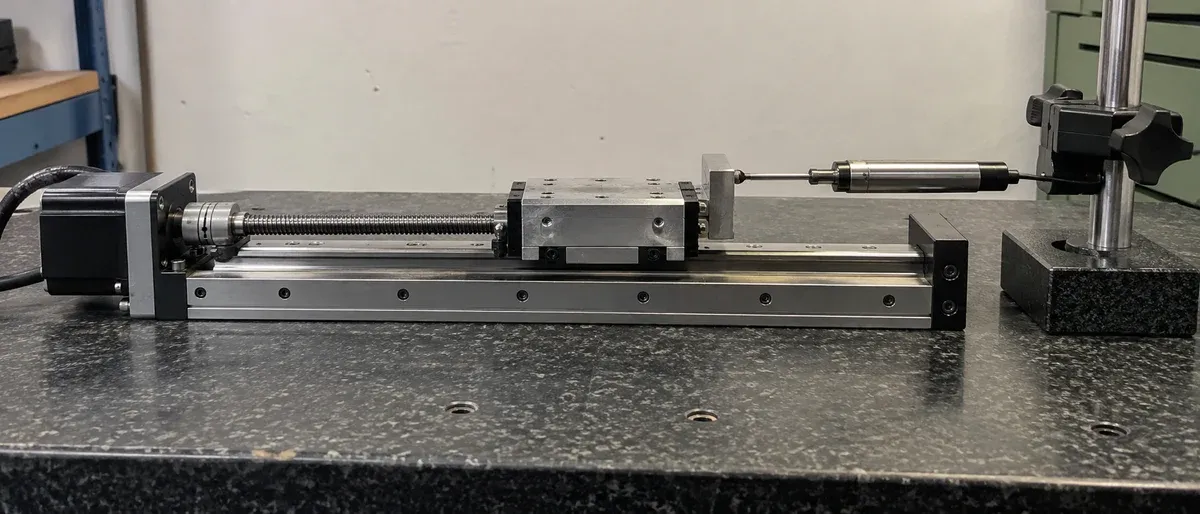
Turn approach direction into a controlled variable
A repeatability test is only interpretable when the journey to the target is known. A stage arriving after a long positive move may not give the same observations as one arriving after a short negative correction. The test plan should therefore treat approach direction as a recorded input, alongside the commanded coordinate and measured position.
The Newport terminology reference distinguishes same-direction and either-direction approaches. Use that distinction to organize data, not to invent a common calculation for every manufacturer’s specification. For the site’s broader separation of resolution, accuracy and repeatability, refer to how specifications are read.
Write the motion sequence in plain language
For a same-direction experiment, name the target, the starting side, the excursion before each return, approach speed and dwell before acquisition. Ensure the entire path fits the permitted travel. If a controller automatically overshoots and returns, record that behavior; the final approach can differ from the apparent direction of the requested move.
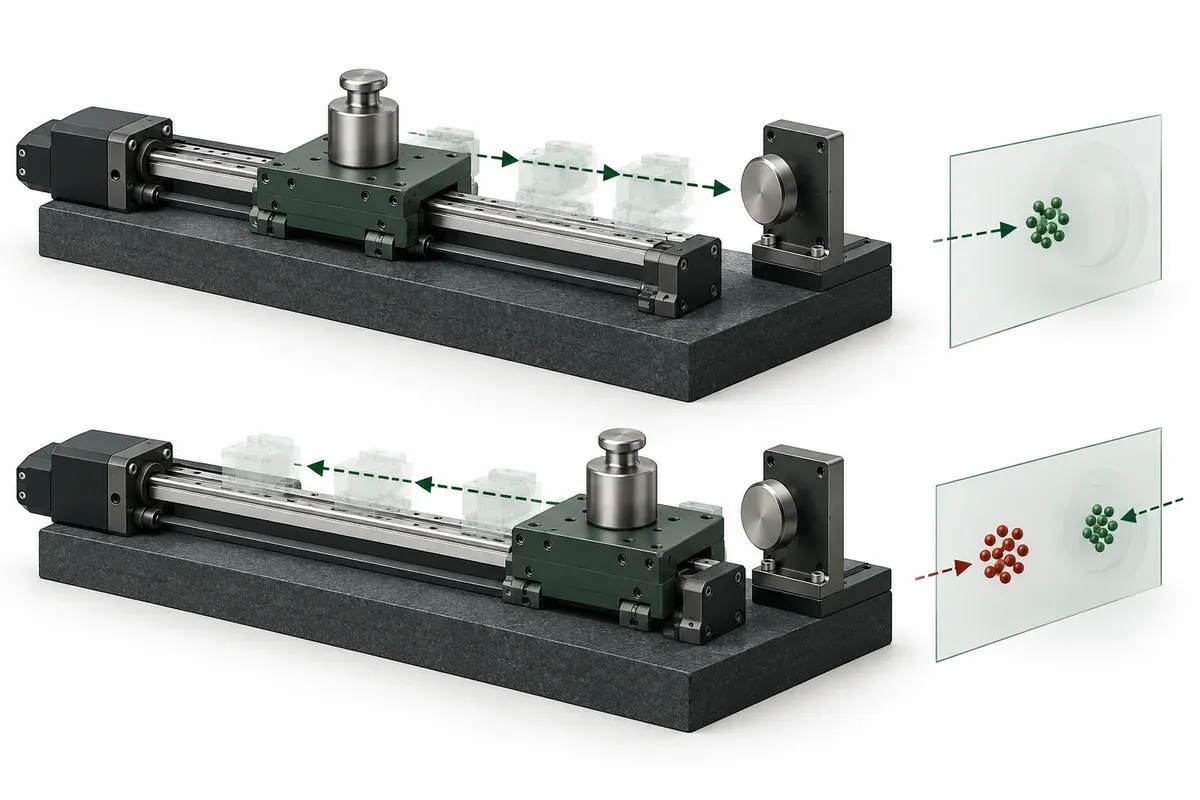
For a two-direction experiment, collect identifiable positive and negative approach groups at each target. State whether groups alternate, run in blocks or follow the production sequence. Alternating may help expose a direction effect while blocked sequences can make time drift easier to see. Neither design excuses missing timestamps. Choose deliberately and preserve enough context to analyze both direction and time.
Do not casually re-home between observations. Doing so changes the experiment by introducing reference-establishment behavior. If production re-homes every cycle, include a separate test that reproduces that workflow and label the result accordingly. Keep the fixed-reference positioning dataset available so the two contributions are not hidden in one summary.
Choose coverage and reporting together
Select targets that represent the working region and include locations where the application is most sensitive. A single convenient midpoint is not evidence for the full stroke. Conversely, a short local task may justify local verification if the report explicitly limits its claim to that region. Choose repetitions based on the intended inference and the applicable procedure, not a universal sample count copied from a different supplier.
For each target, retain individual readings and calculate the agreed statistic separately for each approach group before presenting a combined view. Plot position against time as well as direction. A slowly moving baseline can otherwise resemble random spread or disguise a difference between groups.
Include measurement uncertainty with the result and distinguish it from the observed scatter. A sensor can display many digits without resolving the application question. State the instrument, setup and reported uncertainty basis; see NIST’s uncertainty reporting guidance.
Hypothetical example: a dispensing revisit
Consider a dispensing fixture that normally approaches each location from increasing X but sometimes returns from decreasing X after a retry. Its initial test uses only increasing-X arrivals. That dataset can inform the normal sequence, but it leaves the retry sequence unanswered. No stage capability or numeric threshold is assumed in this example.
A revised plan records both arrival groups, with the same payload, dwell and dispensing-head height. The engineer also keeps the retry’s short excursion as a separate condition rather than replacing it with a long laboratory return. If the resulting groups differ, the next action is investigation under the documented conditions, not automatically declaring a mechanical defect.
Practical checklist for direction-controlled testing
- Mark the positive coordinate direction physically on the setup drawing.
- Define the final approach rather than only the destination command.
- Verify clearance for every excursion, overshoot and return.
- Freeze speed, dwell, payload and compensation settings for the baseline run.
- Preserve target, timestamp, direction and cycle number with every observation.
- Document warm-up, reference resets and any interrupted cycles.
- Show separate groups before applying the agreed combined statistic.
The useful deliverable is a repeatable sequence plus a transparent dataset. When comparing quotations through the stage selector, ask whether a candidate’s cited result matches that sequence. A same-direction number should not silently become a two-direction acceptance bound, and repeatability alone does not establish absolute accuracy or detectable minimum motion.
Questions
Does alternating direction make a test bidirectional?
It provides observations from both directions, but the report still needs the target sequence, repetitions, statistic and measurement conditions.
Can software overshoot make a process effectively unidirectional?
Potentially, if the final approach is controlled and sufficient safe travel exists. Validate the actual sequence rather than assuming the setting guarantees it.
Should the first arrival be discarded?
Only under a documented rule agreed before testing. Preserve excluded observations and the reason for exclusion.
Sources & scope
Sources support the specific points described below. General engineering guidance and third-party examples do not establish a catalogue model's performance or suitability.
- Newport: Motion Basics Terminology and Standards
Unidirectional and bidirectional repeatability refer to controlled approach directions.
Accessed - NIST TN 1297: Reporting Uncertainty
Uncertainty reporting should identify the form and basis of the uncertainty.
Accessed
Related engineering resources
Continue reading
Accuracy & Metrology
Accuracy, repeatability and resolution: three separate acceptance questions
Turn accuracy, repeatability and resolution into separate acceptance requirements, with a worksheet for evidence, conditions and decisions.
Verification guide · 4 min read ·Accuracy & Metrology
Assessing velocity stability and following error during a scan
Plan scan-motion measurements with explicit trajectory definitions, acquisition bandwidth, payload and processing for velocity and following error.
Verification guide · 4 min read ·From requirements to a quotation
Review your stage requirements
Share the motion envelope, payload, orientation and acceptance criteria. Request confirmation of the exact configuration before ordering.
Request a Quote