Key takeaways
- Keep calibration data separate from validation observations.
- An error map addresses the modeled repeatable behavior under its stated conditions.
- Verify the installed system after mapping or configuration changes.
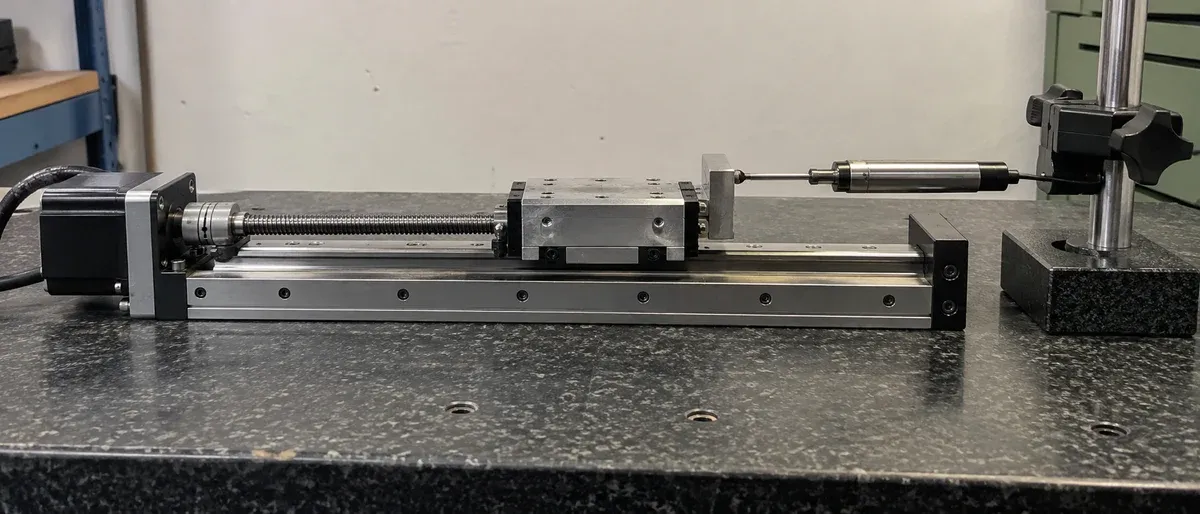
Separate fitting an error from verifying a system
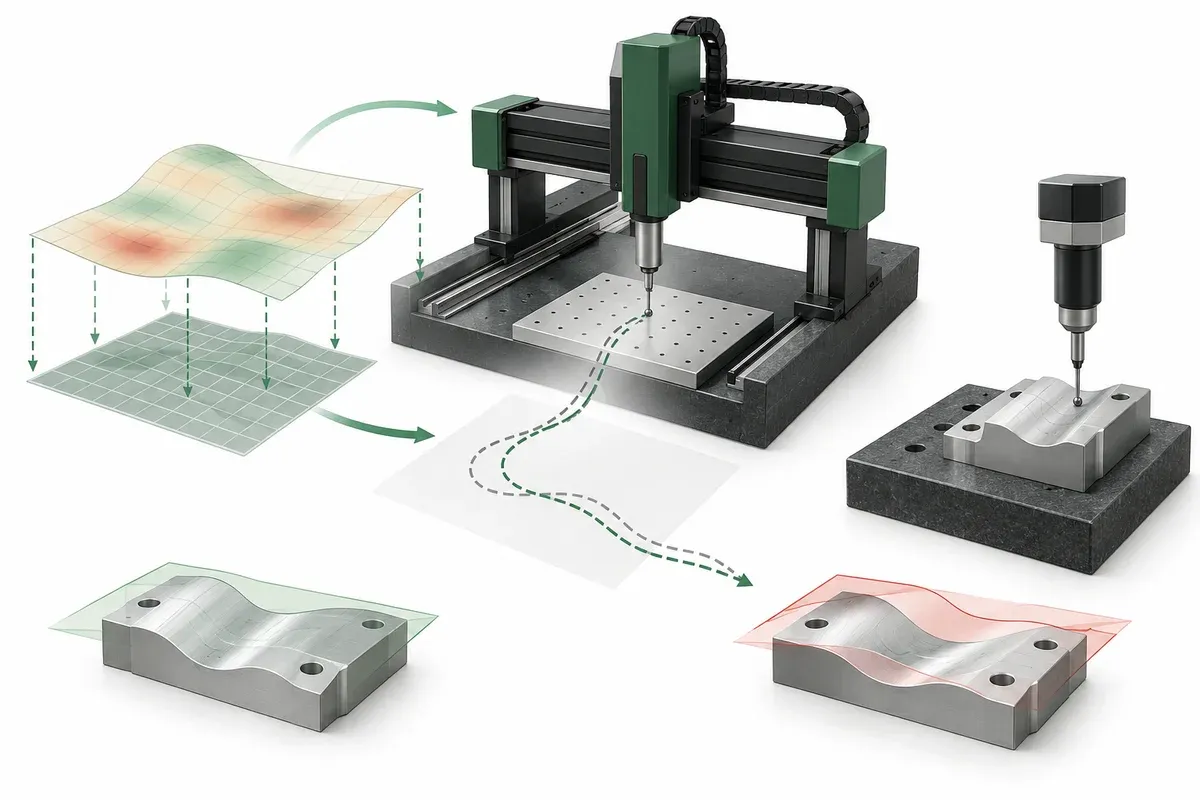
An error map can be useful when measured behavior is sufficiently repeatable to model. The important question is not whether a correction file exists, but whether independent observations show that the corrected system meets its requirement. Keep map generation, implementation and validation as separate stages of the evidence chain.
Zaber’s multi-axis accuracy guide discusses calibration in the context of system geometry. Newport also distinguishes systematic compensation and repeatability. Neither reference establishes that a map will deliver a particular result for this catalogue or for an unmeasured installation.
Record what the map actually represents
Identify the stage, controller, reference method, payload, orientation and functional point used to collect mapping data. State the travel interval, target positions, approach directions and environmental conditions. Preserve the raw observations, fitting method and resulting correction file with version identifiers.
Document whether the map corrects a scale factor, a one-dimensional position function, directional behavior or a larger geometric model. Do not describe a one-axis correction as volumetric compensation unless the actual method supports that claim. Record interpolation, endpoint handling and behavior outside the mapped interval. Extrapolation should never be treated as measured evidence.
Check the sign and coordinate convention before applying the file. A correction associated with the wrong origin or axis can be actively misleading. Confirm whether the controller already applies other compensation, and avoid unintentionally correcting the same contribution twice. Preserve a recoverable configuration baseline before making authorized changes.
Design validation that can fail meaningfully
Set aside positions or trajectories that were not used to fit the map. Measure them with an appropriate reference arrangement after the correction is enabled. Include the relevant approach directions and process conditions. Retain uncorrected and corrected observations as distinct datasets rather than overwriting the original record.
Avoid using only the same points that defined the map. A favorable fit at those points may say little about interpolation between them or behavior under a different sequence. Likewise, a local validation should not be generalized to the entire travel or to another payload height. The report should explicitly state its coverage.
Consider time stability and configuration sensitivity. If repeated baseline observations change substantially during mapping, investigate before building a detailed correction around them. A map of a moving target may be outdated before deployment. Nonrepeatable behavior, measurement artifacts and unmodeled changes need their own assessment rather than increasingly complicated correction curves.
Hypothetical example: a corrected inspection axis
Imagine an inspection axis mapped at evenly spaced positions with a fixed camera mount. The proposed validation uses intermediate positions and the actual production approach sequence. These are planning choices, not measured results or an acceptance recipe. No map is assumed to meet any particular tolerance.
Later, the camera is moved onto a taller bracket. The team reviews whether the original mapping relationship still applies at the new functional point. It does not simply reload the old file and declare the changed machine qualified. The retained original dataset helps distinguish a mapping issue from the effect of the new geometry.
Practical checklist for error-map evidence
- Identify the configuration, functional point and reference used for mapping.
- Preserve raw data, fitted model and correction-file version separately.
- State interpolation, endpoint and outside-range behavior.
- Verify coordinate origin, sign and other active compensation.
- Use independent positions or trajectories for validation.
- Include relevant directions, payload and operating conditions.
- Define changes that trigger review or revalidation of the map.
Report corrected residuals with measurement uncertainty and the agreed acceptance rule. NIST’s uncertainty reporting guidance provides a useful framework. The specification guide keeps accuracy, repeatability and resolution separate; a correction file does not collapse those distinctions. The defensible conclusion describes the validated configuration and coverage, while leaving untested conditions and unsupported performance promises outside the claim.
Questions
Does a small residual on the mapping points prove the map works everywhere?
No. Validate at independent positions and relevant conditions; fitting the original data is not the same as demonstrating predictive performance.
Can an error map correct random variation?
A position-dependent map cannot guarantee removal of nonrepeatable behavior. Its supported scope must be established by measurement.
When should a map be reviewed?
After changes that may alter the mapped relationship, such as remounting, payload geometry, reference setup, controller configuration or relevant environmental conditions.
Sources & scope
Sources support the specific points described below. General engineering guidance and third-party examples do not establish a catalogue model's performance or suitability.
- Zaber: Multi-Axis Accuracy Guide
Multi-axis error correction depends on system geometry and calibration context.
Accessed - Newport: Motion Basics Terminology and Standards
Systematic error compensation does not make repeatability interchangeable with accuracy.
Accessed - NIST TN 1297: Reporting Uncertainty
Uncertainty reporting should state the expression and basis used.
Accessed
Related engineering resources
Continue reading
Accuracy & Metrology
Accuracy, repeatability and resolution: three separate acceptance questions
Turn accuracy, repeatability and resolution into separate acceptance requirements, with a worksheet for evidence, conditions and decisions.
Verification guide · 4 min read ·Accuracy & Metrology
Assessing velocity stability and following error during a scan
Plan scan-motion measurements with explicit trajectory definitions, acquisition bandwidth, payload and processing for velocity and following error.
Verification guide · 4 min read ·From requirements to a quotation
Review your stage requirements
Share the motion envelope, payload, orientation and acceptance criteria. Request confirmation of the exact configuration before ordering.
Request a Quote