Key takeaways
- Define what must pass through the rotational axis before selecting a bore.
- Check the usable opening through the entire installed stack.
- A hollow center does not create an unlimited-turn service connection.
Name the access problem first
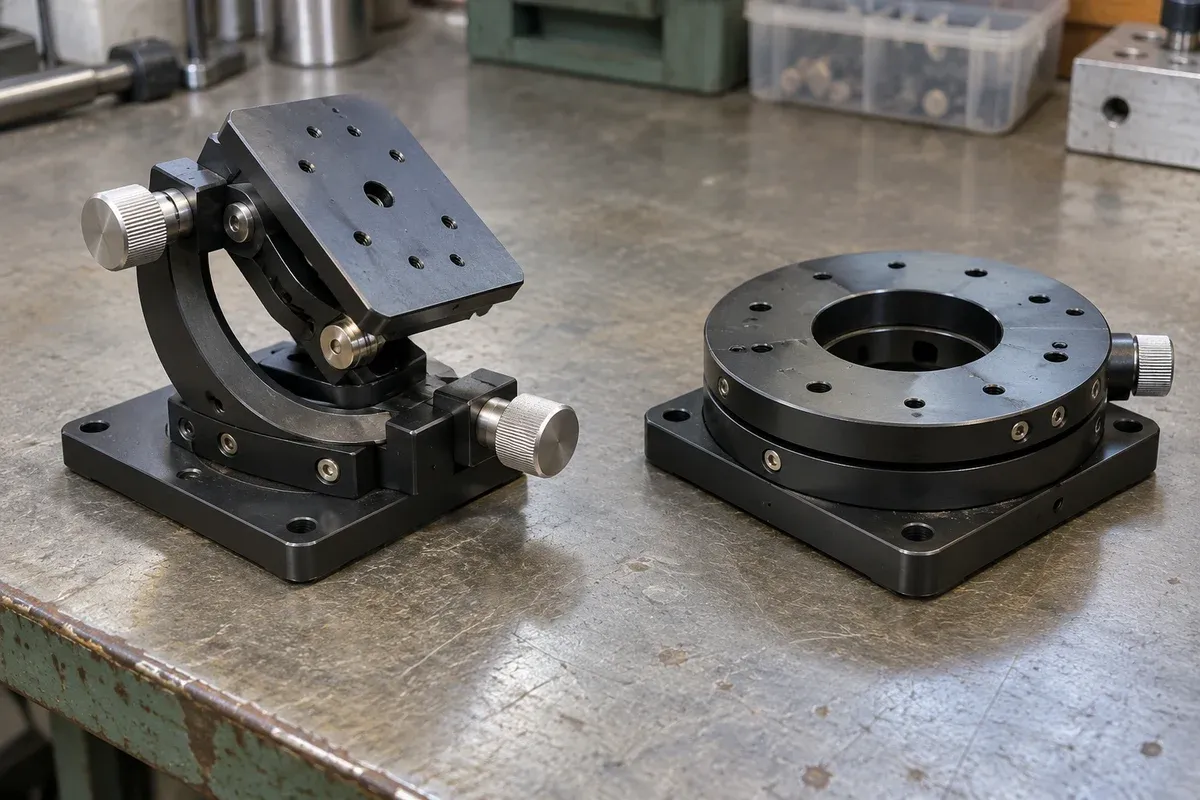
A hollow rotary table is worth considering when something needs a path through the rotation axis. That object might be a mechanical shaft, a service bundle or an optical path. State the purpose precisely before choosing a diameter. An access opening that works for a rigid shaft may not suit a connector that must be installed after assembly.
The hollow-rotary family provides through-hole table candidates. Its central opening is a geometric feature to evaluate within the whole machine. It is not a substitute for checking how the workpiece mounts, how services connect, or how the rotating assembly is supported.
Build an aperture budget through the entire stack
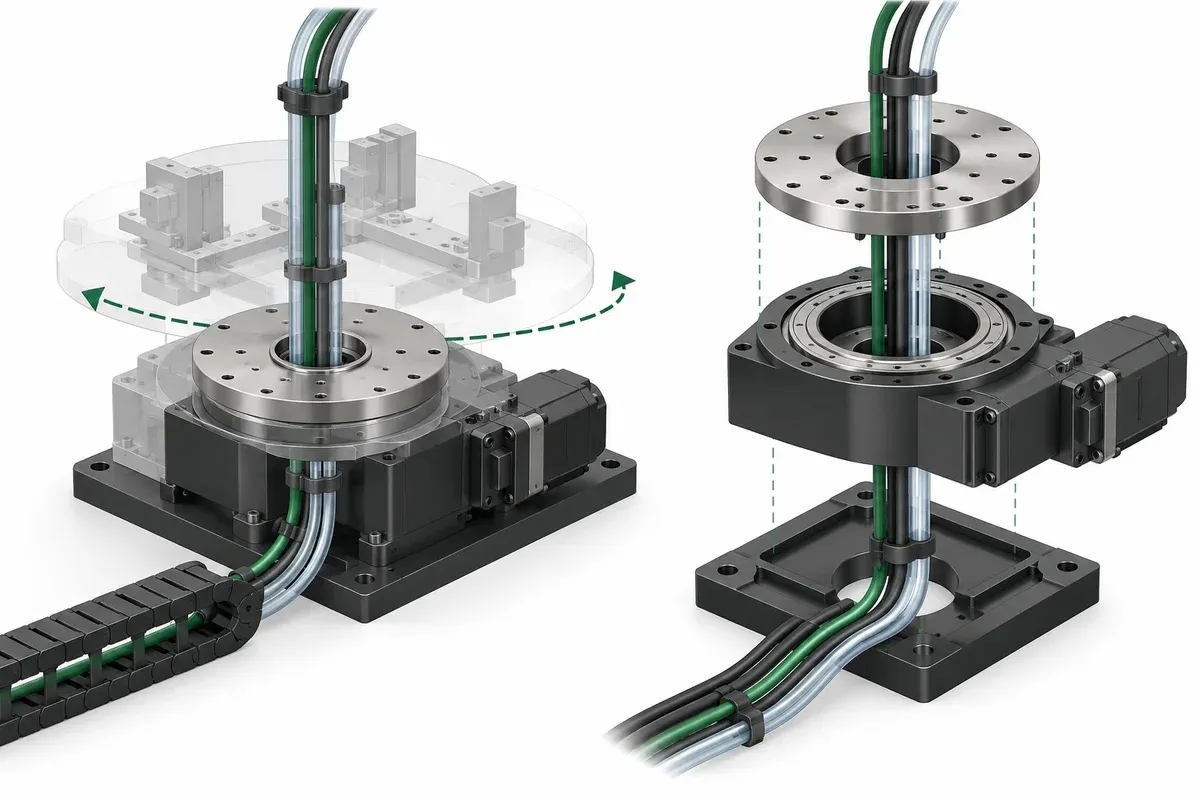
Draw a section along the proposed axis. Include the table, base plate, adapter, fixture and any cover or nearby structure. Mark the smallest available opening at each location. The useful path is limited by the complete assembly, not simply by the largest hole shown on one component drawing.
In a hypothetical cable-installation layout, a connector body requires a 24 mm passage while the cable bundle itself occupies only 12 mm. A design reviewed only for the bundle can fail during assembly even if normal operation would have enough space. Record the largest item that must pass through, the installation sequence and whether it can be attached afterward.
Do not assign a universal clearance allowance from this example. Required clearance depends on the item, tolerances, motion and installation method. Ask for the actual drawing dimensions and let the responsible designer establish the allowance for the assembly.
Separate access from rotating transfer
Passing a service through an opening and transferring that service between stationary and rotating parts are different problems. Identify which side each endpoint belongs to. Then trace what happens over the complete angular sequence, including repeated cycles and return moves.
If an electrical, optical or fluid transfer device is proposed, treat it as a separate component with its own requirements. Confirm compatibility, mounting, environmental suitability and scope of supply. Do not infer its presence from a photograph of a hollow table. A stage specification alone cannot certify the behavior of an added connection system.
For a stationary optical path through the center, show the required clear aperture and where the path must remain unobstructed. Confirm alignment and clearance at the relevant orientations. Avoid treating nominal bore diameter as evidence of optical performance or alignment accuracy.
Inspect what the aperture changes around it
A central opening affects where the fixture can attach. Review the usable mounting area and fastener access rather than assuming a solid adapter can be placed anywhere. Show how the workpiece and any offset components connect to the rotating table.
Provide the loading description separately from the aperture requirement. Zaber’s rotary-selection guide distinguishes axial, radial and moment loading and emphasizes installation orientation. Those general categories are useful review inputs, but its product ratings are not ratings for this catalogue. Request confirmation for the particular hollow-table configuration and assembled geometry.
Also inspect service access. A routing solution that works only before the machine is assembled may be difficult to maintain. Identify which components must be removed to replace a cable or inspect a connection, and make that consequence visible in the design review.
Use a through-path checklist
A practical access review should record:
- The purpose of the opening and the object passing through it.
- The largest installation item, including connectors or tools.
- Minimum clear dimensions through every layer of the stack.
- The angular sequence and endpoint ownership of each service.
- Mounting hardware that could intrude into the path.
- The proposed maintenance and replacement sequence.
- Load and positioning questions requiring separate evidence.
Keep a drawing revision beside each conclusion. This prevents an adapter change from silently invalidating an aperture decision made earlier.
Select the table only after the path is coherent
Use the central opening to establish a shortlist, then compare the complete mechanical and motion requirements. Ask the supplier to review the section drawing and identify any dimensions or interfaces needing confirmation. If a solid rotary stage with external routing could also meet the task, document that alternative on the same basis. The hollow design earns its place when the verified through-path solves a real access problem without leaving other requirements unresolved.
Questions
Does a hollow table eliminate cable twisting?
Not by itself. The opening can provide a routing path, but repeated rotation still requires a reviewed connection arrangement for the attached services.
Is the published bore the usable aperture of my assembly?
Not necessarily. Adapters, fasteners, covers and adjacent equipment can reduce the opening. Check a section through the complete stack.
Should I size a hollow table only by its aperture?
No. Aperture is one screening requirement. Review mounting, axial and radial loading, moments, drive requirements and positioning evidence for the actual configuration.
Sources & scope
Sources support the specific points described below. General engineering guidance and third-party examples do not establish a catalogue model's performance or suitability.
- Hollow rotary tables
Identifies the through-hole rotary-table family and its model-specific mechanical specifications.
Accessed - Zaber rotary-stage selection guide
Distinguishes axial, radial and moment loads and the importance of installation orientation; no Zaber ratings are transferred.
Accessed
Related engineering resources
Continue reading
Stage Selection & Buying Guides
Comparing screw, linear-motor, piezo, flexure and air-bearing stages
Compare stage actuation, guidance, feedback and support separately, then request configuration-specific evidence for the intended movement and load.
Selection guide · 8 min read ·Stage Selection & Buying Guides
Goniometer or rotary stage for a tilt-adjustment task?
Choose tilt geometry by locating the desired pivot, checking rotation-center height and tracing the workpiece path before comparing angular specifications.
Selection guide · 4 min read ·From requirements to a quotation
Review your stage requirements
Share the motion envelope, payload, orientation and acceptance criteria. Request confirmation of the exact configuration before ordering.
Request a Quote