Key takeaways
- A ball-screw label identifies a drive mechanism, not complete system performance.
- Use lead calculations to understand motion conversion, not to claim positioning resolution.
- Request evidence for reversal behavior, maintenance and the actual operating task.
Treat the drive type as a screening clue
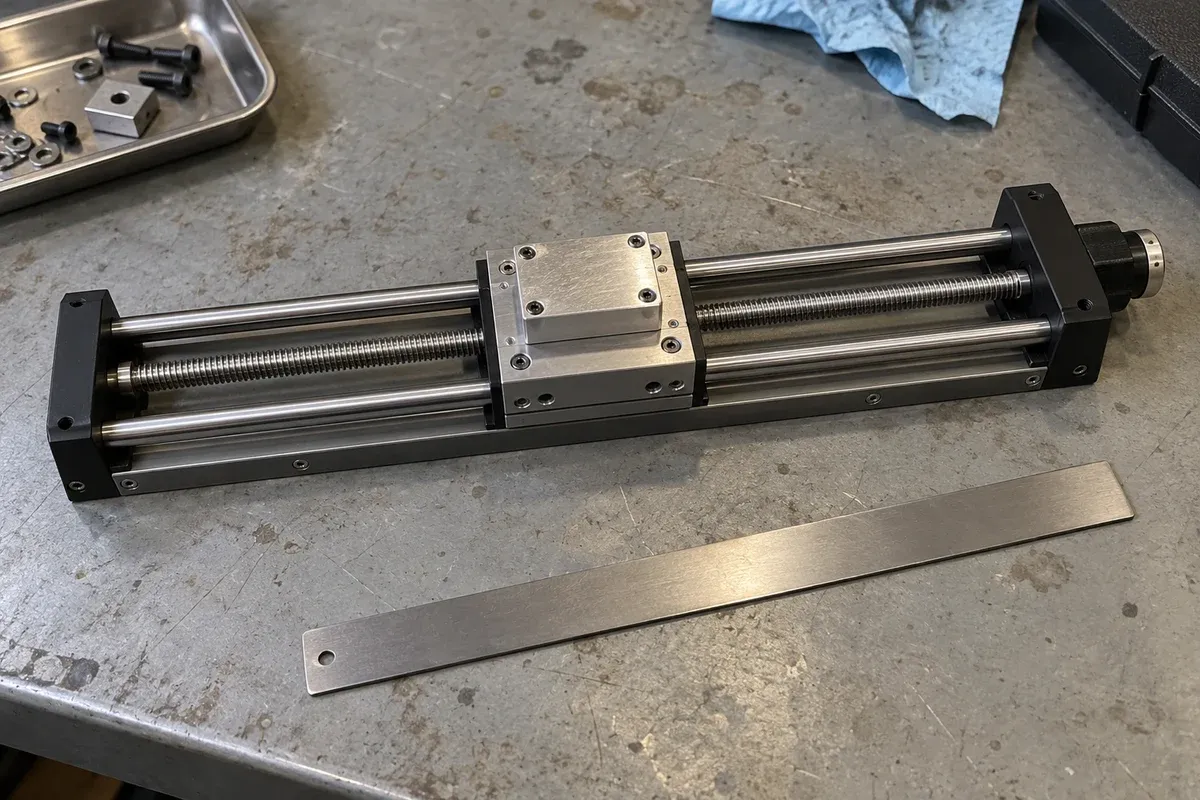
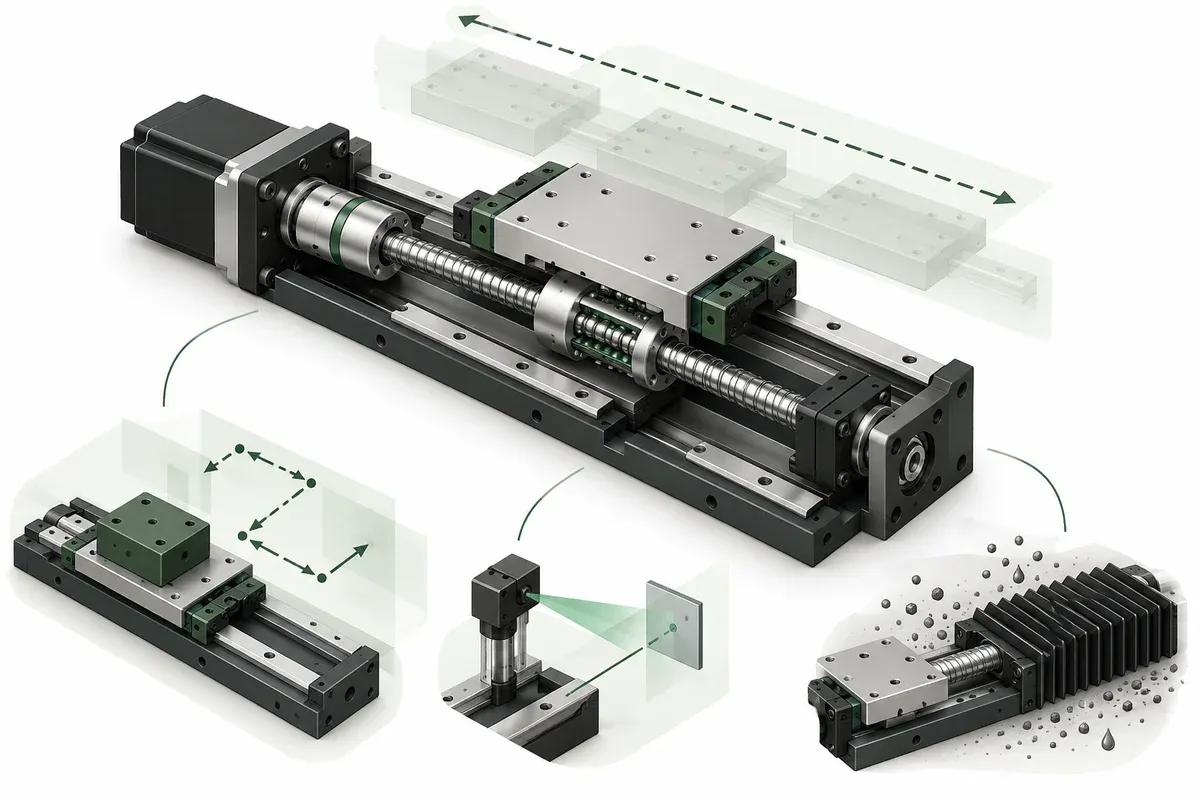
A ball-screw stage can be a sensible candidate when its travel, installation geometry and documented performance match the task. The linear-stage family on this site uses ball-screw drives with different guideway arrangements. That tells you which mechanical architecture to investigate; it does not prove that every model meets the same operating requirements.
THK’s ball-screw technical material describes rolling balls between the screw shaft and nut. Use that mechanism description to understand the component, while keeping complete-stage claims tied to the actual product documentation. A component technology cannot establish the accuracy, duty capability or service needs of an unspecified assembly.
Relate lead to the movement requirement
Screw lead describes nominal linear advance per screw revolution. It is useful for understanding how the drive converts rotation into translation. Keep this geometric relationship separate from the system’s measured positioning behavior.
In a hypothetical direct screw-drive calculation, a 2 mm lead and five screw revolutions correspond to 10 mm of nominal travel. If the screw turns at ten revolutions per second, the corresponding nominal linear speed is 20 mm/s. These are ideal kinematic relationships, not product ratings. They do not establish that a motor can deliver the required motion under load or that the system can reach that speed in the available distance.
The same caution applies to dividing lead by motor steps or command subdivisions. That arithmetic produces a nominal command increment under stated assumptions. It is not evidence of reliable minimum motion, positioning accuracy or repeatability at the work point.
Compare the real movement sequence
Describe whether the process uses long traverses, repeated short moves, reversals or long dwells. Include the required loading and service positions. Ask the supplier to evaluate the sequence with the moving mass and orientation rather than approving a stage based only on its maximum speed entry.
A hypothetical inspection process might move between nearby features and wait for a measurement after each move. Its useful requirement is completion of the whole sequence within the allowed time and position condition. Selecting solely by a high travel-speed figure could overlook what actually limits the process. This is a reason to request sequence-based evidence, not a prediction of any candidate’s behavior.
Keep process timing and mechanism ratings distinct in the comparison. A requested cycle time is a requirement until a suitable configuration and test basis establish it.
Ask what happens when direction changes
If the task revisits positions from different directions, request the relevant reversal and repeatability information. The specification guide distinguishes performance quantities and leaves unsupported data unresolved. Do not turn the word ball-screw into a blanket claim of zero lost motion.
Describe the approach directions that matter to the process. Ask whether a quoted result applies to those directions and whether any control or compensation assumptions are included. If a candidate requires a particular operating approach to meet a requirement, document it as a condition rather than hiding it in an optimistic comparison row.
Include installation and service questions
Ask for the approved mounting arrangement, lubrication or service instructions and environmental limits for the complete stage. State any restrictions from the application, such as access constraints or sensitivity to contamination. Do not prescribe a lubricant, maintenance interval or protective measure from a generic article.
For vertical use, request the actual holding and interruption behavior. Neither a ball-screw label nor a motor description establishes safe load retention. The system designer must assess the application and obtain configuration-specific information.
A screening checklist can therefore cover:
- Total travel and installed envelope.
- Moving assembly and mounting orientation.
- Move sequence, reversals and required dwell condition.
- Positioning evidence at the relevant work point.
- Service access and documented environmental limits.
- Unresolved control and holding requirements.
Keep the shortlist conditional until evidence closes it
A ball-screw candidate deserves further review when its documented geometry and operating envelope plausibly fit the task. Ask for the missing evidence and compare alternatives on the same application basis. Avoid calling any drive technology the universal winner. The final choice should explain why a particular supplied configuration meets the requirement, including its conditions and remaining responsibilities, rather than relying on a familiar mechanism name.
Questions
Does a smaller screw lead guarantee more accurate positioning?
No. Lead describes nominal travel per screw revolution. Accuracy and reliable incremental motion depend on the complete mechanism and control system and need separate evidence.
Does a ball screw guarantee zero backlash?
No. Ask for the specified reversal behavior of the actual assembled stage and its test basis. Do not infer it from the drive family name.
Can a ball screw be assumed to hold a vertical load without power?
No. Confirm the holding arrangement and interruption behavior for the selected configuration. A drive-type label is not a load-holding safety assessment.
Sources & scope
Sources support the specific points described below. General engineering guidance and third-party examples do not establish a catalogue model's performance or suitability.
- Motorized linear stages
The listed linear-stage family uses ball-screw drives and includes crossed-roller and linear-ball guideways.
Accessed - How to read the specifications
Definitions and the catalogue, derived and not-confirmed labels used on this site.
Accessed - THK ball-screw features and types
Describes rolling balls between the screw shaft and nut. No THK component performance is attributed to the stages in this catalogue.
Accessed
Related engineering resources
Continue reading
Stage Selection & Buying Guides
Choosing a vertical lift instead of mounting a linear stage vertically
Compare a dedicated vertical lift with a vertically mounted linear stage by checking layout, gravity loading, support and configuration-specific evidence.
Selection guide · 4 min read ·Stage Selection & Buying Guides
Comparing screw, linear-motor, piezo, flexure and air-bearing stages
Compare stage actuation, guidance, feedback and support separately, then request configuration-specific evidence for the intended movement and load.
Selection guide · 8 min read ·From requirements to a quotation
Review your stage requirements
Share the motion envelope, payload, orientation and acceptance criteria. Request confirmation of the exact configuration before ordering.
Request a Quote